I've been working forever on one chapter of my manuscript/book on parenthood--the chapter on gender. I think I know part of the reason why it's been so hard and time consuming to get this done. In other chapters I've felt free to philosophically explore, even if the issues are controversial, but there are a lot more constraints here. Certain views, and even certain questions, are politically incorrect, taboo, probably genuinely hurtful to some audiences. And so I can't get into "figuring it out" mode and stay there. I keep feeling hemmed in by what I'm supposed to think, as a feminist, or what I'm supposed to say, as a respecter of LGBT people. And so I read some more, think some more, read some more. Well, maybe the end result will be a better chapter!
As evidence of how political correctness can distort inquiry, take this New Yorker article about clashes between so-called radical feminists and transgender activists. It does sound to me like the radical feminist side has some daft views about transgender people and cares too much about safeguarding born-women's spaces, but they do ask some good questions. It really is puzzling how it could be that a biologically female woman and a trans woman are both women in exactly the same sense. What is it that makes them both women? I believe that's a hard question worth thinking about. The radical feminists asking the question may approach these things with inappropriate animus, but at least they're asking the questions. I get the impression from the article that one is no longer allowed to in some academic settings.
There is some philosophical literature on the hard question but I honestly find most of what I've read not in a purely philosophical mode. Politics is in the driver's seat a great deal, not the usual philosophical methods--analysis, thought experiments, testing claims with counterexamples, etc. So people say things that would not withstand philosophical scrutiny, if the topic were something politically neutral like causation, or intentionality, or reference, or whatnot.
What does gender, or transgender, have to do with parenting? The question I'm trying to tackle is whether parents should care about or cultivate gender differences at all. But as a preliminary, I tackle the metaphysics of gender. Are girls/women and boys/men two naturally distinct groups? Interesting, difficult question. I'd really like to approach it as a philosophy question, not as a matter of politics.

8/27/14

8/16/14
"Socially constructed"
 |
| http://www.theplasticbrickmuseum.com |
I don't quite get this, because "socially constructed" categories can earn their keep, even if they're not written into the natural world. In fact they're quite diverse, coming to be in many different ways. Some examples:
Doctors and lawyers. Nobody's by nature a doctor or a lawyer. As a society we created the institutions of medicine and law and established procedures that make one qualify, or not qualify, as a doctor (or lawyer).
Teenagers, seniors. We have lots of age categories that are socially constructed. To be a teenager, you have to have an age ending with "teen" but we draw a circle around people with those ages because of various facts about them, and also because of various decisions, perceptions, norms, etc. Likewise, seniors have to be at the elderly end of the age spectrum, but there are further facts about them, and decisions and perceptions, involved in marking them out. Seniors are not just old, but assumed to be leisured, retired, slowed down, etc. Other age categories are worth thinking about here too: baby, toddler, tween, middle aged, etc.
Blonds, brunettes, redheads. If you listen to people talk about "blonds" you'll realize that a blond isn't just someone with blond hair. Being "a blond" involves a certain amount of ditziness, extra attractiveness, and so on. You can have blond hair but not be "a blond" and you can have brown hair and make yourself a "blond"--by dyeing your hair and taking on the necessary ditziness and sex appeal. Likewise for brunette and redhead--hair color is involved, but also character traits. The whole thing's bound up with culturally perpetuated perceptions.
These three examples reveal various things about "social construction":
- The doctor/lawyer example makes it especially obvious that a category isn't disposable just because it's socially constructed.
- A socially constructed category can have natural prerequisites. You cannot be a teenager without having an age in the teens. So it's possible to agree that male/female is a socially constructed distinction but still think there are natural prerequisites for being one or the other.
- The examples show that socially constructed categories vary in their superficiality and connection with mere perceptions. "Blond" is like that, but teenager much less so and doctor/lawyer not at all,
What I'm really interested in at the moment is the idea of social construction. It doesn't seem as if lawyers is a socially constructed category in anything like the way blonds is, and blonds seems very different from teenagers. So assertions about the socially constructed nature of gender need to come with clarification: in what sense? The idea is more or less radical depending on the answer.
8/6/14
Ethics in Gaza
 | |
| http://www.nytimes.com/interactive/2014/07/15/world/middleeast/toll-israel-gaza-conflict.html |
McMahan's main claim is that too few deaths of Israeli civilians will be prevented by Israel's campaign, considering the cost in Palestinian civilian deaths; this is largely because Israel's anti-missile system is already preventing Palestinian missiles from killing civilians. There's therefore a problem of disproportionality.
As plausible as that conclusion is, it's strikingly unpersuasive how McMahan gets there. He proposes to start with ordinary, personal self defense:
Suppose your life is threatened by a culpable aggressor but your only effective means of defence will kill an innocent bystander as a side effect. Most philosophers believe that it would be impermissible to save yourself at the cost of killing this innocent person.Is that what "most philosophers" believe? I'm not sure, but I think McMahan is surely wrong about why they believe it, if they do. Here's his proposed explanation:
This is mainly because the moral reason not to kill a person is stronger than the reason to save a person. It is therefore generally impermissible to kill one person to save another, even if the killing would be unintended.This can't be the whole story about bystander deaths, because this story also implies that it's wrong to kill an attacker in self defense. Suppose someone is aiming a missile at my house and I (an innocent civilian) can't escape. All I can do to save myself is fire back, killing the attacker. This would be a case of saving a person (namely me) by killing another. Should I stop and think "the moral reason not to kill a person is stronger than the reason to save a person"? No, so the ''better not to kill than to save" principle, so simply stated, isn't tenable and probably also isn't what most philosophers believe.
McMahan actually aims to discuss proportionality as it pertains to unintentionally killing bystanders, not attackers, in a self defense situation, but it's interesting first to notice how little we care about proportionality when it comes to attackers. Suppose it takes 10 people to operate my attackers' rocket launcher, while mine is a solo model. I don't have any reluctance to say I can fire back and kill 10 to save just one (me). If it takes 100 to operate their rocket launcher, I may kill 100 to save myself. People trying to kill me can't undermine my right to fight back simply by piling on!
McMahan asks how many bystanders you may unintentionally kill, if you're killing an attacker in self defense. His answer is simple: not even one innocent bystander may be killed to save yourself. That follows from the "better not to kill than to save" principle. Sticking with that analysis, his objection to Israel's campaign will be that there are more bystanders being killed than civilian deaths being prevented. But McMahan takes on board what most people think: that there is some special prerogative to preserve yourself, permitting one bystander to be sacrificed to save yourself from an attacker. How about two? Maybe, he says, but not three! From that standpoint, McMahan judges that Israelis should be killing at most 2 Palestinian civilians to save 1 Israeli civilian. And then the problem is that the actual ratio is far from that: there have been over 1800 mostly civilian deaths in Gaza so far and perhaps only a handful of Israeli civilian deaths have been prevented, considering that Israel does have an anti-missile defense system already protecting civilians.
These numbers--1 or 2 bystanders may be unintentionally killed to save yourself, but not 3--have nothing but intuitiveness going for them, but do they have even that? Again, 10 guys are operating a rocket launcher and I'm on the verge of firing back with my solo launcher to save myself. Let's suppose (contrary to the simple "better not to kill than to save" principle) that I'm entitled to kill the 10 guys. So the issue is only about bystanders. It's part of the 10 guys' strategy that they will keep some children close by while firing at me, knowing I'll be reluctant to fire back under those circumstances. McMahan gives me, at the outer limit, the right to cause two bystanders deaths, but not three. If I happen to have my own child in my house with me, then to save the two of us, I get, at the very most, four bystander deaths. If there are five or more kids in the attacker compound, morality requires me to succumb to the attack, along with my two kids. Obviously, we're being offered just an illusion of precision here. There really isn't an answer to how many bystander deaths are tolerable. The real intuition most of us have is that there shouldn't be gross disproportionality!
But perhaps we have other thoughts about this as well. It seems different that the attackers are deliberately using the children as innocent shields, compared to a situation in which, by sheer accident, there happen to be children nearby. We might be inclined to say, in the first case, that if I exercise my right to preserve myself, the deaths of the children will on my attackers' conscience, so to speak. In the second case, they've got to be on my conscience. We care not just who causes which deaths, but who is to blame for which deaths. Assessing causality is just part of assessing blame.
McMahan highlights something I do find morally perplexing: Israel does have an anti-missile defense system already in place, so the number of Israeli civilians saved by the Gaza campaign cannot be great. That does make the number of Palestinian civilians killed seem troubling. But you can say why without even mentioning proportionality. It's a truism that if you can kill fewer rather than more to achieve the very same goal, you should. Killing the larger number makes you guilty of gratuitous killing. Granted, we do have some moral intuitions about proportionality too, but they're very imprecise (contrary to McMahan's pretend moral math). There's nothing imprecise about the prohibition against gratuitous killing.
7/10/14
Leiter and Pollitt on Hobby Lobby
I've been busy with this and that, so haven't had time to read the Hobby Lobby decision myself. For those trying to get a grip, Brian Leiter's interview on Point of Inquiry is illuminating and so is Katha Pollitt in The Nation. They both do a good, careful job of articulating why, despite the good of religious freedom, we should be bothered by this decision, especially as women, or on behalf of women. The heart of the matter, from Pollitt:
One little quibble about a point Brian Leiter makes toward the end of the interview. He says the US doesn't protect freedom of secular conscience in the way it protects freedom of religious conscience, except with respect to wartime conscientious objectors. But in fact, at Pollitt notes, many states are now allowing "personal belief" exemptions for parents who don't want to vaccinate, in addition to religious exemptions. On the one hand, hurray, equal rights for the secular conscience! On the other: this is just more of a really bad thing. Perhaps the right thing to say here is that in cases where freedom of religious conscience should be limited, because it's trumped by collective interests, there's nothing good about also allowing freedom of secular conscience.
Where will it all end? “It is not for us to say that their religious beliefs are mistaken or insubstantial,” Justice Alito writes. There is no limit to religious requirements and restrictions in our land of a thousand “faiths.” Several companies have already filed cases that object to all forms of contraception, not just the four singled out by Hobby Lobby, and the day after the decision the Court clarified that its ruling applied to all methods. And why draw the line on legal exemptions at religion anyway? Plenty of foolish parents now risk their children’s lives and the public’s health because they reject vaccines on “philosophical” grounds. What happens when Aristotle, the CEO, claims that birth control—or psychotherapy or organ transplants—goes against his “philosophy”?
Justice Alito’s opinion is canny. Slippery slope? No problem: “our decision in these cases is concerned solely with the contraceptive mandate. Our decision should not be understood to hold that an insurance-coverage mandate must necessarily fall if it conflicts with an employer’s religious beliefs.” He specifically mentions vaccines, blood transfusions and protection from racial discrimination as being in no danger, but he gives no argument about why Hobby Lobby’s logic would never apply. In other words, birth control is just different. Of course, it’s about women. Anyone could need a blood transfusion, after all, even Alito himself. And it’s about powerful Christian denominations, too, to which this Court slavishly defers—for example, in the recent decision finding no discrimination in the Christian prayers that routinely open town council meetings in Greece, New York.
One little quibble about a point Brian Leiter makes toward the end of the interview. He says the US doesn't protect freedom of secular conscience in the way it protects freedom of religious conscience, except with respect to wartime conscientious objectors. But in fact, at Pollitt notes, many states are now allowing "personal belief" exemptions for parents who don't want to vaccinate, in addition to religious exemptions. On the one hand, hurray, equal rights for the secular conscience! On the other: this is just more of a really bad thing. Perhaps the right thing to say here is that in cases where freedom of religious conscience should be limited, because it's trumped by collective interests, there's nothing good about also allowing freedom of secular conscience.
7/7/14
Gender Gaps
There's a lot of worry in philosophy about the gender gap: Why does it exist? What should we do about it? I sometimes wonder why this is thought to be so vexing and urgent, compared to other gender gaps. The person who fixes our air conditioning is always a man. The people who mow our lawn are 100% male. The folks who service our car are all male. The people who try to sell you a car are almost always male. The termite inspector is male. Food for thought: is the gender gap equally problematic in all these areas, or especially problematic in philosophy? Should we care about all gender gaps equally?
6/24/14
Borderline Cases
Anne Fausto-Sterling's books are informative and fascinating. She writes in an exploratory, non-dogmatic way that I really appreciate. She is hard to pin down and I (often) like authors who are hard to pin down. But one argument she seems to make in her books does not convince me much -- the argument that sex must be socially constructed, based on there being intersex individuals who wind up "assigned" to a sex in a social fashion.
About 1.7% of people are born with some sort of an intersex condition, she says. In these cases, decisions have to be made about whether the child will be brought up male, female, both, or neither. These decisions are typically made in light of cultural understandings of what is important in males and females. Therefore...what? Therefore, all sex categorizations are "socially constructed"?
Surely that doesn't follow. Why shouldn't we simply construe intersex individuals as borderline cases? There are clear male babies and clear female babies, and there are also individuals who fall in between. This is so in all sorts of other domains. There are clear chairs and clear couches, but also pieces of furniture that fall in between. There are clear trees and clear bushes, but plants that fall in between. Borderline cases can just remain borderline, unless there's some particular reason to categorize them. Maybe the furniture store has a chair room and a couch room, so we simply must put a chair/couch in one or the other. If we do that on some basis, such as which room has more space available, we don't have to think that has any general relevance to what makes chairs chairs or couches couches. Likewise, even if the sexes of intersex people are "socially constructed," if doesn't follow the sexes of clear cases are socially constructed.
And then, should we even embrace the social construction of sex in the intermediate cases? If you take "social construction" very literally, it seems to suggest we leave it up to society--the community, the state, the doctors, the family. If the community says it takes a penis to be classed with males, then so be it. If the community says it takes two X chromosomes to be classed with females, then so be it. But that's a terrible way to "assign" sexes to intersex babies. Fausto-Sterling actually advocates intersex children being tentatively (and non-surgically) assigned to a sex but later making their own choices based on how they see themselves. These kids will come to see themselves as male or female in a cultural context, so there is a social element there, but the child's self-perceptions have an internal component too, as I think she recognizes. If the child's eventual self-perceptions are given lots of weight, the sex classification of intersex children is at most partly "socially constructed."
As the chair/couch example shows, self-perception could be relevant to categorizing intersex people, but not relevant to clear-case males being male and clear-case females being female. The way borderline cases are dealt with does not necessarily have anything to do with how clear cases are classified. But perhaps that's merely a logical point: in principle, self-perception doesn't have to be relevant to clear males being male or clear females being female. But you might think it is relevant, even if it doesn't have to be. Clear males can come to have a sense of being female and clear females a sense of being male. If we do respect these self-perceptions for intersex individuals, then maybe self-perceptions should also take precedence when sorting supposedly clear cases into male and female categories. All maleness and femaleness would be defined in terms of self-perceptions, as opposed to self-perception entering the picture when other criteria aren't decisive.
That would be a win for the psychological nature of sex, not the social construction of sex. And it certainly would be a hard thing to embrace. It makes sense to think a truly intersex child has no sex until self-perceptions emerge, but some kids are born with a definite sex. Coming to see yourself as having a sex different from your natal sex is difficult for transgender kids precisely because there is (usually) a natal sex.
In any event, I really don't see at all how intersex children provide much support for the claim that all sex classifications are socially constructed. That seems to be the idea in Fausto-Sterling's work (again, she is hard to pin down), and she's had a lot of influence. But I don't see how this reasoning is supposed to work.
6/20/14
Knowing Your Gender
I just raced through John Colapinto's fascinating book As Nature Made Him and now I'm reading Anne Fausto-Sterling's Sexing the Body, so my head is filled with intersex states and genital accidents. But also with some curious questions about how we know our own gender. Colapinto's book is about David Reimer, a man who started life as one of identical twin boys and then lost his penis in a botched circumcision. John Money, the famed sexologist at Johns Hopkins University, convinced Reimer's parents to have him reassigned as a female. His testicles were removed, and over the next 12 years Reimer's parents dressed him like a girl and demanded feminine behavior. Throughout her childhood "Brenda" was unhappy and rebellious, constantly insisting "she" was a boy, not a girl. When Money tells her it's time for vaginoplasty when she's about 12, she won't submit. When she's 14 her history is finally revealed to her and Brenda reverts to her natal gender (with many surgeries required), becoming David Reimer.
One way to read this history is to say David Reimer "knew he was a boy" all along. It's a little odd to put it that way, because for him to know it, it's got to be a fact (assuming we can only know what is true). Is there really a fact of the matter about what gender a person is, independent of their choices and perceptions? But setting that aside, what I find intriguing is how we know our own gender. How does it work? What is it like? One possibility is that we know it introspectively. We peer inward and there it is--we sense boyness or girlness directly. So "Brenda" knew she was really a boy by finding boyness within her consciousness.
Another possibility is that we know our own traits, both physical and mental, more or less directly, and then we draw conclusions about our gender using a learned "theory" of gender. Brenda observed that she was feisty and aggressive, loved all the same activities her twin brother did, felt attracted to girls, but on the other hand, lacked a penis. Reasoning from that set of facts, plus her understanding of gender, she was confused, yet often inferred that she was really a boy.
Do we apprehend gender itself, or just traits from which we infer our gender, using learned premises like"boys have penises" and "girls like to play with dolls" and "boys like to fight"? If you know about your own gender in the second way, then you can be wrong about it. Can you be? No answers today...just some interesting questions.
One way to read this history is to say David Reimer "knew he was a boy" all along. It's a little odd to put it that way, because for him to know it, it's got to be a fact (assuming we can only know what is true). Is there really a fact of the matter about what gender a person is, independent of their choices and perceptions? But setting that aside, what I find intriguing is how we know our own gender. How does it work? What is it like? One possibility is that we know it introspectively. We peer inward and there it is--we sense boyness or girlness directly. So "Brenda" knew she was really a boy by finding boyness within her consciousness.
Another possibility is that we know our own traits, both physical and mental, more or less directly, and then we draw conclusions about our gender using a learned "theory" of gender. Brenda observed that she was feisty and aggressive, loved all the same activities her twin brother did, felt attracted to girls, but on the other hand, lacked a penis. Reasoning from that set of facts, plus her understanding of gender, she was confused, yet often inferred that she was really a boy.
Do we apprehend gender itself, or just traits from which we infer our gender, using learned premises like"boys have penises" and "girls like to play with dolls" and "boys like to fight"? If you know about your own gender in the second way, then you can be wrong about it. Can you be? No answers today...just some interesting questions.
6/17/14
Had to take down a post
I had to take down the recent post "Campus Rape Statistics" because certain links in it were creating strange problems in other posts--a sentence linking to another website kept floating on top of other posts. After an hour of trying to fix the problem I gave up! Sorry, especially to those who left comments.
6/6/14
Mixed Gender Birds
Goodbye vaccination, for a while, hello gender. With the vaccination chapter of my parenthood book 90% finished, I'm going back to the gender chapter. First, more reading.
From reading social constructionist writing on gender, I've gotten the impression that Leonard Sax, author of Why Gender Matters, is seen by feminists as an idiot. Based on a quick perusal, he doesn't seem to be a total idiot. He wants parents to anticipate gender differences, not reinforce them ... or so it seems. Maybe it will turn out that he's not an idiot at all.
 He does say "for starters" too much. And there's a funny argument about a bird on pg. 13. "Research in laboratory animals, for starters, has demonstrated large, innate, genetically determined sex differences in the brain." Given the sweeping scope of the claim, it's odd for the first item of support to be one bird. UCLA scientists found this bird. (Where? When? Are there others? Who knows?) The bird was a "lateral gynandromorphic hermaphrodite." Wow. Male on one side, female on the other. On the left, an ovary, on the right, a testicle. On the left, female plumage, on the right, male plumage.
Here's where it gets funny, if you like black humor. So they killed the bird. Or as he puts it, "Now let's take a look at this bird's brain." Right, they had this amazing bird, and they chopped off its head to get a look at its brain. Okaaay....what did they find out? The male and female sides of the brain contain "intrinsically different" brain tissue. The image in the book certainly shows that it looks different--

So how is it different? I guess this book isn't oriented to people capable of asking such a penetrating question.
Brief aside: When I searched online for the image in the book, I found it in an article by Sax, but found a second image as well (both are from a Nature article). I wonder why he put just the image on the left in his book, not the image on the right. (Translation: I don't wonder.)

Anyhow, did the UCLA scientists actually slay the only lateral gynandromorphic bird who ever lived? No thanks to Sax, I now know the answer is "no"-- these birds show up here and there. In fact, a nice article about these birds is at Jerry Coyne's website. Here's a picture Coyne got from a reader.

Cardinals make the best lateral gynandromorphic birds!
I'll probably have another report or two from Sax's book. One last quick grumble. What's with the gender quiz at the back? Does Sax really think it's indicative of innate femininity that I know what an endive is? I confess that I do, but I'm pretty sure I learned my vegetables types. Males, I think, could manage this. I bet many foodie males even know there are two sorts of endive, the one on top being especially delicious.


From reading social constructionist writing on gender, I've gotten the impression that Leonard Sax, author of Why Gender Matters, is seen by feminists as an idiot. Based on a quick perusal, he doesn't seem to be a total idiot. He wants parents to anticipate gender differences, not reinforce them ... or so it seems. Maybe it will turn out that he's not an idiot at all.
He does say "for starters" too much. And there's a funny argument about a bird on pg. 13. "Research in laboratory animals, for starters, has demonstrated large, innate, genetically determined sex differences in the brain." Given the sweeping scope of the claim, it's odd for the first item of support to be one bird. UCLA scientists found this bird. (Where? When? Are there others? Who knows?) The bird was a "lateral gynandromorphic hermaphrodite." Wow. Male on one side, female on the other. On the left, an ovary, on the right, a testicle. On the left, female plumage, on the right, male plumage.Here's where it gets funny, if you like black humor. So they killed the bird. Or as he puts it, "Now let's take a look at this bird's brain." Right, they had this amazing bird, and they chopped off its head to get a look at its brain. Okaaay....what did they find out? The male and female sides of the brain contain "intrinsically different" brain tissue. The image in the book certainly shows that it looks different--
So how is it different? I guess this book isn't oriented to people capable of asking such a penetrating question.
Brief aside: When I searched online for the image in the book, I found it in an article by Sax, but found a second image as well (both are from a Nature article). I wonder why he put just the image on the left in his book, not the image on the right. (Translation: I don't wonder.)
Anyhow, did the UCLA scientists actually slay the only lateral gynandromorphic bird who ever lived? No thanks to Sax, I now know the answer is "no"-- these birds show up here and there. In fact, a nice article about these birds is at Jerry Coyne's website. Here's a picture Coyne got from a reader.

Cardinals make the best lateral gynandromorphic birds!
I'll probably have another report or two from Sax's book. One last quick grumble. What's with the gender quiz at the back? Does Sax really think it's indicative of innate femininity that I know what an endive is? I confess that I do, but I'm pretty sure I learned my vegetables types. Males, I think, could manage this. I bet many foodie males even know there are two sorts of endive, the one on top being especially delicious.
Liberal Idiocy?
Samantha Bee, of the Daily Show, was apparently wrong when she said anti-vaxxers tend to be liberals (this is via commenter Scu). They come more from crunchier parts of the country, but they appear to be crunchy-cons as often as crunchy-libs, according to Kevin Drum at Mother Jones. This graph (based on research done by Dan Kahan) shows what people of different political persuasions regard as risky. All find vaccination about equally risky.
 The Daily Show segment was still terrific. Here it is again:

6/3/14
Where the Vaccine Refuseniks Are
Looking at vaccination statistics of late, I've been noticing much the same thing. My very own state of Texas is more enlightened than the great state of California when it comes to childhood immunization. More kids in Texas kindergartens (public plus private) are vaccinated than kids in California kindergartens.
 | |
| 2011/212 Texas Kindergarten Annual Report |
 | |
| 2012/13 California Kindergarten Annual Report |
Another surprising thing is that the strictest vaccination requirements are found in two very conservative states. West Virginia and Mississippi don't allow exemptions for any reason, religion or personal.
 |
| http://www.nvic.org/Vaccine-Laws/state-vaccine-requirements.aspx (click to enlarge) |
Yes, when people don't vaccinate, there is more vaccine-preventable disease.
Take it away, Samantha Bee (I can't seem to embed)!
6/1/14
The Misogyny Debate
Frank Bruni is really, really brilliant today.
***
Salon editor Joan Walsh observes, "The widespread recognition that Elliot Rodger’s killing spree was the tragic result of misogyny and male entitlement has been a little bit surprising, and encouraging." So now it's all settled--the guy was a misogynist pig, done!
And here's a line of argument I've seen over and over again, in various quarters. When racists attack people, we blame racism. When homophobes attack people we blame homophobia. Why is it that we can't just go ahead and blame misogyny, in this case? We must be willing to give a free pass to misogynists! The horror!
But no. I'm reluctant to accept Walsh's diagnosis because misogyny comes into the picture very late in Rodger's manifesto, when all the antecedents of his rampage have already been festering for 10 years. The antecedents are hatred, resentment, misery, loneliness, a sense of unfairness, rage (what you might call being "emotionally disturbed" as opposed to "mentally ill"--we don't know yet about the latter). Until late in his short life, his hatred doesn't take a specifically misogynistic form.
Of course, not every feeling of hatred for girls or women is misogyny, if you use the term correctly. Misogyny is not just hatred of women. If you hate popular boys and attractive girls, the second half of your hatred doesn't add up to misogyny; the first half isn't misandry. Misogynists both hate girls or women and hate them for particular sorts of biased, gender-related reasons. They hate then because of actual or perceived feminine traits toward which they feel antipathy. For example, a misogynist might hate women for being dirty (menstruation!) or for perceived inferiority (dumb, emotional!). If you hate girls for not liking you, that's not misogyny any more than hating boys for not liking you is misandry.
What I'm going to show is that misogyny makes a very late appearance in the manifesto, after dozens of expressions of revolting but non-misogynistic hatred.
Age 11 (p. 28) - hatred toward other boys

Age 11 (p. 31) - hatred toward cool kids

Age 11 (p. 32) - hatred toward girls

Age 12 (p. 38) - hatred toward boys

Age 13 (p. 42) - hatred toward girls
 Age 14 (p. 45) - hatred toward peers who bully him

Age 14 (p. 46) - hatred toward peers who bully him

Age 14 (p. 47) - hatred toward boys

 Age 15 (p. 48) - hatred toward boys and girls
 Age 16 (p. 53) - hatred toward boys

Age 17 (p. 56) - hatred toward boys; hatred toward people who have sex
 Age 17 (p. 57) - hatred toward couples

 Age 18 (p. 65) - hatred toward couples
 Age 18 (p. 65) - hatred toward couples
 Age 18 (p. 70) - hatred toward couples

 Age 19 (p. 72) - hatred toward boys
 Age 19 (p. 75) - hatred toward boys
 Age 19 (p. 80) - hatred toward boys

 Age 19 (p. 81) - hatred toward boys
 Age 19 (p. 82) - hatred toward boys and women
 Age 19 (p. 83) - hatred toward everyone
 Age 19 (p. 84) - hatred toward boys, couples, girls

Now we come to misogyny. He starts expressing antipathy toward women for perceived traits.
Age 19 (p. 84) - misogynistic hatred toward women

But mostly the rest of the manifesto contains the same sorts of thoughts and feelings as before.
Age 19 (p. 87) - hatred toward couples


The rest of the manifesto mostly contains the sort of hateful talk that's predominated so far, not the explicit misogyny on p. 84. He starts to plan for the "Day of Retribution" and buys himself guns. Close to the end, there are a few more misogynistic fulminations, alongside plans to flay people, chop their heads off, and so on.
Age 21 (p. 111) - misogynistic hatred of women
 Age 22 (p. 136) - misogynistic hatred of women

Even though the misogynistic passages are a small minority of the hateful passages, you could say they are critical. You could say that if it weren't for Rodger's theories about female inferiority, he wouldn't have come up with his plan for the Day of Retribution. Or he wouldn't have carried them out. That's not out of the question, I guess.
But if you read this manifesto, what seems much more overwhelming is the overall pattern of hate, envy, loneliness, resentment, sadness, hopelessness, craving for status, humiliation, despair, etc. So it is baffling to me that we've settled on misogyny as key to understanding why this happened.
Maybe the focus on misogyny is helpful, in so far as there are other misogynists out there rallying at websites. We ought to be on the alert for them. We should be concerned about what they have done or may do to women. Obviously we should condemn misogyny and recognize it's not such a rare thing. But the one who went on the rampage is this one man, who left a very extensive record of his state of mind. What's in that record is mostly other things, not misogyny. Shouldn't we pay attention?
***
But then what Bruni said. I think he's right and so I'm going to stop writing about this subject!
I hope I am not guilty as charged. I don't have an agenda or a use for the Santa Barbara tragedy ... as far as I know. I wrote the post below yesterday. Maybe, after reading Bruni, I would have thought "enough already" and dropped the subject. Maybe I'm thinking about the feminist debate about Rodger so much because it's just too painful to think about the parents mourning their children. That's too close to home for someone soon to send children off to college. So--mea culpa, but I hate to throw out this post after putting together all the data.WE no longer have news. We have springboards for commentary. We have cues for Tweets.Something happens, and before the facts are even settled, the morals are deduced and the lessons drawn. The story is absorbed into agendas. Everyone has a preferred take on it, a particular use for it. And as one person after another posits its real significance, the discussion travels so far from what set it in motion that the truth — the knowable, verifiable truth — is left in the dust.
***
Salon editor Joan Walsh observes, "The widespread recognition that Elliot Rodger’s killing spree was the tragic result of misogyny and male entitlement has been a little bit surprising, and encouraging." So now it's all settled--the guy was a misogynist pig, done!
And here's a line of argument I've seen over and over again, in various quarters. When racists attack people, we blame racism. When homophobes attack people we blame homophobia. Why is it that we can't just go ahead and blame misogyny, in this case? We must be willing to give a free pass to misogynists! The horror!
But no. I'm reluctant to accept Walsh's diagnosis because misogyny comes into the picture very late in Rodger's manifesto, when all the antecedents of his rampage have already been festering for 10 years. The antecedents are hatred, resentment, misery, loneliness, a sense of unfairness, rage (what you might call being "emotionally disturbed" as opposed to "mentally ill"--we don't know yet about the latter). Until late in his short life, his hatred doesn't take a specifically misogynistic form.
Of course, not every feeling of hatred for girls or women is misogyny, if you use the term correctly. Misogyny is not just hatred of women. If you hate popular boys and attractive girls, the second half of your hatred doesn't add up to misogyny; the first half isn't misandry. Misogynists both hate girls or women and hate them for particular sorts of biased, gender-related reasons. They hate then because of actual or perceived feminine traits toward which they feel antipathy. For example, a misogynist might hate women for being dirty (menstruation!) or for perceived inferiority (dumb, emotional!). If you hate girls for not liking you, that's not misogyny any more than hating boys for not liking you is misandry.
What I'm going to show is that misogyny makes a very late appearance in the manifesto, after dozens of expressions of revolting but non-misogynistic hatred.
Age 11 (p. 28) - hatred toward other boys
Age 11 (p. 31) - hatred toward cool kids
Age 11 (p. 32) - hatred toward girls
Age 12 (p. 38) - hatred toward boys
Age 13 (p. 42) - hatred toward girls
Age 14 (p. 46) - hatred toward peers who bully him
Age 14 (p. 47) - hatred toward boys
Age 17 (p. 56) - hatred toward boys; hatred toward people who have sex
Now we come to misogyny. He starts expressing antipathy toward women for perceived traits.
Age 19 (p. 84) - misogynistic hatred toward women
But mostly the rest of the manifesto contains the same sorts of thoughts and feelings as before.
Age 19 (p. 87) - hatred toward couples
Now the first acts of violence take place. They are directed at a couple, not only at a woman.
Age 19 (p. 87) - hatred toward couples
The rest of the manifesto mostly contains the sort of hateful talk that's predominated so far, not the explicit misogyny on p. 84. He starts to plan for the "Day of Retribution" and buys himself guns. Close to the end, there are a few more misogynistic fulminations, alongside plans to flay people, chop their heads off, and so on.
Age 21 (p. 111) - misogynistic hatred of women
Even though the misogynistic passages are a small minority of the hateful passages, you could say they are critical. You could say that if it weren't for Rodger's theories about female inferiority, he wouldn't have come up with his plan for the Day of Retribution. Or he wouldn't have carried them out. That's not out of the question, I guess.
But if you read this manifesto, what seems much more overwhelming is the overall pattern of hate, envy, loneliness, resentment, sadness, hopelessness, craving for status, humiliation, despair, etc. So it is baffling to me that we've settled on misogyny as key to understanding why this happened.
Maybe the focus on misogyny is helpful, in so far as there are other misogynists out there rallying at websites. We ought to be on the alert for them. We should be concerned about what they have done or may do to women. Obviously we should condemn misogyny and recognize it's not such a rare thing. But the one who went on the rampage is this one man, who left a very extensive record of his state of mind. What's in that record is mostly other things, not misogyny. Shouldn't we pay attention?
***
But then what Bruni said. I think he's right and so I'm going to stop writing about this subject!
5/30/14
Why?
A lot of people have been insisting that we must be incensed by Elliot Rodger's killing spree not only because of the death toll, but because he was a misogynist. I got to thinking about this and read his manifesto (my highlighted version is here). Here goes--my thoughts about why he did it, and the role played by misogyny.
Starting at puberty Rodger begins to worry that other boys/men get to have sex with beautiful girls/women, and he doesn't. Life is horribly, horribly unfair, he thinks. The manifesto contains endless passages expressing anger against men, and endless passages experessing longing for women. Even when he expresses hatred for women, throughout most of the manifesto it's not hatred because they're women, or because they're inferior. He hates women for not giving him sex, just as he hates men for not giving him friendship. These hatreds are parallel, one no more driven by gender bias than the other.
The turning point in the manifesto is pg. 88. This is when he starts to become violent and realizes he could become very violent. Twice he witnesses couples making out, and then furiously throws his coffee at them. He doesn't feel furious because women are crap or expendable or "just things," but because life feels unfair. He is furious that women are unattainable for him, but attainable for others. He cannot do anything or go anywhere without noticing couples and resenting his inability to attain the pleasures of sex and love. He even has to drop classes he's taking because he's so disturbed by couples and attractive women. He is totally obsessed.
For a while he gets the idea he can solve the problem by dressing well or winning the lottery and thereby attracting a woman, but of course that doesn't work. After additional minor attacks on couples and groups of women he decides it's time to start preparing for the Day of Retribution, when he will punish everyone for his sufferings. He buys a gun. The planning and the gun purchase are not preceded by sexist or misogynistic ravings, but by the very same obsessions that fill the manifesto--it's not fair, I long for girls, but other, less worthy guys always get the girls. He seeks retribution because that's the only way he can think of to rectify this terrible unfairness.
Rodger shows little sign of being particularly sexist for most of the manifesto, but he does have a very warped idea about male-female relationships. He thinks getting sex is some kind of a reward for being an impressive man. Having a woman at your side tells everyone "This guy is great!" Not having a woman says "This guy is a loser!" He fails to understand the connection between friendship and sex, and thus cannot start down a path that could lead to sex.
Starting on p. 117 things change and he starts fixating on his hatred of women. Prior to this, I think expressions of hatred for men are far more numerous. He is desperate to explain why women don't feel attracted to him. He can't bear to think it's because of something about him, so he finds fault with women. Now he writes a paragraph of extreme misogyny. But it is very late in the day. This comes after the plan for retribution has been made and the first gun has been purchased, and after hundreds of expressions of anger toward men as well as women, and after hundreds of complaints about life's unfairness.
After the misogynistic paragraph, he quickly comes back to his standard theme: "Women must be punished for their crimes of rejecting such a magnificent gentleman as myself. All of those popular boys must be punished for enjoying heavenly lives and having sex with all the girls while I had to suffer in lonely virginity." (p. 118) And: "I wanted to kill as many attractive young couples as I possibly could." Which is not to say there is never any gender-directed hatred: "My hatred of the female gender could grow no stronger." But he is angry at women because they haven't chosen him for sex, and that is all.
Here's what he says about the roommates he murdered: "These two new ones were utterly repulsive, and one of them had a very rebellious demeanor about him....I knew that when the Day of Retribution came, I would have to kill my housemates to get them out of the way. If they were pleasant to live with, I would regret having to kill them, but due to their behavior I now had no regrets about such a prospect. In fact, I'd even enjoy stabbing them both to death while they slept." (p. 128) Yes, he hates these guys too, not only the sorority women he plans to kill.
Here's a sentence about his sister's boyfriend, toward the end. It sums thing up pretty well: "It is such an injustice. The slob doesn't even have a car, and he is able to get girlfriends, while I drive a BMW and get no attention from any girls whatsoever." (p. 129) But then, there is this misogynistic statement about his mother: "But then again, my mother is a woman, and women are all mentally ill." (p. 130) So his anger does occasionally well up into misogyny.
The final passages include fantasies of sadistically killing "everyone" and fantasies of killing women in particular. "I will punish all females for the crime of depriving me of sex." (p. 132) There's nothing in here about how all women are for sex. He's not saying everyone should get to have sex with any women they want. The complaint is that women wanted to have sex with other men, not with him. It was unfair. He does want to kill others, not just attractive women: "I can only imagine how sweet it will be to ram the SUV into all those groups of popular young people..." (p. 142)
But then (yes) there are also misogynistic tirades. On p. 136 he writes about abolishing women, putting them in concentration camps. This is around where he also calls himself a god. He's days away from committing mass murder. To my mind the anger and sense of injustice that's filled his head for years and years have now generated both an extreme misogynistic fantasy about women and a plan for mass murder and a lot of other lunacy. The anger came first and had multiple effects--the misogynistic tirade and other strange thoughts, and the rampage. The misogyny at the end isn't what made him plan to commit murder or carry out the plan.
What you can learn from this manifesto is that one source of murderous anger is the sexual angst of unsuccessful men. If that is right, then the feminist response we've seen (see here and here) invites us to focus on the wrong thing: the widespread problem of overly aggressive boys and men who hit on women, grab at them, commit date rape -- the usual excesses of aggression. Elliot Rodger was a very passive boy/man until his "day of retribution." Yes, yes, of course, he killed a lot of people, which is very aggressive. But the state of mind that led up to this was one of totally passive dysfunctionality. This is a guy who didn't harass girls, didn't grab butts, didn't impose himself on anyone. To get women's attention he tried to win the lottery over and over again, and bought himself fancy clothes. He wanted the flattery of receiving a woman's attention.
Of course the misogynistic passages of this manifesto are revolting. In fact, they're so revolting there's no way it can be true that Rodger got these ideas from the culture, as some commentators have said. Right beside the misogynistic passages about putting women in concentration camps (p. 136, close to the end of the manifesto) there are passages about flaying people, cutting their heads off, slaughtering them by the hundreds. Rodgers has completely fallen apart by this point. He's exploding in rage. By reading the manifesto, you can see what brings him to this point, and it's not immersion in a sexist culture.
Moral of the manifesto: beware the shy, passive guy on the sidelines. I think that's been the moral after many of these mass killings. The question is: what to do about it?
Starting at puberty Rodger begins to worry that other boys/men get to have sex with beautiful girls/women, and he doesn't. Life is horribly, horribly unfair, he thinks. The manifesto contains endless passages expressing anger against men, and endless passages experessing longing for women. Even when he expresses hatred for women, throughout most of the manifesto it's not hatred because they're women, or because they're inferior. He hates women for not giving him sex, just as he hates men for not giving him friendship. These hatreds are parallel, one no more driven by gender bias than the other.
The turning point in the manifesto is pg. 88. This is when he starts to become violent and realizes he could become very violent. Twice he witnesses couples making out, and then furiously throws his coffee at them. He doesn't feel furious because women are crap or expendable or "just things," but because life feels unfair. He is furious that women are unattainable for him, but attainable for others. He cannot do anything or go anywhere without noticing couples and resenting his inability to attain the pleasures of sex and love. He even has to drop classes he's taking because he's so disturbed by couples and attractive women. He is totally obsessed.
For a while he gets the idea he can solve the problem by dressing well or winning the lottery and thereby attracting a woman, but of course that doesn't work. After additional minor attacks on couples and groups of women he decides it's time to start preparing for the Day of Retribution, when he will punish everyone for his sufferings. He buys a gun. The planning and the gun purchase are not preceded by sexist or misogynistic ravings, but by the very same obsessions that fill the manifesto--it's not fair, I long for girls, but other, less worthy guys always get the girls. He seeks retribution because that's the only way he can think of to rectify this terrible unfairness.
Rodger shows little sign of being particularly sexist for most of the manifesto, but he does have a very warped idea about male-female relationships. He thinks getting sex is some kind of a reward for being an impressive man. Having a woman at your side tells everyone "This guy is great!" Not having a woman says "This guy is a loser!" He fails to understand the connection between friendship and sex, and thus cannot start down a path that could lead to sex.
Starting on p. 117 things change and he starts fixating on his hatred of women. Prior to this, I think expressions of hatred for men are far more numerous. He is desperate to explain why women don't feel attracted to him. He can't bear to think it's because of something about him, so he finds fault with women. Now he writes a paragraph of extreme misogyny. But it is very late in the day. This comes after the plan for retribution has been made and the first gun has been purchased, and after hundreds of expressions of anger toward men as well as women, and after hundreds of complaints about life's unfairness.
After the misogynistic paragraph, he quickly comes back to his standard theme: "Women must be punished for their crimes of rejecting such a magnificent gentleman as myself. All of those popular boys must be punished for enjoying heavenly lives and having sex with all the girls while I had to suffer in lonely virginity." (p. 118) And: "I wanted to kill as many attractive young couples as I possibly could." Which is not to say there is never any gender-directed hatred: "My hatred of the female gender could grow no stronger." But he is angry at women because they haven't chosen him for sex, and that is all.
Here's what he says about the roommates he murdered: "These two new ones were utterly repulsive, and one of them had a very rebellious demeanor about him....I knew that when the Day of Retribution came, I would have to kill my housemates to get them out of the way. If they were pleasant to live with, I would regret having to kill them, but due to their behavior I now had no regrets about such a prospect. In fact, I'd even enjoy stabbing them both to death while they slept." (p. 128) Yes, he hates these guys too, not only the sorority women he plans to kill.
Here's a sentence about his sister's boyfriend, toward the end. It sums thing up pretty well: "It is such an injustice. The slob doesn't even have a car, and he is able to get girlfriends, while I drive a BMW and get no attention from any girls whatsoever." (p. 129) But then, there is this misogynistic statement about his mother: "But then again, my mother is a woman, and women are all mentally ill." (p. 130) So his anger does occasionally well up into misogyny.
The final passages include fantasies of sadistically killing "everyone" and fantasies of killing women in particular. "I will punish all females for the crime of depriving me of sex." (p. 132) There's nothing in here about how all women are for sex. He's not saying everyone should get to have sex with any women they want. The complaint is that women wanted to have sex with other men, not with him. It was unfair. He does want to kill others, not just attractive women: "I can only imagine how sweet it will be to ram the SUV into all those groups of popular young people..." (p. 142)
But then (yes) there are also misogynistic tirades. On p. 136 he writes about abolishing women, putting them in concentration camps. This is around where he also calls himself a god. He's days away from committing mass murder. To my mind the anger and sense of injustice that's filled his head for years and years have now generated both an extreme misogynistic fantasy about women and a plan for mass murder and a lot of other lunacy. The anger came first and had multiple effects--the misogynistic tirade and other strange thoughts, and the rampage. The misogyny at the end isn't what made him plan to commit murder or carry out the plan.
What you can learn from this manifesto is that one source of murderous anger is the sexual angst of unsuccessful men. If that is right, then the feminist response we've seen (see here and here) invites us to focus on the wrong thing: the widespread problem of overly aggressive boys and men who hit on women, grab at them, commit date rape -- the usual excesses of aggression. Elliot Rodger was a very passive boy/man until his "day of retribution." Yes, yes, of course, he killed a lot of people, which is very aggressive. But the state of mind that led up to this was one of totally passive dysfunctionality. This is a guy who didn't harass girls, didn't grab butts, didn't impose himself on anyone. To get women's attention he tried to win the lottery over and over again, and bought himself fancy clothes. He wanted the flattery of receiving a woman's attention.
Of course the misogynistic passages of this manifesto are revolting. In fact, they're so revolting there's no way it can be true that Rodger got these ideas from the culture, as some commentators have said. Right beside the misogynistic passages about putting women in concentration camps (p. 136, close to the end of the manifesto) there are passages about flaying people, cutting their heads off, slaughtering them by the hundreds. Rodgers has completely fallen apart by this point. He's exploding in rage. By reading the manifesto, you can see what brings him to this point, and it's not immersion in a sexist culture.
Moral of the manifesto: beware the shy, passive guy on the sidelines. I think that's been the moral after many of these mass killings. The question is: what to do about it?
5/28/14
Vaccine Refusers
Most vaccine refusers seem to fall into four groups:
 It's the You-first refusers that are interesting, to my mind. Thinking about them, you have to open the "social ethics" toolbox, maybe taking out the prisoner's dilemma, the tragedy of the commons, Kant's categorical imperative, the voter's paradox, the social contract, questions about the morality of freeriding, etc.
But who thinks like a You-first refuser? Aren't real world vaccine refusers all in groups 1 and 2? In fact, a popular author outright welcomes his readers to be You-first refusers. Here's a delicious/horrifying passage from The Vaccine Book, by Robert Sears, MD.

I do "fault parents who think vaccines are too risky and decide to put their own kids first." I don't think parents "do, and should, have the right to decline vaccination"--if he means a moral right. I'm not even sure parents should have a legal right. But how exactly to make the case? The passage is interesting and challenging because it's not immediately obvious how best to respond. Or rather--you can come up with a roughly right response pretty fast, but it's not obvious what is the exactly right response.
Back to work....
- Conscientious Refusers--people who reject all vaccination, like conscientious objectors in wartime reject all fighting. They usually have religious reasons.
- Critical Refusers--people critical of mainstream science and medicine. They will go on thinking vaccines cause autism (for example) no matter how many studies show otherwise.
- Doing/allowing Refusers--they see a problem with doing something that stands a chance of causing serious side effects, but see no problem with allowing a child to be infected with a vaccine-preventable disease. Unlike those in group 1, they would accept a vaccine with no associated risks.
- You-first Refusers--people who think enough other people are vaccinating their children so that they don't have to. In the early days of a vaccine, when herd immunity doesn't exist yet, they will vaccinate their children. In the late days, when they think herd immunity protects their children sufficiently, they opt out.
It's the You-first refusers that are interesting, to my mind. Thinking about them, you have to open the "social ethics" toolbox, maybe taking out the prisoner's dilemma, the tragedy of the commons, Kant's categorical imperative, the voter's paradox, the social contract, questions about the morality of freeriding, etc.But who thinks like a You-first refuser? Aren't real world vaccine refusers all in groups 1 and 2? In fact, a popular author outright welcomes his readers to be You-first refusers. Here's a delicious/horrifying passage from The Vaccine Book, by Robert Sears, MD.
Back to work....
5/21/14
Deadly Choices


This is a superb book--full of information about infectious diseases, the impact of vaccination, the history of vaccination resistance, the autism controversy, and also some very interesting passages about vaccination ethics and the tragedy of the commons. Plus it's very readable and succinct. Highly recommended!
5/20/14
The Elves and the Cobbler
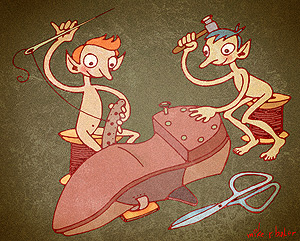
The Enterprising Elves
On the first day in my newly carpeted house, I leave my shoes outside. In the morning I am delighted to find they have been extraordinarily well repaired. I am less delighted when I receive the bill. (p. 10)
This is supposed to be the same type of situation as Robert Nozick's radio thought experiment, which is meant to show there's not always an obligation to pay for benefits nonvoluntarily received.
I say "Right" about this scenario--I don't have to pay the elves--but it seems to me that outright requesting benefits is more than what's needed for there to be an obligation to pay. Consider this continuation of the story of the elves:
The Enterprising Elves and the Cancelled Cobbler
After putting on my shoes and tossing out the bill, I stroll to my cobbler's shop and cancel my monthly shoe repair appointment.
That seems to change things. If I were indifferent to the elves' services and had no monthly plan with the cobbler, I could indeed toss out the bill and never look back. But in fact I welcome their services. Now at this point in the story, it's hard to say I have to pay for the elves' work. Should I pay the elves even though they invaded my cobbler's turf? Should I pay my cobbler, even though he didn't repair my shoes? But consider this:
The Elves Come Back
A month has passed and as usual I leave my shoes outside my door. The elves once again repair my shoes. I no longer have a standing appointment with my cobbler. Once again I toss out the bill.
To my my mind, now the unrequested repairs do have to be paid for. True, I didn't request the repairs, but I welcomed them and my behavior shows I'm counting on the elves to show up. If I'd really wanted to avoid the obligation to pay the elves, I would have had to keep my shoes inside. If I couldn't do that--remember the carpets--then I needed to show I was not counting on the elves by maintaining my appointments with the cobbler and paying his bills. But it just can't be that I may continue to receive the repairs, having arranged my life accordingly, but I don't have to pay for them.
Extrapolation to vaccination ethics ... well, long story. We'll save that for another day.
5/19/14
When is freeriding wrong?

Certain scenarios make it pretty clear that freeriding isn't always wrong. Robert Nozick's example of the freeriding group radio refusenik is a nice example of permissible freeriding. Generally speaking, it just can't be that an aggressive neighborhood association can saddle me with endless obligations to contribute to their collective schemes. Likewise, an enthusiastic PTA may generate any number of projects that do have benefits for all, but we wouldn't want to say they have the power to make it obligatory for parents to pitch in on all of these things. The basic intuition here, I think, is that there's a difference between receiving benefits you requested and receiving benefits that come unbidden. But what about these unbidden benefits? There are cases and then there are cases.
Here are three that involve individual rather than collective benefits, but I think they're illuminating nevertheless:
Case #1 - The Accidental Subscription. Suppose due to a mistake somewhere, you wind up being sent a subscription to Rolling Stone. You receive it every week and read it, not bothering to contact the magazine to let them know their error. (Real life example!)
Case #2 - The Requested Subscription. In this scenario you get Rolling Stone because you requested it.
Case #3 - The Double Subscription. In the third case, you have a requested subscription, and then an accidental subscription starts to arrive. You think "Lucky me!" and cancel your paid subscription. You continue enjoying the accidental subscription without paying for it.
If benefits must be requested for you to have to pay for them, then you have to pay only in Case #2. My intuition, though, is that you have to pay in both Case #2 and Case #3. You didn't request the subscription you go on enjoying in Case #3, but your actions are tantamount to requesting it. Your actions show you'd be prepared to pay, if it came to that. After all, you're on standby, ready to do differently, if you're ever threatened with losing the benefit. You paid for a subscription before you got lucky, so presumably you'd pay again, if the free copies stopped arriving.
This analysis carries over pretty well to cases where one benefits from a collective project. I don't have to support the neighborhood radio show because, though I may enjoy it, I'm not on standby, ready to do differently if my non-participation threatens the show. I'm prepared for the show to fail. Some goes for many (but not all!) PTA projects. I'm not on standby, ready to do any differently. Vaccination is different. Many refuseniks would presumably participate, if their non-participation threatened the immunity of their child's school. The vaccination refusenik is therefore not just a benefitter from but a welcomer of immunization. In fact, more than that: the refusenik is poised to participate more, if others participated less.
Now, collective projects are more puzzling. The magazine subscriber in Case #3 is prepared to pay, if paying is needed to keep the magazine coming. He's on actual standby, ready to take out his wallet. The vaccination refusenik is not on actual standby, but only on "hypothetical" standby: she would be prepared to vaccinate, if (contrary to fact) that were ever needed to preserve herd immunity. Arguably, though, the same moral flaw is on display in both cases: putting yourself on mere standby, while others actually pay for a benefit you value, makes you an exploiter of actual payers.
If you're not on standby, but ready to see an unrequested product disappear or a collective project fail, that's another matter. We might still judge you harshly--for having terrible judgment about the worth of the project--but you wouldn't be a freerider. You might even be something worse, but you wouldn't be a (bad) freerider.
5/16/14
"Soft Atheism"
Philip Kitcher hits many nails on the head. I like what he says about the reason to be skeptical of all religious beliefs. Yes, this really is "the most basic reason for doubt" (or one of them):
I also like what he says about rejecting religious doctrine while retaining the achievements of "religions at their best":The most basic reason for doubt about any of these ideas is that (when you understand words in their normal, everyday senses) nobody is prepared to accept all of them. Even if you suppose that Judaism, Christianity and Islam share some common conception of a divine being, the Hindu deities are surely different, the spirits and ancestors of African and Native American religions different again, and that’s before we get to Melanesian mana or the aboriginal Australian Dreamtime. It’s very hard to think that every one of these radically different conceptions picks out some aspect of our cosmos.So asserting the doctrines of a particular religion, or family of religions, requires denying other contrary doctrines. However, when you consider the historical processes underlying the doctrines contemporary believers accept, those processes turn out to be very similar: Long ago there was some special event, a revelation to remote ancestors. Religious doctrine has been transmitted across the generations, and it’s learned by novice believers today. If the devout Christian had been brought up in a completely different environment — among aboriginal Australians or in a Hindu community, say — that person would believe radically different doctrines, and, moreover, come to believe them in a completely parallel fashion. On what basis, then, can you distinguish the profound truth of your doctrines from the misguided ideas of alternative traditions?
To sum up: There is more to religion than accepting as literally true doctrines that are literally false. Humanists think the important achievements of religions at their best — fostering community, articulating and supporting values — should be preserved in fashioning a fully secular world. That secular world ought to emerge from a dialogue between humanism and refined religion, one in which religion isn’t thrown on the rubbish heap but quietly metamorphoses into something else."Soft atheism," he calls this.
5/15/14
Nozick's Group Radio Thought Experiment
Here's a fun thought experiment from Anarchy, State, and Utopia (Robert Nozick), with a few variants at the end:


Do I have to take my turn and produce a radio show? Surely not. We can't be lassoed into obligations that easily--just because some group of people decides to jointly bring about a public benefit.
My thought is: OK, I agree with Nozick about that scenario--you don't have to produce the radio show on your appointed day. But what's going on here, and how is this different from other cases in which you are a nefarious freerider for refusing to contribute to a joint enterprise you benefit from but didn't request or initiate?
Do I have to take my turn and produce a radio show? Surely not. We can't be lassoed into obligations that easily--just because some group of people decides to jointly bring about a public benefit.
My thought is: OK, I agree with Nozick about that scenario--you don't have to produce the radio show on your appointed day. But what's going on here, and how is this different from other cases in which you are a nefarious freerider for refusing to contribute to a joint enterprise you benefit from but didn't request or initiate?
Subscribe to:
Posts (Atom)