Showing posts with label animal books. Show all posts

7/19/13

It's a Matter of Respect


I'm home from one trip and about to embark on another, so obviously I'm too busy for blogging--there's cleaning and packing to do, right?  Right, but that would be so boring....

Some long drives in the past week gave me time to think about animal welfare regulation just a little more.  In my past posts, I attempted to think about the ethics of welfare regulation "ad hominem" -- in the technical sense (see sense #2, here).  That is, starting from my opponent's premises.  My opponent draws a very sharp line between rights and welfare. Being raised as food violates a pig's rights, and then there is the separate question of the pig's welfare--how miserable or happy is the pig, hour to hour? My opponent is bothered by over-attention to welfare issues, because the rights violation is the underlying problem. 

Now, I think even with this sharp dichotomy, there's a good case for welfare regulations, as I initially argued here (before I saw the Francione-Friedrich debate), but that post was, as I say, "ad hominem" (in the technical sense!) -- I was going along with an approach to animal ethics that isn't actually my own, and thinking about where it leads (and doesn't lead).  But what about how these issues look from my own standpoint?

The primary thing we owe to animals (I argue, in my book Animalkind: What We Owe to Animals), is respect. Animals in extreme captivity are disrespected because they can't be themselves--pigs can't be pigs, fish can't be fish.  A calf who can't so much as turn around is treated not as an animal but as a meat machine (to use Ruth Harrison's excellent phrase).   We may need to supplement respect-talk with compassion-talk, but I think respect is primary.  And it's appropriate even when we are uncertain what an animal is feeling.  Do animals habituate to horrible environments and stop feeling or caring?  Even if they did, that wouldn't make those environments OK -- they're still disrespectful. 

Suppose a zoo gives the animals more space, or an animal farm releases a pig to a group pen or pasture.  On my view, this isn't a superficial change-- a change to mere welfare, as opposed to rights -- it's a change to what really matters.  It's more respectful.  The animal is now at least more able to exercise his or her natural capacities.  Now, very small changes aren't worth huge amounts of effort or money, so on this respect account, we can still debate how to focus animal advocacy.  But an increase in liberty is a meaningful change, not a surface change.

Now, imagine we gradually make life better for a pig. We respectfully increase the size of the pen, then we respectfully allow the pig out doors, and we respectfully allow herd behavior, etc.  We don't clip ears or dock tails, and so on.  Nevertheless, the day comes when the animal is slaughtered and turned into barbecue (aside: Dear Michael Pollan, I am not enjoying the description of a pig barbecue in part I of your new book Cooked).  How can any of the previous improvements be respectful if the last stage is so disrespectful?

You could try to make a case that killing animals doesn't harm them, but I think that's false (see Animalkind, p. 128-31).  No, it's clearly harmful and disrespectful to kill an animal for the pleasure of a good barbecue (even assuming this pleasure runs pretty deep -- and we should allow that it does).  But respect comes in degrees--you have done far more of what you should, if you allow an animal to exercise his or her natural capacities prior to death.  I don't think the purpose of the whole system (using animals for our benefit) annuls all the apparent progress.  And in any case, the whole system doesn't have to be completely brought down, in the name of respect.   I'm prepared to countenance situations in which respectful people will pursue their own good at the expense of animals--i.e. situations in which harming or killing is a necessary evil. (Animalkind embraces this "necessity" standard and gives examples of justifiable use.)

Anyhow, the point is that on some views in animal ethics, we can help animals in two radically different, incommensurable ways--by securing their rights and by improving their welfare -- with one way running deeper than the other. But on other views, there's just one basic parameter--such as respect.  So we do better by animals on the very same parameter, whether we give them more liberty or go much further and save them from all exploitation. This sort of "one parameter not two" approach can take many forms.  The respect approach in my book is one; the capacities approach in Martha Nussbaum's book Frontiers of Justice also eschews any sharp rights/welfare distinction; and of course utilitarians take a one parameter approach, with that one parameter being well-being (rights, they say, are "nonsense upon stilts").

Because I think in terms of respect, I don't really feel at home with the whole welfare vs. rights debate -- it's not really my debate.  For that reason, this could very well be my last post on the subject.  Time to get back to ... well, all sorts of philosophy-stuff on my desk, but mostly packing.

11/6/10

Some We Love, Some We Hate, Some We Eat

The subtitle of this book, by psychologist Hal Herzog, is Why It's So Hard to Think Straight about Animals.  That's the main thesis:  our thinking is a mess.  Our attitudes about animals are so inconsistent that we even have "double standards" when it comes to members of one species.  For example, in the introduction we hear about one of Herzog's neighbors in the Smoky Mountains (I love his writing)--


Not even a dog is a dog is a dog--the breed counts.  It gets even crazier in a research laboratory.  The mice in the cages are treated according to government guidelines, while those scurrying around on the floor after hours are caught in traps and disposed of.  Weird.

If we can't even treat all members of one species the same way, obviously we're going to be even less capable of treating members of different species consistently.  We don't just "not care" about all animals equally, some we even hate.  Mice aren't so bad, but rats have those long thick tails....eww.

Even people with a high level of animal concern are shown to be basket cases.  Apparently people who consider themselves vegetarians eat quite a bit of meat and many wind up going back to omnivory altogether.

Chapter after chapter describes inconsistency after inconsistency, making me think (frequently)--what about the committed, passionate, and consistent?  They exist. They really do. I was delighted to find portraits of them in the last chapter, and Herzog seems genuinely impressed.  There are portraits of people who run an animal sanctuary and a wonderful couple of pages about people who are devoted to helping out endangered sea turtles.

Are we really as inconsistent as Herzog says? I think he overdoes it at a few points.  For example, he opens the book with a story about a friend who doesn't eat land animals and birds, but does eat fish.  The first sentence of the book gives his assessment: "The way we think about other species often defies logic."

The friend doesn't treat all animals uniformly, but it doesn't follow she's inconsistent.  If the principle is "don't eat factory farmed food," then consuming fish is consistent with rejecting other kinds of meat.  Yes, there are likely to be ways she deviates from that principle, but that's life.  To make a diet liveable, you have to simplify:  yes to fish (and I won't worry about farmed fish); no to other meat (and I won't make an exception for "humane meat"). 

In the chapter on animal ethics, Herzog has a very clear and accurate picture of the main perspectives, but his fondness for uniformity makes him see just a little too much virtue in hyperegalitarianism. First he couldn't be more negative:
Joan Dunayer lives in a moral universe that should cause even hardcore animal activists to shudder.  Can a reasonable person really believe, as Dunayer apparently does, that one should flip a coin when deciding whether to snatch a puppy or a child from a burning building, or that duck hunters should be imprisoned for life?
But then he does an about face:
The problem for animal liberationists is that Dunayer is right. If you take the charge of speciesism literally, if you refuse to draw any moral lines between species, if you really believe that how we treat creatures should not depend on the size of their brains or the number of their legs, you wind up in a world in which, as Dunayer suggests, termites have the right to eat your house.
I don't think consistency or eschewing speciesism mean seeing no differences between species. It means seeing only those differences that are real and morally relevant, whatever they may be.  Of course, we're in big trouble if we start seeing differences between canine breeds, between floor mice and cage mice, and the like.  But there's nothing that says we have to think there's one uniform system of ethics that applies to every single type of animal there is--from dust mite to dog to chimpanzee to human being.

We can make distinctions without falling into inconsistency, but clearly we humans make way too many distinctions, and many of them are biased and cultural and indefensible..and downright nutty.  This book is a bit depressing (why can't people be smarter and more conscientious?) but also amusing.  Humans sure are strange.

10/18/10

Philosophy of Hunting...for Hunters

I'm always on the lookout for good reading about hunting.  I regularly have hunters in my animal rights class, and usually cover the topic, but I have trouble finding reading on the subject.  So I welcomed the copy of Hunting: Philosophy for Everyone that recently came my way, courtesy of the good guys at Wiley-Blackwell.

The anthology is written as a hunter's companion, not as a balanced presentation of the debate about hunting.  All of the books in this series are like that.  The book on fatherhood is for fathers, the book on climbing is for climbers.  I think the series is ingenious, and I can see why the editors decided to include hunting as one of the topics.

The editor of the volume, Nathan Kowalsky, starts his introduction with reminiscences of hunting with his father as a kid. Dad sometimes picks him up at school with a deer in the back of his van.  Cool, he thinks, but "they were never my deer."  "My deer" because you killed it?  What's apparent from page 1 is that the world looks different to hunters.

Anyway, at 14 Kowalsky finally gets to go deer hunting, and has a buck in his sights, but can't pull the trigger.  "Not because I didn't want to kill him, but because I wasn't confident I'd kill him well."   Killing him well. That notion sets the tone for much of the book.  It's not about "whether," it's about "how."

To make sure the deer is killed well, Dad takes the shot, and the deer falls to the ground. Kowalksy recollects--
There was only one thing that mattered to me: that the buck was okay. And by okay I meant that he was well dead.  Death was always in the cards, but it had to be good.  Weird, huh?  I loved that buck, that one, right there. he deserved the right kind of death. And then I cried!  I guess 14-year-old boys are allowed to.  It's always odd to consider why one cries. We cry when we're happy, when we're sad, when we're relieved, and when we're frustrated.  We cry when we see beauty, and when we see horror. And yet neither of these things truly captured what I felt. I don't know of any words that really could.  But it was good to cry, and it was good that the buck died as he did.  (Dad was a good shot.)
I'm afraid I just found this story troubling.  It troubles me that the boy cried--should we really kill in front of kids, and teach them to kill?  It troubles me even more how the obvious seems to be unspeakable.  The deer was shot dead--he lost his life.  How could that not be distressing?

In the first article, by Jesus Ilundain-Agurruza, philosophy itself is huntified with a billion metaphors.  Again, a hunter's sensibilities just aren't everyone's.  I can't warm up to light-hearted banter about the accoutrements of suffering and death.  In the first half of the chapter, he explains Singer's principle of equal consideration of interests;  no hunting is allowed, for the sake of trivial interests.  What's the serious interest served by recreational hunting? The article switches muses in mid-stream: it gives a "virtue ethics" defense of hunting.  The justification for hunting lies in the hunter's attitude.  "A central aspect of this superior kind of hunting is the ritual of honoring the kill and paying homage to it." But wait, isn't the thing itself--killing for recreation--non-virtuous?   The article just doesn't explain how to get around that (apparent) problem.

I confess, when the next chapter started with a description of black bear hunting, I was kind of tuckered out. There had already been so much killing.  I was cold, my feet were wet, and I just wanted to go home.   The fact is, I simply find the whole idea of recreational killing extremely strange  I'm definitely not the intended audience for this book.

But then, I've got all these hunting students, and I really want to understand what's on their minds. So no doubt I will persevere next time I cover this topic in my class.  There's an article by Roger Scruton ("The Sacred Pursuit") that looks like required reading.  I'm going to have to tackle the essay about the vegan-turned-hunter, even though I overdosed on that type of narrative when I read The Vegetarian Myth last year.  Yes, there are are also articles calling into question hunting (Lisa Kretz) and articles on neutral themes (J. R. King), but on the whole, this is a book that will speak to hunters, not critics of hunting.

See here for a much more thorough review of the book.

9/5/10

Lucy

Here's a novel you might enjoy if you're interested in ethics "across the species divide."  Lucy is half human, half bonobo--the creation of Stone, a primatologist living in Congo who's killed by soldiers as the story begins.  He created her to protect bonobo genes from extinction (interesting idea: it's genes that matter, not the organisms that have them).  Plus, he was hoping to improve the human genome (another interesting idea: humans don't need to become brighter and stronger and closer to immortal, just nicer).

Anyhow, another primatologist saves the girl, takes her back to America, and we find out how humans react to someone who has all the best characteristics of both humans and bonobos, but can't claim to be completely human. We also get to do a lot of thinking about the label--why is "human" an automatic honorific?  Why is "animal," in the sense of "not-human," an automatic dishonorific?  Why can't we take individuals one at a time, just as they are?  (The philosopher James Rachels--sadly deceased--would have loved this novel; the "moral" of the story is precisely his own view on animals and ethics, a view he calls "moral individualism.")

Some readers will quibble about Lucy's mix of human and bonobo traits.  She's the girl who has it all--all the best human traits and all the best bonobo traits.  She looks almost completely human (never fear, she's not hirsute) and isn't  language-challenged or promiscuous, but she does eat her bananas whole.  It's not realistic, but this premise allows Gonzales to explore how we react to species itself, regardless of species-related characteristics.  We would discriminate against a Lucy based on sheer species, he speculates, just like in real life people discriminate based on sheer race, sheer gender, and so on.

This is a genuine novel--a very straightforward, un-"literary" one--not a fictionalized philosophical argument.  You could read it at the beach, but then again, you could have good classroom discussion about the issues it raises. There's the issue about species (should we care about it?) but another nice, thorny question runs through the book, one about creating life.  What if Stone had known just how Lucy's life was going to turn out? Would it have been wrong for him to create her?  Why? Why not?

I'm about 2/3 done, so if you comment, NO SPOILERS PLEASE!

9/2/10

Killing for Fun

So I have a book about hunting in my hands, courtesy of a publisher, and I'm trying to decide whether to blog about it.  It's a philosophical examination of hunting, but it's written for hunters, and largely by hunters.  So there is a great deal of jocularity about the whole business. The presupposition of most of the articles seems to be "we are all hunters here."   There's a lot of good ol' boys and girls clowning around. That's (to put it mildly) off-putting.

I am not an ignoramus about hunting.  I regularly have hunters in my Animal Rights class, and I give them plenty of opportunity to explain hunting and defend it.  My class has heard from several students whose parents own and operate Texas hunting ranches. I've heard blow-by-blow accounts of how canned hunting works.  Another student showed the class a video about Safari hunting in Africa, complete with a scene of hunters blowing a crocodile's head off (and saying "cool!")  We've heard from environmentally responsible duck hunters and people who hunt with bows and arrows in Colorado. One semester we heard from a guy who shoots squirrels with BB guns just for the hell of it.  He also explained how much fun it is to sit on the back of a truck and take shots at armadillos. 

I can concede a lot:  as far as harm to animals goes, a lot of hunting is no worse than factory farming, and in fact much better.  There is also an honesty to hunting that appeals to me.  While most people don't want to think about the killing behind the cellophane, the hunter directly confronts it.  It's also true that all hunting is not alike, and some hunters think carefully about how they hunt.  In the end, though, I just can't get past one critical thing:  hunters kill for fun.

It takes a little care to say how and when killing can be coupled with fun.  Rewind 500 years. You're a native American hunter just trying to provide protein, clothing, and building materials, for yourself and your tribe.  While hunting, may you enjoy yourself?  Of course.  And I can perfectly understand how that might be.  But if you did enjoy yourself, you still wouldn't be killing for fun.  

I suspect today's most conscientious hunters would like nothing more than to be that native American subsistence hunter.  I suspect they play-act themselves into that role, pretending that they're hunting for necessities, not for fun. But how can that really be true, if they obtain meat from the grocery store 99% of the time, and their hunting fills leisure time just like hiking, climbing, and going to art museums do for other people?

The native American hunter was hunting in order to acquire necessities --with fun as an expected byproduct; but the recreational hunter is hunting in order to acquire fun--with necessities as an expected byproduct.  (Let's assume meat is a necessity, just for the sake of argument.)  It's a subtle difference, but a big difference.  Imagine a surgeon who enjoys her work.  She goes to work anticipating having fun in the operating room.  If she cuts people open in order to have fun, that's troubling.  If she cuts people open in order to help them, and only expects to have fun, that's completely different.

Killing for fun seems bizarre and unwholesome, so hunters tend to wax poetic.  Substitute whatever words you like, there's still the same problem.  If hunters are trying to acquire super-profound personal gratification--a sense of oneness with nature, whatever--it still seems obvious one shouldn't kill for personal gratification.

The tricky question is: does it matter?  If the surgeon does cut to have fun, should we worry about her? Censure her? Stop her? Call her behavior wrong, as opposed to just questioning her motives?  The same questions arise about the hunter:  if hunters harm animals less than average meat eaters, should we be less concerned about them, morally? Or is their killing for fun a reason for concern? What kind of concern?  Should we charge them with moral errors, or just be repulsed?

This is the set of questions I'd like to see explored in the hunting book. And explored forthrightly.  We'll...see.

5/15/10

Animals and Ethics

I enjoyed this interview with Angus Taylor, author of Animals and Ethics. Toward the end, the host talks about a point that's often made by my students.

"You can't really liberate animals like chickens and cows because they don't have an ecological place anymore, so there's not really an end point for them other than letting them die out...."

My students often assume that "liberationists" must want to throw open the doors and let the billions of animals out. How could liberating a species  mean exterminating it or radically reducing its size?

Their assumption about "liberationists" is understandable, considering the way animal rights authors  throw around comparisons to slavery. Abolitionists wanted a better life for slaves, not no life at all.

Angus points out that extinction is sometimes the right way to go. If some nefarious operation was genetically engineering submissive servants for majority benefit, the right thing would be to end it and phase out the servants, not keep breeding them and set them all free. 

OK, but I can see my students' puzzlement. If you wanted to phase out the servants, you wouldn't call that "servant liberation"! Should people against animal farming really think of themselves as liberators?

Well, what's in a name? But there's an interesting underlying issue here.  There really is some question who is the truest friend of domesticated animals.  If you're really "for" them, can you really think their lives are so pitiful and worthless that it would be better if they didn't exist? 

Anyhow... I need to get a hold of Angus's book. My little secret is that I have not read the entire animal ethics literature. I'm especially ignorant about recent continental writing about animals. This book looks to be the comprehensive survey that would solve all my problems.

4/20/10

Francione vs. Smith

Here (see 4/16 podcast) is a debate between Gary Francione and Wesley Smith on the Michael Medved show.  I reviewed Smith's book recently and I've blogged before about Francione.

They start by agreeing on the distinction between "animal welfare" and "animal rights."  Either you support business as usual, but want the usual things to be done nicely, or you think that animals are persons with the rights we usually attribute to persons.  Both are invested in the dichotomy, but for opposite reasons. 

There really is a middle path.  In fact, when Francione makes his argument against eating animals, he doesn't rely on rights talk. He simply says:
(1) It's wrong to inflict unnecessary suffering on animals.
That's an irresistible principle.  It makes for an irresistible argument against meat-eating considering that what we obtain from eating animal products is (usually...in most cases...) just pleasure and convenience.

Wesley Smith fails to respond, instead repeating some familiar bromides about how meat-eating is natural.

Francione quickly forgets he's talking to a defender of the status quo, and starts attacking a completely different foe--Humane Society style animal advocacy (or "welfarism," as he misleadingly calls it). 

Francione comes back to Smith's assertion that it's natural to eat meat.... but Medved wants to talk about medical research. Now it starts to be a problem for Francione that he opened with the irresistible principle.  By any measure, some medical research is necessary.  So how can it be wrong?

Francione back-pedals.  Moral justifiability doesn't turn on what's necessary or unnecessary after all!  He grudgingly concedes that some research is "empirically necessary" and "beneficial"...but no, that's not enough. It appears that he believes the irresistible principle, but also believes:
(2) It's wrong to inflict necessary suffering on animals.
Observation: when someone asserts (1), there's an "implicature" that they reject (2). That's part of what makes (1) so irresistible.  When you assert (1) and then (2), it's a whole new ballgame--the "animals are persons with rights" ballgame.

Next:  a change of subject and a reminder that Smith and Medved are capital "C" Conservatives.  Smith is bothered that Francione believes in a woman's right to abort a fetus but not the right to eat a chicken.  Francione points out that the rights-holding fetus is inside the rights holding woman, whereas the chicken isn't.  There's a difference. He throws in some stuff about racism and patriarchy that elicits derision.

Smith brings up PETA's Holocaust on your Plate campaign.  Colonel Sanders vs. Hitler.  Francione says he isn't interested in ranking evils.   It's all wrong.

Medved:  In Exodus, Moses kills the overseer who is beating an innocent slave.  We generally think that human beings are obligated to kill others and risk their own lives to stop the suffering and death of human beings.  Are human beings obligated to do the same to stop the suffering and death of animals?

Francione: Moses shouldn't have killed the overseer. (Smith points out that Francione is a pacifist.)

Medved shifts the focus from killing bad people to sacrificing yourself to prevent their misdeeds. What about sacrificing yourself to save 1000 people. If that's obligatory, must you do the same to save 1000 animals?

Francione: You could save 1000 right now by donating your organs at a hospital.  It's not obligatory, but it's admirable.  

OK, but would it be just as admirable to sacrifice yourself to save 1000 animals as it would be to sacrifice yourself to save 1000 humans?  Francione won't be cornered into answering such questions.

Francione comes back to the idea that it's wrong to impose unnecessary suffering on animals.  99.9% of our use of animals is unnecessary, he says.    It seems a tad disengenuous to keep pushing (1) when he also believes (2). It makes is seem as if he's just applying common sense, when in fact he has a revolutionary view of animals as persons with basic rights as strong as ours.

Smith pipes up about the main claim of his book--animal advocates are undermining human exceptionalism.

Francione:  what is special about humans is our ability to love, feel compassion, reach out, help the vulnerable other.

It really is the height of irony when people like Smith blow the trumpets about human specialness, which to a great degree consists of our extraordinary moral goodness (he says), and then use that to defend hideous acts of cruelty.   Please.  

Medved to Smith: How would we be worse off if the status of animals changed?

Smith: if we see ourselves as just another animal in the forest, we will act like that.

This is one of the very implausible themes of his book.  It's strange how people throw around predictions without any evidence to support them.  Are animal advocates really a more "animalistic" bunch than the rest of us?  I had not noticed that. 

He goes on to say: we'd be worse off without meat, medical research, wool coats, horse riding, etc.

Surprise revelation during this debate:  conservative commentator Michael Medved is close to being a vegetarian (he only eats fish).  Based on that and his line of questions in the interview, I'm going to recommend my book to him (what chutzpah).  Animal ethics without equality--I think that's his stance, and that's what I argue for.

4/10/10

Reader, I Bought It

Lierre Keith’s book, The Vegetarian Myth, that is. I confess, I bought it because the author got pied by angry vegans and that made me curious.  (This is a lovely example of wrongs that don’t harm. I believe the book is doing very well largely because of the pieing.)
First, the book’s style. Sometimes it reads like recovery literature.  In her 20 years of being a vegan, Keith suffered mightily, both from countless health problems and moral torment.  Sometimes it reads like the literature of religious awakening.  Out of the darkness of veganism, she is reborn into the light of meat-eating. There’s also a coming-of-age component.  Before she was a child, now she has “adult knowledge.”   This recovered, enlightened, knowledgeable adult now speaks to us as a prophet, a healer.  She issues fervent commandments.  She tries to save us from our agony, our childishness, our stupidity.
Phew. So what’s the adult knowledge she wants to share so we too can be saved?  I’m going to distill, here, but I’d say her primary message is that life comes from death.  To wit:  there are worms and little creatures in the soil, mice in our fields, predators in forests, bacteria in the rumens of cattle, and such like. Not only does life come from the death of animals, but it also comes from the death of plants. Thus, any diet we can choose will involve the death of plants and animals.  Keith didn’t know these things during her 20 years of wandering in the vegan desert.  Now that she’s found it out, she wants us to know too.  
But what does it all mean? Isn’t there a difference between eating cows and eating carrots?  No, she says.  Part of her adult knowledge is a wildly anthropomorphic view of plants.  On her view, plants make choices.  Apple trees want us to eat their apples, and want us to defecate on the ground, so that the seeds can become new apple trees.  If we don’t do this, then we’re not doing what the tree wants.
Keith even thinks plants are sentient. So are all the tiny creatures in the soil. Which makes me think: there is adult knowledge even in a dictionary.  Look it up!  A sentient apple tree would consciously want things and feel things.  It might, for example, enjoy the gentle tug when someone picks an apple, feel pleasantly lighter after the picking, perhaps get mad at people for defecating in the wrong places.  Sentience means feeling. 
All signs are that feeling takes place in brains.  No brains in apple trees, no feelings.  No brains in bacteria, no feelings. It probably also takes a brain with a  certain amount of sophistication for there to be feelings.  It does not at all go without saying that worms, because of their nervous systems, have feelings.
As to values, I’m equally unimpressed.  In Keith’s universe, there’s absolutely no difference between driving a spade into the ground and accidentally killing a snail, and driving recklessly down a busy street and killing a child.   This hyperegalitarianism is essentially mystical and religious, not rational, and certainly not enlightened.
Some readers of this book are going to feel much better tucking into their next hamburger and ignore everything else. In fact, Keith preaches a gospel of abstinence. It’s just that she’s changed her mind about what we should abstain from.  From being super-vegan, she goes super-green.  Don’t have children, she says. Don’t drive a car.  Don’t live in a city. Don’t live in a place where food can’t be grown locally.
And there’s more.  Don’t support agriculture. You heard that right—the crime of crimes is planting annual crops.  So: no wheat, no oats, no corn, and (for God’s sake!) no soybeans.  Eventually topsoil is damaged, so agriculture isn't sustainable.
So:  build yourself a little hut, get yourself a goat and some chickens.  I’m pretty sure she’ll let you have a garden, but only if you fertilize with goat and chicken manure.  Heaven forbid that you should walk into the Home Depot garden shop.
What next?  If “Thou shalt be green!” replaces the ten commandments and the categorical imperative and the greatest happiness principle, how may I fill my time?  If we mustn’t ship in oatmeal from across the country, may we ship in books?  Can I have a computer if it’s manufactured in China?  Do I have to dress in skins?
Does your ultimate greeniac have a goat or not have a goat?  I think that’s the fascinating (or not so fascinating) question this book is really about. She says: get the goat.  It’s good for you too. She never met a low-carb salesman she didn’t love.
But what about the goat?  Remember:  vegetables are sentient. Apple trees get mad when we use flush toilets. So the goat matters, but not especially.
I say: the goat matters, and yes, especially.  The city folk matter, because there’s a ton of them.  There’s no point in contemplating the end of agriculture, because you need it to feed 7 billion people. And let’s not kid ourselves: it’s complete nonsense to think that our giant herds of livestock are easy on the earth, while crops are brutal.  Livestock needs lots of space. They displace wildlife. They use tons of water and erode land.  We’re already using 1/3 of the earth’s non-ice land surface for livestock.  Responsible environmentalists know that we need less meat, not more.
Putting aside animal issues, this book raises an interesting question:  if the ultimate green life is not a good life, do we have to choose it anyway to keep earth habitable for as long as possible?   I don’t really think so.  What the point of chugging away in our gardens, childless and with only the provisions that we can get within bicycling distance?  I think I’d get tired of reading the super-local poets and having quilting bees or whatever it is that’s supposed to fill my time.  There’s a reason people gave up that life 10,000 years ago.  They preferred a different one.  I prefer a different one. If we really can't live a good life on earth forever, then so be it.
Reading this book made me want to run out and buy Thomas Friedman’s book Hot, Flat, and Crowded, with all it's clear-eyed realism. We’re not going back in time, we’re going forward.

4/4/10

Pig 05049


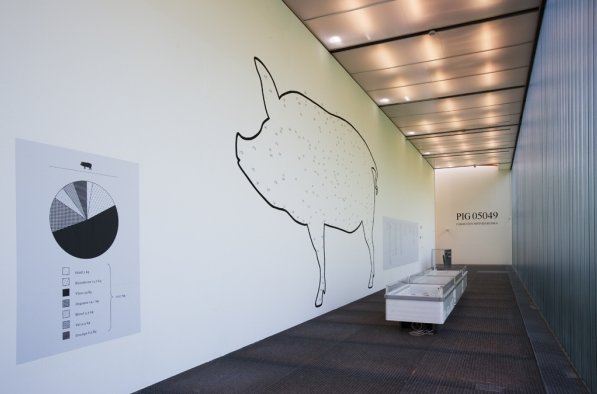
Here's a really interesting sounding exhibit and book: Pig 05049.  It details everything made using one pig's body--all 185 products.  Bill Buford's response here is (I gather) that traditional farmers have a more personal relationship with their pigs, but the killing is just as awful; furthermore, if you're going to kill an animal, you ought not waste any of its body.  So--pig 05049, ho hum? I would say the French pig Buford ate for dinner was better off being able to graze around in a wide open field, while pig 05049 had no real life at all.  Surely we should prioritize letting animals have lives over avoiding wastefulness.

3/27/10

Jonathan Balcombe

To buy or not to buy... I'm thinking about reading Jonathan Balcombe's book Pleasurable Kingdom or his latest, Second Nature.  I rather like the topic of the first book--pleasure and happiness in (non-human) animals.  People with ethical concerns tend to focus on animal pain, and lose sight of the good experiences animals enjoy.  The book seems to be "positive psychology" for the animal kingdom, but without the self-help overtones. Cool!

I'm a tough customer, so I listened to an interview with Balcombe to help me make up my mind. Here he is on the Diane Rehm show.  He's really articulate and knowledgeable, but this is my reservation:  there's never a moment in the entire interview when he seems skeptical or puzzled.  Isn't it actually rather difficult to get a grip on animal minds?  For that matter, isn't "animal ethics" a difficult subject? Hmm.

Anybody out there familiar with Jonathan Balcombe's books and willing to comment?  UPDATE:  Taking the plunge....will report back on this book later!

3/18/10

Getting Pied by Vegans

I sure hope it never happens to me. It seems some vegans feel a special hostility for animal advocates who are ex-vegans (the woman who was pied), pre-vegans, or non-vegans (me). You can see this if you frequent abolitionist blogs and twitter feeds. It is disconcerting--in fact saddening.

Note at the end of the post how Smith manages to collapse distinctions between pie-throwing types and the good people at the Humane Society. You see, it's all one big organism. The tentacle that threw the pie is connected to the same octopus as the tentacle that's trying to pass a referendum in Ohio right now. (Which reminds me--I need to send the Humane Society a check.  I want that referendum to succeed.)

Smith makes the same mistake about ethicists that he does about animal organizations.  No, it's not one big organism. It's not even two organisms--welfare and rights. No, we don't have to choose between the very conservative idea that we should keep doing all the usual things to animals, but do them nicely, and the radical idea that every rat, pig, and mouse has super-strength rights just like ours.

Since Smith calls one of his blogs a "bioethics seminar" I'm going to offer him a reading list. Outlooks inbetween "rights" and "welfare" include utilitarianism, Martha Nussbaum's "capacities" approach to animals in Frontiers of Justice, and David DeGrazia's approach in Taking Animals Seriously.  And mine, in Animalkind.

3/12/10

Animalkind Review

Here's James Garvey's review of Animalkind in the curent issue of The Philosophers' Magazine.  I really appreciate his tolerance for shades of grey.
Our thinking about animals is a mess. We moo at a cow in the countryside, maybe pat a little lamb on the head, then enjoy burgers and kebabs for lunch. Philosophers have tried to tidy things up in two ways. The old school argues that animals are more like things than people, so why not treat them as we wish? Recent philosophers say that animals are like us in some morally relevant sense, and we must therefore treat them with the respect owed to human beings. Liberate them from zoos, labs and factory farms, give them rights, and so on.
My fellow blogger and tpm columnist, Jean Kazez, explores a middle path between these views in her book, Animalkind. Animals aren’t just things, she says, but they’re not our equals either. Our lives matter more, but animal lives do still matter – we have to treat them with all due respect, depending on the value their lives have. It’s complicated – and you have to think things through carefully, case by case. Kazez takes the world’s ragged edges seriously. The result is a readable, compelling, and thought-provoking account of our difficult relationship to animals.
Some animals are like us in some senses, not at all like us in others. Marshalling evidence, she says that mammals, birds and fish are almost certainly conscious, but creatures like ticks are probably not. Some animals seem to do some thinking – not human thinking but still thinking – while others don’t. The jury is out on whether certain creatures have a sense of self. Different interpretations are possible concerning the future-directed thoughts of animals. There’s no such thing as chimpanzee moral philosophy, but there’s enough fairness and reciprocity in their behaviour to give us pause.
Kazez’s point is that sharp lines separating animals and people are hard to find – we have differing abilities and complex similarities. Animal defenders and their opponents see clear boundaries and obvious facts which lead to loud but conflicting conclusions. Kazez sees many shades of grey, all the while guided by a certain notion of respect.
She arrives at it by thinking about the different capacities creatures have. “If capacities are what give value to a life, then to compare animal and human lives, we must compare animal and human capacities.” We have a large number of valuable capacities. We can think about the future and the past, about ourselves and others; we have culture, aesthetic abilities, language – and some animals have some of these capacities too, to varying degrees, and other abilities as well. All of this adds value to animal lives, but human lives are especially valuable in comparison. Animals are somewhere on a sliding scale below us, deserving of consideration depending on their particular abilities. We are not all equal, but animal lives are nevertheless worth something. Human lives, though, are worth more.
Before you ask, she does wonder why we should think that human capacities are more valuable. Why think that having a sense of self trumps a cool set of claws? If I could breathe underwater, I’d never stop talking about it. We can try to curb our arrogance, but “we must make judgements, because real-world choices depend on doing so. The judgement most of us arrive at is that there is something special about our capacities and thus about us….[w]e have to move on with our understanding of the way things are, imperfect though it may be.”
The respect we owe animals depends on a complex view of values. The caveman is right to spear the proto-cow, because his family is owed more respect than his prey. Rescue parties are right to save humans before animals, because people are owed more respect than pets. But when we kill animals for something that is not worth the loss of their valuable lives, we are not treating them with the respect they deserve. No ivory trade, no hunting for fun, no leather, no fur hats, no unnecessary animal testing, and no eating meat just to satisfy a taste for it.
Even this final conclusion about our dietary choices is a complicated one. Eating meat because you like the taste is closer to killing for a pretty pelt than a worthwhile medical experiment. However, and this line really got me, “For most people, being good is a work in progress, never to be completed.” Kazez knows that we struggle to be good, and it’s not an all-or-nothing affair. She tells us a lot about her own efforts, including her inability to give up milk with her cappuccino. Some dietary choices are imperfect but still better than others.
There’s no easy answer on any page of this book. There’s no jargon, symbolic notation, or numbered distinctions – just plain, clear English. You are as likely to hear about recent primate studies as the views of philosophers. It presupposes curiosity and intelligence but no special background. It’s the effort of a philosopher doing honest work in the world.

3/10/10

A Rat is a Pig is a Dog is a Boy

The title of this book comes from something Ingrid Newkirk once said.  Longer version:  "When it comes to having a central nervous system, and the ability to feel pain, hunger, and thirst, a rat is a pig is a dog is a boy."  Opponents of animal rights like to quote the short version.

Anyway, I got interested in this book because my new book challenges egalitarianism, and yet advocates for animals.  How, I wondered, would Wesley Smith get from "not equal" to a scathing attack on the animal rights movement? Even if a pig is not a boy, aren't we doing terrible things to pigs, and aren't animal organizations entirely right to work for change?

Let's start with a false dichotomy

In chapter 1, Smith starts by distinguishing between "animal welfare" and "animal rights". The animal welfare approach says pretty much any use of animals is legitimate, and only concerns itself with "how". Want a pair of alligator shoes? Fine, just be nice to the alligator. The animal rights view sees animals as inviolable. No alligator shoes allowed.

I think the welfare/rights dichotomy is simplistic and unfortunate. Suppose you think we should only use animals for our benefit when it is necessary. In essence, you're against gratuitously harming animals. That will mean no alligator shoes. So you'd be more radical than the animal welfarist. But you wouldn't have to go further and believe in animal rights. You might think some animal research is OK, since it's in some robust sense necessary, unlike alligator shoes.

What could justify seeing animals as usable, but only when necessary? After all, that's not how we see human beings. That's what my new book is about. But my book is not the only one that occupies the middle ground between "welfare" and "rights." By my lights, most of the interesting work in animal ethics today occupies that middle ground.

Oh come on, do I have to read Animal Liberation?

But recognizing moderates wouldn’t serve Smith’s purposes. In Chapter 2, he grudgingly admits that Peter Singer actually is a moderate: he's not just a welfare advocate, and not in favor of animal rights. But he’s quick to say that Singer's influence is on the wane.
Despite Singer’s guru-like status among most animal rights afficionados, the movement’s uncompromisingly radical spirit has passed him by, to the point that he is now viewed by some prominent liberationists as something of a conservative and even, of all things, a speciesist. (p. 24)
He gets this view of Singer from "abolitionist" Gary Francione, whom he warmly thanks in the acknowledgments. Not that Smith really respects Francione’s ideas. He thinks he’s a loon. But it serves his purposes to make it seem as if Francione is the brains of the animal movement.

3/9/10

Eating People

This is book review week, apparently. I recently read Animals, a novel by Don LePan about a future world where animals have gone extinct, and a growing subclass of mentally impaired humans serve as (a) pets and (b) meat. 

LePan's future humans are doubly prejudiced.  Their prejudices about mental disabilities convince them that the impaired are not human.  Then speciesism takes over.  "Not human" means "morally unimportant" in their minds.

The novel makes us see what a terrible thing it is to be prejudiced, and how that attitude can blind us to important truths.  Bravo.

[Pause for emphasis.  Really, bravo!]
The thing is, LePan invites us to go further--to see a moral equivalence.  The kids are kept in filthy pens, fattened up, castrated, tagged, etc.  We are to think "That's just what we do to animals!"

Is it the same? LePan's human livestock are impaired children, so presumably no more knowing than cattle. Yet he focuses on a boy who's been miscategorized.  He's just deaf, not mentally impaired. So he is aware of what's going on and suffers accordingly.  There's no way to equate the boy's plight with a farm animal's.

Most of the "childstock" in Animals don't understand what they're going through.  So there's a stronger case to be made for an exact equation.  Certainly lots of ethicists think so--the argument from "marginal cases" is ubiquitous in the animal ethics literature.  The novel is that argument in fictional form, with lots of "essaying" interspersed with a brief story. 

Myself, I'm not wild about the idea that animals and impaired children are morally interchangeable. In LePan's novel,  children can wind up being eaten by their own parents.  Surely that relationship matters.  If there's one duty we can all agree on, it's the duty not to eat your children!

To think animals and impaired children are morally interchangeable, you'd have to think it was morally irrelevant that impaired humans are "the weak among us"--not only children, but particularly helpless children.  Note: we have extra solicitude not just for impaired humans but for impaired animals.  Think about all those stories about beached whales being helped by humans that turn up in the newspaper periodically.

When we think "how terrible!" about the treatment of the childstock in Animals, there are lots (and lots) of factors that enter into that assessment.  (I explore all of this at length in my new book--see chapters 5 and 6). It's not inevitable that we must think exactly the same thing about eating childstock and eating livestock.

Animals is compulsively readable, but truly sickening (perhaps the author will take both descriptions as compliments).  After reading it, I decided to go on a people-eating diet.  No, I'm not cutting back on eating people, but cutting back on people-eating books and movies.

In the last year, I've read/seen an awful lot: The superb and amazingly creepy novel Under the Skin, by Michel Faber.  Cormac McCarthy's The Road.  The movie War of the Worlds.  In the end, nothing's really going to make us equate eating animals and eating people.  Cora Diamond makes that point very effectively in her memorable essay "Eating Meat and Eating People."  If you're going to get into this territory, I'd start with that.

Against Animal Rights

Coming soon:  my review of the new book A Rat is a Pig is a Dog is a Boy, by Wesley J. Smith. The title comes from something Ingrid Newkirk once said.  Longer version:  "When it comes to having a central nervous system, and the ability to feel pain, hunger, and thirst, a rat is a pig is a dog is a boy."  Opponents of animal rights like to quote the short version.

Anyway, I was interested in the book (and asked the publisher for a copy) because my book challenges egalitarianism, and yet advocates for animals.  I wondered how Smith would get from "not equal" to his diatribe against the animal rights movement.  Can't we see ourselves as different but also recognize the wrongs we do to animals?

The book turns out to be interesting on another level.  Before requesting the book, I saw that Smith was affiliated with "The Discovery Institute."  From the bland website, this looked like some plain vanilla conservative organization.  I googled again last night and realized he's affiliated with the Discovery Institute-- the Seattle organization that promotes the teaching of intelligent design in public schools. 

That sheds light on Smith's main theme:  human exceptionalism.  He sees animal rights advocates as dangerously threatening the supremacy of the human species.  We're yielding our pedestal to the rats, pigs, and dogs of his title.

Must religion really lead us down this road?  Just to make things interesting, I'm simultaneously reading Why Animal Suffering Matters, by Andrew Linzey, the Oxford theologian.  Animal suffering does matter, he says, but not because there are no important differences between humans and animals.

Even conservativism doesn't have to lead us down this road.  Matthew Scully, the speech writer for George and Sarah, wrote Dominion, one of the finest books on animals there is.  In National Review, he writes this about Smith's appeal to human exceptionalism:

The great challenge hanging over the book is how to square the abuse of animals -- if not the worst of sins then surely among the lowest -- with Smith's grandiose talk of "human exceptionalism." It makes a mighty fancy defense for cheap meat, fine furs, and the like, and in practice seems to mean that instead of making informed moral choices we can just keep granting ourselves exceptions. "Human exceptionalism" is offered to us as some sort of all-purpose absolution for every human excess or iniquity at the expense of animals.
More on the book soon.

1/29/10

Raw - What Is It Good For?

My latest column at The Philosopher's Magazine--

Blogging at 3 Quarks Daily, the legal philosopher Gerald Dworkin recently discussed whether food can be considered art. Cooking is a “minor art form”, he argues, but if he’s right, food doesn’t always lend itself to discussion. Food writers tend to tell me more than I want to know about the state of their taste buds, seldom making the jump to any bigger issues. No wonder: most of the time, food isn’t about anything. But it can be, as I discovered during a trip to a raw food restaurant in Dallas, promisingly called Bliss.

Sandwiched between a busy street and an elevated train track, the tiny place had outdoor seating only. Across the street was a “can this be real?” liquor store where bikini-clad women brought orders out to customers sitting in cars and pick-up trucks – possibly all a holdover from a strip club next door that seemed to have shut down. We looked over menu options like Rawsagna Supreme, Rawko Taco and Naked Pizza while suffering a sense of impending doom, thanks to the vapid, end-of-the-world soundtrack that was being piped in. Our children had to be reassured that we were safe, despite the panhandler who reached his hand in and asked for train fare.

No doubt I was receptive to the semiotic possibilities because I had been reading The Year of the Flood, a new novel by Margaret Atwood. The restaurant staff could have been members of “The Gardeners”, a cult set in the near future that uses organic gardening, veganism, science, and a little Old Testament religion to hold their own in a world overrun by mega-corporations, environmental devastation, and genetic engineering run amok. The Gardeners live in Pleebland, a violence-infested neighbourhood outside the wealthy, gated HelthWyzer community. Under the leadership of Adam One, they prepare for a prophesied flood by honing survival skills and respect for animals and nature. Ren grew up a Gardener, but works in a strip club called “Scales and Tails” when the year of the flood – a waterless pandemic, as it turns out – arrives. She has to do more than deliver liquor to cars, but maintains her wits and doesn’t forget her Gardener roots.

All organic and vegan, Bliss goes a step further than the Gardeners, and eschews cooking. As we waited for our food, we wondered about this. It’s environmentally sound to eat local and organic, and good for animals to eat vegan, but how is it better to eat raw? I pondered the fact that heat is just the motion of molecules. Were we to prefer less motion, the way Puritans disapproved of dancing?

Later on I looked into health claims made by raw foodists. Cooking robs food of vitamins, and some of the compounds formed by cooking are possible carcinogens. But in a new book called Catching Fire: How Cooking Made Us Human, Harvard primatologist Richard Wrangham argues that cooking has its benefits, or at least had them, back in the days when we were barely past apehood. Heating changes the chemistry of food, making it more readily digested. Our forebears got more energy from their food when they started cooking it and quickly developed smaller guts and bigger brains. Social relations were altered and time was freed up for other pursuits, at least for men (Wrangham says that cooking is universally women’s work). If it weren’t for cooking, we’d still be chewing our food for six hours a day, like chimpanzees. Plus, cooking is needed to make things taste good. Isn’t it?

I picked up Atwood’s book not because I was thinking about going to Bliss, but because I’d been paying attention to a debate about animals and genetic engineering. Atwood’s novel is full of perverse animal life. Most of our familiar species have gone extinct, and greedy corporate scientists are busy engineering new and curious species. There are colourful Mo’hair sheep with human hair, rakunks made from raccoon and skunk genes, and pigs with human brains. The Liobam has been created to support the biblical prophesy about the lion lying down with the lamb.

Back here in the real world, I’d been reading about a proposal to genetically alter factory farmed animals so that they can’t feel pain. Though there are thorny arguments to be considered, novelists can help us imagine who we will have become, by the time we are using bioengineering to remake the animal world. We will have become a species on the precipice of extinction, Atwood’s novel says. There’s nothing that isn’t strange in this novel, but there’s both strange-good and strange-bad. The Gardeners, though gently mocked throughout the book, are strange-good. Though they are greener than green, I’m pretty sure we are meant to heed their messages.

But what about going one step beyond – going green, organic, vegan, and raw? When our food finally arrived, I was stunned. It was absolutely delicious. The flavours were intense and unique, and sheer heat was not missed. In fact, it turns out that hot spices are just as warming as high temperatures. And we did not sit there chewing for hours like chimpanzees.

Atwood’s novel was delicious too – as an exploration of science and religion, environmental ethics, and our planet’s future, but also as just plain riveting fiction.

NOTE:  It will interest Dallasites to know that Bliss may (may) be moving to a new location soon. If you want to dine in Pleebland, better do so soon. 

1/28/10

Being with Animals

I enjoyed this interview with Barbara King, author of the new book Being with Animals, but listening to her talk about connecting with animals makes me think I may be animal-challenged.  One of our cats jumps up and walks in front of my computer screen about 10 times a day.  True confessions: I find this non-pleasing. Might we say that calm cats are calming, and frantic cats are...franticking?

I particularly like what she says about looking out at buffalo in Yellowstone National Park and finding something marvelous about the way they go about their business with total indifference to her. Watching them gives her a feeling of atunement not directly with them, but with the universe. E.O. Wilson's notion of biophilia comes to mind.

I used to have a major I-thou relationship with our dogs when I was growing up. A favorite thing to do was to lie on the floor and watch out basset hound Andy eat his food. Great sound effects. Are cats just a bit less I-thou?

She does a great job of answering one caller's question about vegetarianism.  I'm looking forward to reading the book.

1/14/10

Conscientious Participators

If you object to a practice, should you stand on the outside and protest, or get in the middle of it and make sure it's at least done better? Surely it depends what the chances are of making a difference by protesting, and what good you could do on the inside.

I used to have an immediately negative reaction to the whole concept of a lab veterinarian. I suspect that much of what goes on in animal labs shouldn't be going on at all. So lab veterinarians always struck me as partners in crime. What were they doing in there, instead of taking care of animals who are valued for their own sake--like cats and dogs?

I completely changed my mind as a result of reading Larry Carbone's very informative and moving book What Animals Want: Expertise and Advocacy in Laboratory Animal Welfare Policy. This is a must read for anyone who wants to understand what goes on in US animal labs and what the Animal Welfare Act does (and doesn't do) for animals.

We find out in the first paragraph that Larry Carbone doesn't eat meat, a tidbit I found reassuring. It conveys (in less than 10 words) that he takes it seriously that we have obligations to animals. He never takes a stand for or against animal research (at one point he says we might not have a right to do it, but we "need" to). His position is rather that animal research is going to be done for the foreseeable future; so animals in labs need good caretakers and advocates; and who is better poised to be a good caretaker and advocate than a lab veterinarian?

It's very hard get "behind the scenes" in an animal lab.  If you let PETA be your escort, you will see one thing. If you let Americans for Medical Progress be your guide, you'll see another.  (Watch this PETA video and then this pro-research video, and feel your head spin.)  Carbone reveals that the truth is not the white wash we get from defenders of animal research. All is not completely well, and the Animal Welfare Act does not give animals all the protection they need. But the images of torture we get from animal rights organizations aren't representative either.

This is a book that will tell you how Animal Care Committees (IACUCs) really work--and whether they are anything at all like Human Subject Review Boards (the answer is no).  What about the 80,000,000 rats and mice a year that aren't covered by the Animal Welfare Act (amazingly enough)? Are they being treated much worse than covered species (like hamsters and guinea pigs)?  What happens when a lab flunks an inspection--for example, if the dog cages are too small? How much pain is inflicted on lab animals? How are they "sacrificed" when an experiment is through?  This is a book that answers many of the questions that will occur to you if you spend some time reading and thinking about animal research.

But what about conscientious participation?  Right or wrong?  I would say:  right.  Animal research will be done whether Carbone participates or not.  It would be unconscionable for all concerned people to look to the very, very far future, concentrating their efforts on bringing animal research to an end. Today's animals have to have their caretakers and advocates. It's interesting to learn, as well, that insiders have some power to reduce the number of animals used. Part of a lab vet's job is to serve on the animal care committees that must approve research proposals before they are sent to funding agencies.  Though these committees almost invariably approve of research (so they are by no means "ethics commitees"--see chapter 8), they can recommend using fewer animals.  They also have the power to shape the proposal in order to reduce pain and suffering.  It's all to the good for there to be caring veterinarians serving on these committees.

It's also true that lab veterinarians are poised to be whistleblowers, should it be impossible to solve problems on the inside.  Yet I imagine it must be a terribly difficult decision when to resort to that solution. Once a whistleblower, never again a lab vet--or so I would assume. The whistleblower becomes a protester on the outside, instead of a conscientious participator.

No doubt there also need to be protestors like that.  Peter Singer talks about some of them in the very thorough and disturbing chapter on research in Animal Liberation--another "must read" for someone trying to get a full picture of animal research.

I should say--as long as I'm commenting on books--an animal research bookshelf should also include The Animal Research War (Michael Conn and James Parker).  The chapters on what it's like to be targeted by animal rights protestors are very worth reading. As for the rest, the authors are admirably restrained about the word "terrorism," but I do think they white wash animal research.  They try to reassure the public that lab animals are adequately protected under US law. I think anyone who reads Singer and Carbone will find that extremely doubtful.

1/5/10

What Karen Dawn Said


Using Amazon's "look inside" feature last night, I discovered that Karen Dawn does a fantastic job of responding to the "anti-welfare warriors" in Thanking the Monkey (pages 6-7).


If I'd read that back in December when I was making similar points (e.g. here and here), I could have saved a lot of time and energy.  What Karen Dawn said!  Her book has graphics and endorsements to die for.  I want to read more of this book.

12/29/09

More On Eating Animals

John Williams has a point (many points, actually).  I too was puzzled by Foer's never referring to Peter Singer.  Almost as surprisingly, he never refers to Matthew Scully's more "writerly" book about animal issues, Dominion.  If I had to recommend one book on the treatment of animals--especially to someone looking for a "good read"--it would be Scully's book.  It is simply fantastic. Singer and Scully come to mind not just because they're obvious predecessors, but because there's a quality in both of them I missed in Foer.  Williams aptly calls it "forcefulness and clarity of purpose." It's interesting, though, how gracious Singer is about Foer's book in this review... another sign of clarity of purpose?  Eating Animals is going to awaken a new generation of readers to the travesty of factory farming.  It wouldn't make sense to fuss too much.