I've watched far too many episodes of "Breaking Bad" in the last few weeks, and just about my only defense is that the show does provide lots of food for thought about ethics. Spoiler alert! If you're trying to catch up before the season finale on Sunday, don't read this post.
Lots of people get killed in the show, and many of the killings are done for purposes of self-preservation. The killings make it clear that self-preservation is one thing, self-defense another. You might plausibly say killing in self-defense is always justifiable, but clearly killing to preserve yourself is very often wrong. Take for example Todd killing the boy on the bike. It was a matter of self-preservation, because the boy had witnessed the train heist, but not self-defense (the boy was not on the attack), and the killing was obviously very wrong. When Walt poisons Brock, nearly killing him, that was self-preservation (he did it to get Jesse to help him find the evil, murderous Gus), not self-defense (the boy was not on the attack). When Walt watches Jane die, his rationale had to do with self preservation, but she was not attacking him--it was not self-defense. We may have some degree of sympathy for a person who kills for purposes of self-preservation, but we certainly don't excuse them in the way we do when people kill in self-defense.
OK, strange segue: when it comes to killing animals, we don't make this sharp distinction between self-preservation and self-defense. I can kill an animal in self-defense: if a bear attacks me, I can attack the bear to protect myself. But it's also true, we think, that a perfectly innocent rabbit could be killed, if I were lost in the woods and had to kill to survive. We can't kill innocent, non-attacking humans for purposes of self-preservation, but we can kill innocent, non-attacking animals for purposes of self-preservation. Surely we can. That means that if animals have rights at all, they are not as robust as human rights. They are overridden in cases of self-defense and self-preservation, whereas human rights are overridden only in cases of self-defense (focusing just on those two circumstances).
The interesting thing is that even staunch defenders of animal rights often grant the self-preservation exception, and I'm sure they don't grant it across the board, excusing every killing for self-preservation in a drama like "Breaking Bad." Without putting it this way, they actually agree that animal rights are less robust than human rights. Case in point: in the book Zoopolis, Sue Donaldson and Will Kymlicka say it is permissible for us to kill animals when it is necessary for survival, though they think all animals have basic rights. They don't explain this in terms of animal rights being particularly overridable, but instead say people struggling to survive aren't in the "circumstances of justice" where rights must govern our decisions. But I very much doubt they think the struggle to survive always puts us outside the "circumstances of justice". They believe starving Eskimos are not in the "circumstances of justice" with respect to seals, but I doubt they'd say Walter White wasn't in the "circumstances of justice" with respect to Brock and Jane. Survival motives give us a prerogative to dispatch animals for self-preservation, and less of a prerogative to dispatch humans for self-preservation -- in fact no prerogative at all.
So--why are animal rights more overridable? What's that really all about? I offer an answer in my book Animalkind, but truth is, I'm still thinking about. I find it a very hard question.

Showing posts with label animals as food. Show all posts
Showing posts with label animals as food. Show all posts
9/26/13

7/19/13
It's a Matter of Respect


Some long drives in the past week gave me time to think about animal welfare regulation just a little more. In my past posts, I attempted to think about the ethics of welfare regulation "ad hominem" -- in the technical sense (see sense #2, here). That is, starting from my opponent's premises. My opponent draws a very sharp line between rights and welfare. Being raised as food violates a pig's rights, and then there is the separate question of the pig's welfare--how miserable or happy is the pig, hour to hour? My opponent is bothered by over-attention to welfare issues, because the rights violation is the underlying problem.
Now, I think even with this sharp dichotomy, there's a good case for welfare regulations, as I initially argued here (before I saw the Francione-Friedrich debate), but that post was, as I say, "ad hominem" (in the technical sense!) -- I was going along with an approach to animal ethics that isn't actually my own, and thinking about where it leads (and doesn't lead). But what about how these issues look from my own standpoint?
The primary thing we owe to animals (I argue, in my book Animalkind: What We Owe to Animals), is respect. Animals in extreme captivity are disrespected because they can't be themselves--pigs can't be pigs, fish can't be fish. A calf who can't so much as turn around is treated not as an animal but as a meat machine (to use Ruth Harrison's excellent phrase). We may need to supplement respect-talk with compassion-talk, but I think respect is primary. And it's appropriate even when we are uncertain what an animal is feeling. Do animals habituate to horrible environments and stop feeling or caring? Even if they did, that wouldn't make those environments OK -- they're still disrespectful.
Suppose a zoo gives the animals more space, or an animal farm releases a pig to a group pen or pasture. On my view, this isn't a superficial change-- a change to mere welfare, as opposed to rights -- it's a change to what really matters. It's more respectful. The animal is now at least more able to exercise his or her natural capacities. Now, very small changes aren't worth huge amounts of effort or money, so on this respect account, we can still debate how to focus animal advocacy. But an increase in liberty is a meaningful change, not a surface change.
Now, imagine we gradually make life better for a pig. We respectfully increase the size of the pen, then we respectfully allow the pig out doors, and we respectfully allow herd behavior, etc. We don't clip ears or dock tails, and so on. Nevertheless, the day comes when the animal is slaughtered and turned into barbecue (aside: Dear Michael Pollan, I am not enjoying the description of a pig barbecue in part I of your new book Cooked). How can any of the previous improvements be respectful if the last stage is so disrespectful?
You could try to make a case that killing animals doesn't harm them, but I think that's false (see Animalkind, p. 128-31). No, it's clearly harmful and disrespectful to kill an animal for the pleasure of a good barbecue (even assuming this pleasure runs pretty deep -- and we should allow that it does). But respect comes in degrees--you have done far more of what you should, if you allow an animal to exercise his or her natural capacities prior to death. I don't think the purpose of the whole system (using animals for our benefit) annuls all the apparent progress. And in any case, the whole system doesn't have to be completely brought down, in the name of respect. I'm prepared to countenance situations in which respectful people will pursue their own good at the expense of animals--i.e. situations in which harming or killing is a necessary evil. (Animalkind embraces this "necessity" standard and gives examples of justifiable use.)
Anyhow, the point is that on some views in animal ethics, we can help animals in two radically different, incommensurable ways--by securing their rights and by improving their welfare -- with one way running deeper than the other. But on other views, there's just one basic parameter--such as respect. So we do better by animals on the very same parameter, whether we give them more liberty or go much further and save them from all exploitation. This sort of "one parameter not two" approach can take many forms. The respect approach in my book is one; the capacities approach in Martha Nussbaum's book Frontiers of Justice also eschews any sharp rights/welfare distinction; and of course utilitarians take a one parameter approach, with that one parameter being well-being (rights, they say, are "nonsense upon stilts").
Because I think in terms of respect, I don't really feel at home with the whole welfare vs. rights debate -- it's not really my debate. For that reason, this could very well be my last post on the subject. Time to get back to ... well, all sorts of philosophy-stuff on my desk, but mostly packing.
7/10/13
Dueling Analogies

- Amnesty International works for better conditions for prisoners on death row (reform), while also working to abolish the death penalty (basic change).
- Feminists work for driving rights for women in Saudia Arabia (reform), while also aiming to change the underlying sexist social structures (basic change).
- There used to be packed orphanages in the UK (and elsewhere) because adoption wasn't legal -- children were consigned to these places with no exit. Children's advocates worked to make orphanages kinder places (reform) while also working to legalize adoption (basic change).
- While waiting for child labor to be outright abolished (basic change), you could of course work for shorter working hours (reform).
- It's perfectly reasonable that anti-slavery abolitionists worked to stop parents and children being separated in auctions (reform), while at the same time working to abolish the whole institution of slavery (basic change).
- A law against sow crates is like an anti-bellum law limiting lashes to 40 instead of 42.
- Persuading people to buy more humane products (e.g. pork produced without sow crates) is like persuading a rapist to rape less violently.
- Advocating more humane treatment of farm animals is like advocating more humane treatment of people in death camps during the Holocaust.
- In all of my cases, the reform is significant. The prisoners clearly do want more time outside their cells, more phone calls, etc; women care about being able to drive; orphans want fewer beatings; child laborers want shorter hours; slave families don't want to be broken up. This is important because I think animal can tell the difference between being able to turn around and not being able to turn around -- it matters to them. Anti-regulation analogy #1 is flawed because I very much doubt you can even tell the difference between being lashed 40 times rather than 42.
- In my scenarios, the reformers want reform and more. Everyone knows AI wants an end to the death penalty; everyone knows feminists want full equality for women, not just driving rights; etc. etc. We need this in a good analogy, because the pro-reform animal organizations and advocates are just as clear that they want reform and more. In the anti-regulation analogies, we seem to be invited to imagine advocacy groups who want reform but nothing more. I think that's why we recoil. We think "How appalling to just want to make slavery, rape, and death camps more humane!" Fill in the details so that the reform groups want reform and more, and now these reformers don't seem so bad -- in fact not bad at all. Think about a covert German anti-Nazi group with influence on gas chamber designers. They shouldn't exert influence to make death easier for millions? No--that just can't be right.
- In my analogies there's no implied approval. That's important, because supporting reforms of the animal industry doesn't imply approval. Some who support reform are adamantly opposed to animal consumption. In the anti-regulation analogies, implied approval is at least hinted at. What's the idea in case #2? Will rape counselors sit down with rapists and just ask them to tone it down a bit? With more realistic details, the implied approval and absurdity disappears. Suppose we try to deter violence by imposing harsher punishments for aggravated rape instead of punishing all rapists alike. Now separately targeting the "how" and "that" of rape doesn't seem so absurd! In fact, this is exactly what the criminal justice system does. And (surely) rightly so.
10/26/12
Eating Meat, Raping Women
The long comment thread triggered by Gary Francione's Philosophy Bites interview degenerated in predictable ways, but did get me thinking about one of the standard abolitionist "moves". Francione and another commenter toward the end of the thread argue that supporting "humane" animal products is like supporting "humane" rape, or supporting "humane" child molestation. I got to thinking about whether this makes any sense at all, and ... no, it doesn't.
First, some thoughts about the ethics of using animals for food. What many say, despite varying ethical orientations, is that the animal eater is guilty of causing "unnecessary harm". The phrase suggests a balance that's "off". There's a certain harm done--H. And there's a certain benefit to the consumer--B. The wrongness owes to the fact that H is a serious harm, B is a trivial benefit. Bad H:B ratio, in some sense or other (there are many ways to spell that out). If you think in those terms, then you implicitly allow that the balance can be worse and it can be better. So there are degrees of wrongness, and there also degrees of rightness.
If you think about eating animals in terms of what's "necessary" and "unnecessary", you'll probably wind up saying that some people actually ought to consume meat. The harm, H, is relatively trivial, considering the benefit, B. Take a poor mother who has no other good source of protein for her children but goat's milk. The goat seems to not mind being milked and lives outdoors (low H); the children get health-saving benefits (high B). She ought to milk that goat and feed her children.
Lots of people think this way about eating animals-- in terms of what's necessary and unnecessary, or implicitly in terms of the H:B balance. I talk about unnecessary harm in my book Animalkind. David DeGrazia talks about unnecessary harm in his excellent book Taking Animals Seriously. Any utilitarian implicitly thinks in terms of balance, though there's a lot more to utilitarianism than that, and utilitarians have a particular view of how to balance H and B. Even Francione talks in these terms, in that Philosophy Bites interview, though maybe that's just loose rhetoric for him, and not what he really has in mind (since in his writings he says animals are persons who cannot ever rightly be used as resources).
Now (getting to the point!) on the balance analysis, it clearly does make sense to encourage humane omnivorism as an improvement over indifferent omnivorism because humane omnivorism involves a better balance. H is decreased, so the H:B ratio is improved. So the humane omnivore has got to be morally better than the indifferent omnivore.
So ... must we go down exactly the same road and see humane rape (absurdly enough) as exactly the same sort of improvement over brutal rape? There are some ethicists who apply the same concepts to every single moral problem. So if the "unnecessary harm" analysis of wrongness applies to animal consumption, it has to apply to rape as well. But there are lots of possible reasons not to go that route. Perhaps we are pluralists about ethics, so recognize that all problems don't yield to the same analysis. Perhaps we think rape is in a unique moral category. Whatever the ultimate explanation, no, I would not say rape is wrong because it's a case of "unnecessary harm." Its wrongness is not a question of an imbalance. Forced sex is inherently wrong, and not because of an H:B ratio that's unfavorable. Or so it seems to me.
If you reject the balance analysis of the wrongness of rape, then humane rapists aren't morally analogous to humane omnivores. Switching to humane omnivorism goes to the heart of the matter, reducing the core wrongness. In the case of rape, it's certainly better to be more humane and worse to be more cruel (the crime of rape does come in degrees), but the "how" doesn't go to the heart of the wrongness. You do reduce the core wrongness of eating meat by treating the animal more compassionately. You don't reduce the core wrongness of rape by treating the victim more compassionately.
Glad we cleared that up! This is one of those cases where an analogy looks demented on the surface, and if you think about it for a couple of hours, it still looks demented. So you've basically thrown out those hours of your life. But maybe making the argument here will convince a few people (I'm an optimist!) that they need to retire the humane meat/humane rape analogy.
First, some thoughts about the ethics of using animals for food. What many say, despite varying ethical orientations, is that the animal eater is guilty of causing "unnecessary harm". The phrase suggests a balance that's "off". There's a certain harm done--H. And there's a certain benefit to the consumer--B. The wrongness owes to the fact that H is a serious harm, B is a trivial benefit. Bad H:B ratio, in some sense or other (there are many ways to spell that out). If you think in those terms, then you implicitly allow that the balance can be worse and it can be better. So there are degrees of wrongness, and there also degrees of rightness.
If you think about eating animals in terms of what's "necessary" and "unnecessary", you'll probably wind up saying that some people actually ought to consume meat. The harm, H, is relatively trivial, considering the benefit, B. Take a poor mother who has no other good source of protein for her children but goat's milk. The goat seems to not mind being milked and lives outdoors (low H); the children get health-saving benefits (high B). She ought to milk that goat and feed her children.
Lots of people think this way about eating animals-- in terms of what's necessary and unnecessary, or implicitly in terms of the H:B balance. I talk about unnecessary harm in my book Animalkind. David DeGrazia talks about unnecessary harm in his excellent book Taking Animals Seriously. Any utilitarian implicitly thinks in terms of balance, though there's a lot more to utilitarianism than that, and utilitarians have a particular view of how to balance H and B. Even Francione talks in these terms, in that Philosophy Bites interview, though maybe that's just loose rhetoric for him, and not what he really has in mind (since in his writings he says animals are persons who cannot ever rightly be used as resources).
Now (getting to the point!) on the balance analysis, it clearly does make sense to encourage humane omnivorism as an improvement over indifferent omnivorism because humane omnivorism involves a better balance. H is decreased, so the H:B ratio is improved. So the humane omnivore has got to be morally better than the indifferent omnivore.
So ... must we go down exactly the same road and see humane rape (absurdly enough) as exactly the same sort of improvement over brutal rape? There are some ethicists who apply the same concepts to every single moral problem. So if the "unnecessary harm" analysis of wrongness applies to animal consumption, it has to apply to rape as well. But there are lots of possible reasons not to go that route. Perhaps we are pluralists about ethics, so recognize that all problems don't yield to the same analysis. Perhaps we think rape is in a unique moral category. Whatever the ultimate explanation, no, I would not say rape is wrong because it's a case of "unnecessary harm." Its wrongness is not a question of an imbalance. Forced sex is inherently wrong, and not because of an H:B ratio that's unfavorable. Or so it seems to me.
If you reject the balance analysis of the wrongness of rape, then humane rapists aren't morally analogous to humane omnivores. Switching to humane omnivorism goes to the heart of the matter, reducing the core wrongness. In the case of rape, it's certainly better to be more humane and worse to be more cruel (the crime of rape does come in degrees), but the "how" doesn't go to the heart of the wrongness. You do reduce the core wrongness of eating meat by treating the animal more compassionately. You don't reduce the core wrongness of rape by treating the victim more compassionately.
Glad we cleared that up! This is one of those cases where an analogy looks demented on the surface, and if you think about it for a couple of hours, it still looks demented. So you've basically thrown out those hours of your life. But maybe making the argument here will convince a few people (I'm an optimist!) that they need to retire the humane meat/humane rape analogy.
10/16/12
Animal Ethics Links
You might be interested in this Philosophy Bites interview with Gary Francione. Don't miss the first couple of comments by Spencer Lo, who draws on many passages in Practical Ethics (the latest edition, published in 2011) to argue that Francione misrepresents Singer's position on killing animals. Francione at first writes off Lo as a defender of "corporate welfarists" but (fortunately) settles down and responds at length, later in the thread. I'll leave it to you to ponder whether he responds fairly. (Comments welcome.)
Also interesting: Brian Leiter did a poll on what philosophers eat, and found philosophers remarkably worried about eating animals, even if they do (mostly) eat them. Over half the carnivores said they thought they should be vegetarians (or vegans). There's lots of great discussion and debate in the comment thread.
Also interesting: Brian Leiter did a poll on what philosophers eat, and found philosophers remarkably worried about eating animals, even if they do (mostly) eat them. Over half the carnivores said they thought they should be vegetarians (or vegans). There's lots of great discussion and debate in the comment thread.
5/4/12
NYT Meat Contest Winner
It's Jay Bost, here and below.
As a vegetarian who returned to meat-eating, I find the question “Is
meat-eating ethical?” one that is in my head and heart constantly. The
reasons I became a vegetarian, then a vegan and then again a
conscientious meat-eater were all ethical. The ethical reasons of why
NOT to eat meat are obvious: animals are raised and killed in cruel
conditions; grain that could feed hungry people is fed to animals; the
need for pasture fuels deforestation; and by eating meat, one is
implicated in the killing of a sentient being. Except for the last
reason, however, none of these aspects of eating meat are implicit in
eating meat, yet they are exactly what make eating some meat unethical.
Which leads to my main argument: eating meat raised in specific
circumstances is ethical; eating meat raised in other circumstances is
unethical. Just as eating vegetables, tofu or grain raised in certain
circumstances is ethical and those produced in other ways is unethical.
What are these “right” and “wrong” ways of producing both meat and plant
foods? For me, they are most succinctly summed up in Aldo Leopold’s
land ethic: “A thing is right when it tends to preserve the integrity,
stability and beauty of the biotic community. It is wrong when it tends
otherwise.” While studying agroecology at Prescott College in Arizona, I
was convinced that if what you are trying to achieve with an “ethical”
diet is the least destructive impact on life as a whole on this planet,
then in some circumstances, like living among dry, scrubby grasslands in
Arizona, eating meat, is, in fact, the most ethical thing you can do
other than subsist on wild game, tepary beans and pinyon nuts. A
well-managed, free-ranged cow is able to turn the sunlight captured by
plants into condensed calories and protein with the aid of the
microorganisms in its gut. Sun > diverse plants > cow > human.
This in a larger ethical view looks much cleaner than the
fossil-fuel-soaked scheme of tractor-tilled field > irrigated soy
monoculture > tractor harvest > processing > tofu > shipping
> human.
While most present-day meat production is an ecologically foolish and
ethically wrong endeavor, happily this is changing, and there are
abundant examples of ecologically beneficial, pasture-based systems. The
fact is that most agroecologists agree that animals are integral parts
of truly sustainable agricultural systems. They are able to cycle
nutrients, aid in land management and convert sun to food in ways that
are nearly impossible for us to do without fossil fuel. If “ethical” is
defined as living in the most ecologically benign way, then in fairly
specific circumstances, of which each eater must educate himself, eating
meat is ethical; in fact NOT eating meat may be arguably unethical.
The issue of killing of a sentient being, however, lingers. To which
each individual human being must react by asking: Am I willing to divide
the world into that which I have deemed is worthy of being spared the
inevitable and that which is not worthy? Or is such a division
hopelessly artificial? A poem of Wislawa Szymborska’s, “In Praise of
Self-Deprecation,” comes to mind. It ends:
There is nothing more animal-like
than a clear conscience
on the third planet of the Sun.
For me, eating meat is ethical when one does three things. First, you
accept the biological reality that death begets life on this planet and
that all life (including us!) is really just solar energy temporarily stored in an impermanent form. Second, you combine this
realization with that cherished human trait of compassion and choose
ethically raised food, vegetable, grain and/or meat. And third, you give
thanks.
11/19/11
Everyone should see ...
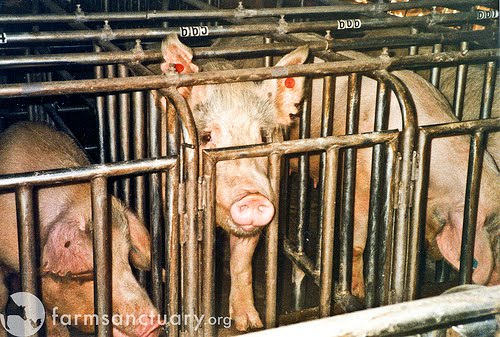
... this terrific news report about factory farm egg production. I have the greatest admiration for people who go undercover like this. So much for Sparboe eggs--no longer bought by McDonalds or sold at Target.


9/2/11
Veganish or Vegetarian?
 |
| my favorite cookbook - full of fantastic vegan and vegetarian recipes |
If someone smokes a pack of cigarettes a day, they’re clearly a smoker; but if, once or twice a year, they get drunk at a party and smoke a cigar, then they’re a non-smoker who smokes every once in a while. We propose a similar way of thinking for veganism: if 95%’ish of the time you’re vegan, you’re vegan or veganish.
Do you see Catholics kicking members out for using birth control? Do you see Mormons 86’ing members who drink beer or coffee? How about public shaming of Jews who don’t eat kosher? And, these are effin religions! Hell, veganism isn’t even supposed to be a religion but we set far stricter criteria and far higher standards to live by. And we don’t offer an after-life, heaven, or any other nifty parting goods for participating.
And, by the way, what is the real difference between someone who eats 100% vegan vs someone whose dietary intake is 95% vegan? Does the difference really mean less animal suffering? Depends, but if the difference is just lots of misc ingredients in various meals during a given year, that is probably not the case.
In a world that is so crazy, so cruel, and so barbaric, why is it that so many vegans are hardest on fellow vegans who don’t meet the mythical standards of strict vegan?Good quesion!
But now, what about vegetarians? I nearly jumped when I saw this post--"Let's kill Vegetarian! Why Vegetarianism must go and VeganISH should ascend"? Phew, no, it doesn't say "Let's kill VegetarianS"! But Joe Haptas has a problem with vegetarianism ... as they say.
His main point is that vegetarianism is not a coherent ethical stance. In some cultural settings (rural India?) it might make sense to think "meat bad, milk-and-eggs not bad." After all, meat inevitably involves killing, and milk/eggs could be obtained with no killing and no cruelty. However in developed countries, that's not how things work. There's massive cruelty behind meat, but also behind dairy products and eggs. So vegetarianism couldn't possibly make sense as an ethical stance. If you can't be a perfect vegan (and few can), at least be veganISH, not vegetarian, he says.
But hold on. Yes, these points about eggs and dairy are important, yes, many omnivores don't know them. The uneducated omnivore might imagine eggs and dairy are innocent, so vegetarians have done all that is morally important, by giving up meat. This is a mind-set I do encounter frequently when I teach my course on animal rights. But people who actually take the step to become vegetarian have typically done a lot of research first and the facts about eggs and dairy are widely available. Vegetarians know that eggs and dairy aren't innocent. They consume eggs and dairy because (basically) vegetarianism is their way of being vegan(very)ish.
There are other ways, of course. You can just be a randomly erring vegan, lapsing at parties, or on special occasions, or by not reading labels, or when the spirit moves you, but there's something to be said for being a consistent vegetarian, not a frequently lapsing vegan. Vegetarianism is not (usually) driven by a mistake (the mistake of thinking eggs and milk don't matter), but partly by animal impact facts, and party by psychological considerations.
Vegetarianism is OK! Reason #1 - Animal impact
Here's what I wrote about this a while back--
If you eat chicken all year, the cost in chicken lives is 25-50. All those chickens will have endured what chickens go through to wind up on our plates--which is a lot if they were ordinary factory farmed chickens, though less, if they weren't. If you eat cage-free eggs all year, roughly one laying hen went through those same things, plus one male chick was killed (since the males have no economic value). That makes it a very rational choice to give up chicken first, before eggs.Now, there are other two-way decisions where things will come out differently. What if it's a choice between eggs and beef? If 10 people collectively decide between a year of egg-eating and a year of beef-eating, they will certainly kill less and cause less suffering if they eat beef. 20 chickens will die for the eggs, and maybe just one steer for the beef. Plus, the steer will have a more enjoyable year. So an eggless beef-eater would be in finer moral fettle than a beefless egg-eater.
If you think through the costs to animals and the environment of beef vs. milk, you will come to the same conclusion. Ideally, we should give up both. If you're not up to that, then your first priority should be giving up beef.
What if it's a choice between an omnivorous diet including a little meat, eggs, and dairy, and a vegetarian diet that's non-stop eggs and dairy? Again, the vegetarian diet isn't morally superior.
To ward off these arguments about egg-free beef eaters and eggs/dairy-crazy vegetarians, we've got to be a little more precise (is this getting excruciating?). A vegetarian diet of the sort real vegetarians typically eat--low in eggs and dairy (and with humane options chosen when possible)--is less harmful to animals than the standard omnivorous diet. There. That's the claim, and I think it's true.
Vegetarianism is OK! Reason #2 - Motivation and Sustainability
If you're going to adopt a challenging diet, psychology matters. An imperfect diet that you can maintain for decades or even a lifetime does more good than a perfect diet that you maintain just for a year. Vegetarianism is, I think, more sustainable than veganism or even veganishism, at least for many people. That, not ignorance about the impact of eggs and dairy, is presumably why there are far more vegetarians than vegans.
First, meat is actually easier to give up, and keep giving up, than eggs and milk. Meat inherently and obviously involves killing. You can see that, so finding meat repellent comes easily. That's motivating. Second, eggs and milk are everywhere, so abstaining from them requires a global change of diet. It's a much harder thing to do, on a long-term basis.
The -ish in being veganish might make the diet less sustainable than a vegetarian diet, depending on what sort of -ish is involved. Suppose you reject the distinction between meat and eggs/dairy. So you're anti-vegetarian about your -ish. Your lapses include occasionally eating a hamburger or pepperoni on your pizza, or whatever you fancy. One lapse might lead to another, because you've reminded your taste buds of these possibilities.
It's also self-reinforcing to have a set of rules and take pride in being able to follow them consistently. The lapsing vegan may ultimately get tired of feeling so fallen.
**
I think Carpe Vegan has a very helpful message for vegans. The main message is about tolerance and inclusivity--about not giving up just because you're "only" veganish. I can even accept that vegetarians are the ugly stepsisters of vegans, veganish or otherwise. But we're not naive, not unprincipled, and not not-helping. We're drawing a line in a place where it actually makes sense to draw it--both in terms of animal impact and human psychology. Vegetarians are imperfect, certainly, but have good reasons for their particular way of being imperfect.

p.s. I just had a look at the contributors list at Carpe Vegan and found Rhys Southan's name on it. Well that's interesting! Rhys is also my favorite bad ex-vegan. His blog (Let Them Eat Meat ... no, no, wrong conclusion!) is constantly smart and frequently hilarious.
3/5/11
The Till-Kill Argument

Yesterday my animal rights class discussed the "Till-Kill Argument"--an argument due to animal scientist Steven Davis (made famous when Michael Pollan appealed to it in this NYT article). The argument is that if we want to do the least harm to animals, we're better off with a "veg & beef" diet than a vegan diet. Here's his math:

2/19/11
The Greenest Possible World
A couple of nights ago I gave a presentation on the environmental impact of meat for SMU's vegetarian club. Here's the slide show--comprehensible without my voice-over, I think.
The slide show makes an argument--that the future will bring either vastly more factory farming or more plant eating. It cannot bring more traditional farming, with animals grazing under the wide blue sky. Why not? Because 30% of the earth's non-ice land surface is already covered in livestock (26%) and feedcrops (4%). Lovers of wildlife should be extremely concerned. "Mild" animals--billions of grazing cows and sheep--are literally crowding wild animals out of existence. They are also contributing to climate change and depleting valuable resources.
There are lots of cool graphs, charts, and maps in the slideshow, many from the UN report Livestock's Long Shadow--a really fabulous resource.
I think it's quite clear we should eat more plants, but here's what's less clear to me. From a green point of view, how far (ideally) would we roll back animal farming? Would we ideally reduce the 30% to 25%...to 20%...to 15%...or to what? Some animal pastures can be converted to plant farming, with much higher nutritional yields. Plant farming is much more efficient. But some pastures cannot, so that eliminating animal farming on that land means expanding plant agriculture elsewhere. I suspect the greenest possible world feeding 9 billion people (in 2050) couldn't be a purely vegan world.
On the other hand, the greenest possible world will also not be one in which the whole world consumes animal protein at the rate that affluent countries do today. Consumption of animal products has to decline, if 9 billion people are going to be fed in 2050, with any land left for other species. From a strictly environmental standpoint, the moral rule to promote is "eat more plants." It's all to the good for some to eat none, to compensate for others who over-consume. But in the greenest and most egalitarian of all possible worlds (that involve 9 billion people living on this planet), I think everyone will eat a little meat.
That's a surprising conclusion to reach, I think. It's not ethically unproblematic to take the life of any animal, whether or not they have robust rights just like ours. So it's odd to admit that it's got to be done. Perhaps the best diagnosis is this: there are so many humans that our options are tragically narrowed. We simply cannot all survive and also grant animals the full moral status they are entitled to. Going into a future with too many people and not enough land, we cannot completely stop using them as food.
On the other hand, we also can't use animals as food to the degree that we do now. The average American's animal consumption is the highest in the world--250 pounds of meat per year! Consumption of animal products is going to have to decrease, but perhaps not to zero.
Sound right? Look at the charts, maps, and graphs in the slide show, and let me know what you think.
**
"The Emperor's Gnu Clothes" (from January 25) has recently been much discussed (Stangroom, Blackford, Coyne, Schoen, Rosenau). That's for your reading pleasure. I think I've run out of things to say on the topic.
The slide show makes an argument--that the future will bring either vastly more factory farming or more plant eating. It cannot bring more traditional farming, with animals grazing under the wide blue sky. Why not? Because 30% of the earth's non-ice land surface is already covered in livestock (26%) and feedcrops (4%). Lovers of wildlife should be extremely concerned. "Mild" animals--billions of grazing cows and sheep--are literally crowding wild animals out of existence. They are also contributing to climate change and depleting valuable resources.
There are lots of cool graphs, charts, and maps in the slideshow, many from the UN report Livestock's Long Shadow--a really fabulous resource.
I think it's quite clear we should eat more plants, but here's what's less clear to me. From a green point of view, how far (ideally) would we roll back animal farming? Would we ideally reduce the 30% to 25%...to 20%...to 15%...or to what? Some animal pastures can be converted to plant farming, with much higher nutritional yields. Plant farming is much more efficient. But some pastures cannot, so that eliminating animal farming on that land means expanding plant agriculture elsewhere. I suspect the greenest possible world feeding 9 billion people (in 2050) couldn't be a purely vegan world.
On the other hand, the greenest possible world will also not be one in which the whole world consumes animal protein at the rate that affluent countries do today. Consumption of animal products has to decline, if 9 billion people are going to be fed in 2050, with any land left for other species. From a strictly environmental standpoint, the moral rule to promote is "eat more plants." It's all to the good for some to eat none, to compensate for others who over-consume. But in the greenest and most egalitarian of all possible worlds (that involve 9 billion people living on this planet), I think everyone will eat a little meat.
That's a surprising conclusion to reach, I think. It's not ethically unproblematic to take the life of any animal, whether or not they have robust rights just like ours. So it's odd to admit that it's got to be done. Perhaps the best diagnosis is this: there are so many humans that our options are tragically narrowed. We simply cannot all survive and also grant animals the full moral status they are entitled to. Going into a future with too many people and not enough land, we cannot completely stop using them as food.
On the other hand, we also can't use animals as food to the degree that we do now. The average American's animal consumption is the highest in the world--250 pounds of meat per year! Consumption of animal products is going to have to decrease, but perhaps not to zero.
Sound right? Look at the charts, maps, and graphs in the slide show, and let me know what you think.
**
"The Emperor's Gnu Clothes" (from January 25) has recently been much discussed (Stangroom, Blackford, Coyne, Schoen, Rosenau). That's for your reading pleasure. I think I've run out of things to say on the topic.
9/28/10
"Brave New Animal" Links
Thanks, Texas State-ers, for a great discussion yesterday. Here are the links I promised you--
(1) Eating Animals
Humane Society Videos
(see "Beef Recall")
Lots of links (at my class blog)
reading suggestions too--see right column
(2) Altering ourselves
Meet the vegetarians
Schwitzgebel--do ethicists eat less meat? More here. Also this, on Bloggingheads. The graph I showed, based on his preliminary data (click to enlarge)--

(3) Altering treatment
(4) Altering animals
Livestock biotech summit (starts today!)
Goat silk
Burpless cattle
Pain-free livestock (Adam Shriver's article)
The nature of pain (Donald Price)
Milk without killing? Article in NYT is here.
Lab meat
(1) Eating Animals
Humane Society Videos
(see "Beef Recall")
Lots of links (at my class blog)
reading suggestions too--see right column
(2) Altering ourselves
Meet the vegetarians
Schwitzgebel--do ethicists eat less meat? More here. Also this, on Bloggingheads. The graph I showed, based on his preliminary data (click to enlarge)--

(3) Altering treatment

(4) Altering animals
Livestock biotech summit (starts today!)
Goat silk
Burpless cattle
Pain-free livestock (Adam Shriver's article)
The nature of pain (Donald Price)
Milk without killing? Article in NYT is here.
Lab meat
8/24/10
Brave New Animal
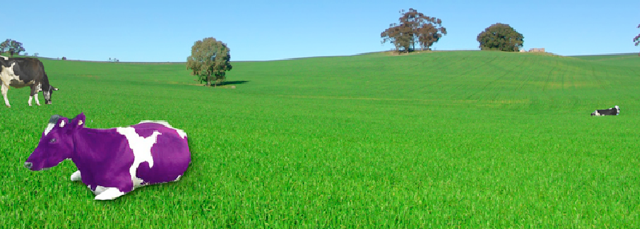
- Meat without killing: vat meat, as discussed here. Also may help feed over-populated word, as this article suggests.
- Genetically engineering cattle that have kangaroo digestive systems, to reduce carbon emissions produced by their belching--see here.
- Genetically engineering pain-free livestock--as discussed by Adam Shriver here.
- Producing all-female dairies using semen-sorting--see here.
7/29/10
Could Eating Animals Be Just Slightly Wrong?
Thinking about yesterday's post, a question occurs to me. Eric Schwitzgebel says he considers eating animals to be "just slightly wrong"--like not answering the emails of undergraduates. The more I think about it, the more I find that an odd notion. I can see how causing suffering and death to animals could be considered not bad at all, and I can see how it could be considered less bad than doing the same thing to people (I actually argue for that in my book), but how could it really be "just slightly wrong"? What way of thinking about the suffering and death of animals could allow you to make that tepid assessment? Suddenly I'm puzzled. Anybody have any ideas?
7/28/10
I Shouldn't but I Will

Regular readers may recall that in 2009 Josh Rust and I surveyed several hundred philosophers and non-philosophers on their opinions about various moral issues; we also asked survey respondents to describe their own behavior on those same issues. Some preliminary results of the study are here, here, here, here, here, and here.Many interesting things. The majority of ethics professors disapprove of eating mammals. Second, a whopping 81% of female philosophers born in 1960 or later (the under 50 FPs) disapprove. Wow! But equally surprising, "conscience and behavior go separate ways." The under 50 FPs eat mammals as much as anyone else in the survey.
The biggest divergences in moral opinion concerned our question about "regularly eating the meat of mammals such as beef and pork". 60% of ethics professor respondents rated mammal-meat consumption as morally bad, compared to 45% of non-ethicist philosophers and just 19% of non-philosophers. Opinion also divided by gender and age. Women were about 1.5 times as likely to condemn mammal-meat consumption (55% of women rated it bad vs. 37% of men). There was a similar shift of opinion with age: 55% of respondents born in 1960 or later condemned mammal-meat consumption, compared to 35% born before 1960. One might expect a compound effect for young female philosophers, and indeed it was so: Fully 81% of female philosophers born in 1960 or later said it was morally bad to regularly eat the meat of mammals.....
People often do things they think are a little morally bad. For example, I think eating meat is slightly morally bad (on par with driving a gas-guzzling car or being somewhat neglectful of emails from undergraduates), and yet for lunch today I had a salami sandwich. Apparently, a substantial proportion of young female philosophers think and act as I do: 38% of them reported having eaten the meat of a mammal at their previous evening meal -- a rate not statistically different from the 39% reported rate among respondents overall. (Caveat: The total number of female philosopher repondents born 1960 or later was small -- twenty-six -- so the exact percentage should be interpreted cautiously.) Similarly, despite the difference in normative view, there was no statistically detectable difference in the mean age of respondents who said they had eaten the meat of a mammal at their previous evening's meal: mean birth year 1954.3 for those who said they had vs. 1955.1 for those who said they hadn't.
Our survey doesn't call into doubt the relationship between normative ethical view about meat-eating and strict vegetarianism: 78% of those who reported that they never eat mammal meat said eating mammal meat is bad, compared to 32% of those who reported sometimes eating meat. However, it seems that among non-vegetarians there is little if any relationship between normative ethical view and actual meat consumption: If you don't think eating meat is bad enough to warrant strict vegetarianism, but you still think it's somewhat bad, you're just as likely as anyone else, it seems, to have a salami sandwich for lunch. Conscience and behavior go separate ways.
I wonder if Schwitzebel is jumping to conclusions when he tries to explain why the under 50 FPs eat about as much meat as anyone else in the survey. He surmises that it's because, like him, they think eating meat is just "slightly morally bad" (on a par with ignoring emails from undergraduates). He doesn't seem to have statistics that tease out who sees eating mammals as "slightly morally bad," or "seriously morally bad," or "bad enough to warrant strict vegetarianism." The statistics he presents don't seem to rule it out that some or many of the under 50 FPs who do eat meat, nevertheless see it as more than slightly morally bad.
Here's the possibility I think we should take seriously. There are many people (the under 50 FPs and others) who do believe eating mammals is seriously bad, yet have a very difficult time giving it up. I have encountered a lot of people like that in my Animal Rights class. There's further confirmation in a study that shows that 42% of animal activists are not vegetarians. These people very likely think that eating mammals is more (or even much more) than slightly morally bad.
If many people eat mammals but think it's seriously bad, what's going on? Well, mammals taste good. But I suspect there's a bit more to it. Experimental evidence needed!
Footnote. In case anyone's worried about this, presumably Schwitzgebel is using eating mammals as merely a test case whereby to explore relationships between moral beliefs and behavior. He doesn't really mean to suggest that anyone's a strict vegetarian simply because they don't eat mammals.
7/19/10
Foie Gras or Cat Food?

7/7/10
Vegan Purity
Let's talk about the "Chronicle" article (without the adjunctivitis). Here's the passage that I think will draw fire from vegans--
On the other hand, is this line of thinking entirely worthless? I don't actually think so. Even drawing the line where advocates of veganism really do, there really is a question what sort of a life a human being can have, while fastidiously avoiding every last infringement on sentient life. There is something to the idea that these ethicists want us to reduce our ecological footprints until we're on our toes...or not fully living. I think that's a reason to avoid purism, but not a reason to abandon the whole attempt to treat animals morally. Fromm seems to agree:
Life is everywhere. I squash millions of micro-organisms with each step and wash down the drain unnoticed multitudes with each shower. Brushing my teeth kills innumerable bacteria (it's them or my gums!). With every swallow, I destroy some of the bacteria in my gut that keep me alive by helping to digest my food. But even larger creatures like cockroaches and rats, do they enter into the purview of animal-rights activists? And the HIV virus, the swine flu, tuberculosis? Do I want to eschew antibiotics and vaccines that help my life out of respect for theirs?Obviously, Fromm has not read his Regan and Francione. These people draw the line in a way that easily allows us to brush our teeth. The crucial characteristic for them is being a subject-of-life or (simpler still) sentience (Francione), not mere animalhood. So Fromm's reductio ad absurdum is premised on a misunderstanding.
The grandstanding of vegans for carefully selected life forms, to serve their own sensitivities—through their meat- and dairy-free diets, their avoidance of leather and other animal products—doesn't produce much besides a sense of their own virtue. As they make their footprint smaller and smaller, will they soon be walking on their toes like ballet dancers? And if so, what is the step after that? Pure spirit (a euphemism for bodily death)? If our existence is the problem—which it is—then only nonexistence can cure it. The supreme biocentric act is not to discover yet one more animal product to abstain from. The supreme biocentric act is dying, returning the finite matter and energy you have appropriated for yourself and giving them back to the creatures you stole them from. And what makes them so pure? Are they shedding tears as they tear you and each other apart? The real "crime" is existence, not being or using animals.
On the other hand, is this line of thinking entirely worthless? I don't actually think so. Even drawing the line where advocates of veganism really do, there really is a question what sort of a life a human being can have, while fastidiously avoiding every last infringement on sentient life. There is something to the idea that these ethicists want us to reduce our ecological footprints until we're on our toes...or not fully living. I think that's a reason to avoid purism, but not a reason to abandon the whole attempt to treat animals morally. Fromm seems to agree:
I think vegetarianism is admirable. I would recommend it. Unlike vegans, who are enlisted in an open-ended but futile metaphysic of virtue and self-blamelessness that pretends to escape from the conditions of life itself, vegetarians have more limited goals and have marked out a manageable territory with fewer cosmic pretensions. They are concerned about their health. Or they don't want animals to be raised expressly to be tortured and killed—especially in factory farms and slaughterhouses—for their dinner plates. Or they don't want to ingest the dead bodies of fairly complex creatures, which is apt to make them feel queasy. No doubt they would prefer all animals (whatever that might include) to be treated humanely, but they are not prepared to stop wearing leather shoes or eating Jell-O. At least vegetarianism—though it can't resolve the moral dilemma of the savagery of our lives—is more or less possible in both theory and practice.What he's rejecting is perfectionism about doing right by animals, not everything. I give him high marks for his conclusions, low marks for misrepresentations he made along the way.
6/30/10
"Pescatarian"

As for the hypocrisy: not so fast. When I first stopped eating meat 17 years ago, it was entirely because I didn't want to support factory farming. (I could have opted for a humane-only diet, but that seemed non-viable. If I maintained my appetite for meat, I wasn't going to be able to limit myself to humane meat.) Killing was not the issue. Fish, I figured, have normal lives, not the bizarrely limited lives of factory-farmed cows, pigs and chickens. So there is a moral difference between eating fish and eating meat.
Since I made the decision not to eat meat, my thinking has changed somewhat, and so has the world. My reason for not eating meat is still first and most confidently my disapproval of factory farming. But now I'm also more worried about the killing itself. That means I have to be more concerned about eating fish. I've also become more concerned about the enormous problem of over-fishing and the way modern fishing methods damage the environment. Furthermore, since I stopped eating meat, more and more of the fish in the store is farmed fish, and those animals don't actually have normal lives at all.
Despite all of that, I still think eating fish can be morally better than eating land animals--especially if you take care about which fish you eat (wild, plentiful species like Alaskan salmon are OK; bluefin tuna is not OK). But it's not perfectly OK. So why do I continue?
Well, I don't exactly--I don't continue just as before. We've stopped buying fish for home consumption. I still eat fish when there's something to be gained beyond simple taste--when that makes it easier to eat out, eat with friends and family, sample a local cuisine while traveling, enjoy "sea life" in places like Hawaii. Those are morally good goals, but so is protecting animal life.
So: it's a conflict. But I'm not going to call myself a "pescatarian" or plead guilty to simple hypocrisy. It's more complex than that.
5/26/10
From Humane to More Humane?

I'd sure like all this to be true, but is it? Is there a trajectory from more humane, to even more, to really humane? Technologically, it's possible (see "Milk without Killing," here) to have a mostly female herd of cows or flock of birds, but there's also economics and human preferences to consider. Can I really tell myself that buying free range eggs and relatively humane milk constitute a push in the direction of a vegetarian utopia?
5/24/10
Veganism vs. Vegetarianism: An Interview with Tzachi Zamir
Veganism vs. vegetarianism is a frequent topic on this blog. For the most part, I frame the issue this way: if veganism is ethically better, is it nevertheless still excusable just to be a vegetarian? I love to discover a whole new way of thinking about things, so I was excited to read Tzachi Zamir’s article Veganism recently (thank you, Taylor). Zamir rejects the idea of vegetarians as low-achievers, and argues for the counterintuitive position that vegetarianism is actually the ethically preferable diet. I discussed the main ideas in the article here, but had lots of questions about details. So here we go, this blog’s first interview.
Tzachi Zamir is chair of the English Department at Hebrew University in Jerusalem and author of Ethics and the Beast: A Speciesist Defense of Animal Liberation and Double Vision: Moral Philosophy and Shakespearean Drama, both from Princeton University Press.
My earlier post stuck to the main lines of your argument, which I’ll get to, but one of the things I really like about the article (which became chapter 6 of your book Ethics and the Beast), is the detailed discussion of very concrete questions in veterinary ethics. (In the book’s introduction you say your wife is a veterinarian.) I wanted to ask you about some of those issues.
I was intrigued by your suggestion that invasive procedures should be judged based on whether they (a) benefit the animal or (b) enable the owner-pet relationship (without altering “what the animal is”). An example of the latter you give is declawing a cat when an owner is on the verge of giving up the cat to save his sofa. Declawing isn’t so profound a change as to alter what the animal is, so in those dire cases, you think it’s OK. You say “muting a dog” couldn’t be defended in the same way. Can you explain?
 Before I respond to your question, I need to contextualize my answer in relation to the larger stakes in this particular discussion. Small animal veterinary medicine presupposes a paternal framework that is surely questionable. Anti-pet arguments issued from the standpoint of animal-welfare would oppose the very framing of a human-animal relationship in such terms, and would object to any acts that rely upon such paternalism. Keeping pets would accordingly be morally rejected. For reasons presented in my paper (and book), such a conceptually pure position isn't beneficial to pets or to humans. Responsible and loving pet-keeping can exemplify a form of non-exploitative relationship between humans and animals. You did not ask about this prior move, so I shall not expound on it.
We are accordingly assuming that some forms of paternalism in relation to pets is morally permissible, meaning that it's legitimate for us to act in ways that they themselves would not pursue and even resist (vaccinating them is an example of such an act). In terms of veterinary ethics, the morally easy cases are the ones that either straightforwardly benefit the animal, even if the animal does not experience them as desirable (say, operating on a dog hit by a car), or actions that irresponsible owners ask to be performed, but are obviously detrimental to the animal (an owner asking to euthanize recently born puppies of his un-spayed dog). Veterinarians should find both such cases easy to deal with, complying with the former and not with the latter.
The morally problematic cases fall in the middle. These are cases in which a) the animal does not benefit from the procedure, b) the animal is either discomforted, maimed, or loses permanently one of its capacities c) the owner insists on having the procedure.
Such procedures fall into two groups. First we have procedures that involve short-term pain, and from which the animal recuperates (tail-docking, ear trimming, declawing-- actions for which circumcision is a reasonable human analogue). The second group involves procedures that permanently eliminate one of the animal's capacities (wing-trimming, spaying, neutering, removal of vocal chords). The distinction between these kinds of actions does not map onto what may or may not be done to an animal. Some of the requests for short-term painful actions are immoral. Cosmetic operations (tail docking, ear trimming), are not to be performed, because by cooperating with such requests, the veterinarian is not just acting in a non-beneficial way to the specific animal, but is actually supporting a practice (cosmetic modification) that should be abolished. On the other hand, spaying and neutering (for reasons elaborated below, should be performed). A person asking to remove the vocal chords of a dog is permanently destroying that animal's capacity to communicate. Such acts should not be done. Obviously, we can only speculate how the loss of this capacity is experienced by the dog, but my own sense is that maiming an animal in this way should never be performed, and that such owners should be discouraged from taking in animals in the first place.
Yet I also realize that such remarks are the privileges of a philosopher, who can simply prescribe what is right and what is wrong. Life is harder for the conscientious veterinarian, who isn't operating in a perfect world, and confronts tacit ultimatums, in which a problematic procedure is either performed, or the animals is abandoned and is likely to die. It is in this context that the suggestion above regarding declawing was made. People who care that much about their sofas should be discouraged from taking in cats. Sometimes responsible owners ask for this procedure, because recently born toddlers risk themselves when playing with the older house cat. Declawing is a painful procedure (the nail is removed including the topmost digit from which it issues), requiring a recovery period of several days. Yet unlike the loss of a voice or procreative capacities (which I will discuss below), I do not see an indication for a substantial loss in terms of the animal's own experience. Once the alternative for the cat is to be abandoned, it is overall better for the cat to be declawed. Here, then, is one of those uncomfortable points in which the anti-pet purist has an easier time: no pets means no spaying, neutering, declawing (outlawed in some places), and no seemingly self-serving attempts to justify such acts.
You say that (b) type reasoning is “foreign to human-human morality,” but the day I read your article, a friend of mine said she’d started medicating her daughter for ADHD because “we couldn’t take it any more” (there weren’t school issues, as far as I know). Not that she was going to give the girl up, of course, but the relationship was suffering. Does that seem beyond the pale to you, or justifiable in the same way as declawing
As you say, there was no question of turning out her daughter. The disanalogy between this example and my point relating to procedures that preserve the relationship as such, is that unlike pediatricians, veterinarians are constantly aware that owners may abandon their animals and that it is accordingly often beneficial for these animals to be subjected to otherwise objectionable procedures. This, I tried to say, should not serve as a carte blanche that is meant to sanction any cruelty. The veterinarian is morally required to factor in the kind of damage done, its duration, and its long-term modification of the animal's experience as far as we are able to imagine it (the strength of Nagel's skepticism and the fear of anthropomorphic projection are overrated). Like any issue in practical ethics, the veterinarian is also urged to consider alternatives and to suggest them to the owner, including finding another home for the animal.
Tzachi Zamir is chair of the English Department at Hebrew University in Jerusalem and author of Ethics and the Beast: A Speciesist Defense of Animal Liberation and Double Vision: Moral Philosophy and Shakespearean Drama, both from Princeton University Press.
My earlier post stuck to the main lines of your argument, which I’ll get to, but one of the things I really like about the article (which became chapter 6 of your book Ethics and the Beast), is the detailed discussion of very concrete questions in veterinary ethics. (In the book’s introduction you say your wife is a veterinarian.) I wanted to ask you about some of those issues.
I was intrigued by your suggestion that invasive procedures should be judged based on whether they (a) benefit the animal or (b) enable the owner-pet relationship (without altering “what the animal is”). An example of the latter you give is declawing a cat when an owner is on the verge of giving up the cat to save his sofa. Declawing isn’t so profound a change as to alter what the animal is, so in those dire cases, you think it’s OK. You say “muting a dog” couldn’t be defended in the same way. Can you explain?
 Before I respond to your question, I need to contextualize my answer in relation to the larger stakes in this particular discussion. Small animal veterinary medicine presupposes a paternal framework that is surely questionable. Anti-pet arguments issued from the standpoint of animal-welfare would oppose the very framing of a human-animal relationship in such terms, and would object to any acts that rely upon such paternalism. Keeping pets would accordingly be morally rejected. For reasons presented in my paper (and book), such a conceptually pure position isn't beneficial to pets or to humans. Responsible and loving pet-keeping can exemplify a form of non-exploitative relationship between humans and animals. You did not ask about this prior move, so I shall not expound on it.
 We are accordingly assuming that some forms of paternalism in relation to pets is morally permissible, meaning that it's legitimate for us to act in ways that they themselves would not pursue and even resist (vaccinating them is an example of such an act). In terms of veterinary ethics, the morally easy cases are the ones that either straightforwardly benefit the animal, even if the animal does not experience them as desirable (say, operating on a dog hit by a car), or actions that irresponsible owners ask to be performed, but are obviously detrimental to the animal (an owner asking to euthanize recently born puppies of his un-spayed dog). Veterinarians should find both such cases easy to deal with, complying with the former and not with the latter.
The morally problematic cases fall in the middle. These are cases in which a) the animal does not benefit from the procedure, b) the animal is either discomforted, maimed, or loses permanently one of its capacities c) the owner insists on having the procedure.
Such procedures fall into two groups. First we have procedures that involve short-term pain, and from which the animal recuperates (tail-docking, ear trimming, declawing-- actions for which circumcision is a reasonable human analogue). The second group involves procedures that permanently eliminate one of the animal's capacities (wing-trimming, spaying, neutering, removal of vocal chords). The distinction between these kinds of actions does not map onto what may or may not be done to an animal. Some of the requests for short-term painful actions are immoral. Cosmetic operations (tail docking, ear trimming), are not to be performed, because by cooperating with such requests, the veterinarian is not just acting in a non-beneficial way to the specific animal, but is actually supporting a practice (cosmetic modification) that should be abolished. On the other hand, spaying and neutering (for reasons elaborated below, should be performed). A person asking to remove the vocal chords of a dog is permanently destroying that animal's capacity to communicate. Such acts should not be done. Obviously, we can only speculate how the loss of this capacity is experienced by the dog, but my own sense is that maiming an animal in this way should never be performed, and that such owners should be discouraged from taking in animals in the first place.
Yet I also realize that such remarks are the privileges of a philosopher, who can simply prescribe what is right and what is wrong. Life is harder for the conscientious veterinarian, who isn't operating in a perfect world, and confronts tacit ultimatums, in which a problematic procedure is either performed, or the animals is abandoned and is likely to die. It is in this context that the suggestion above regarding declawing was made. People who care that much about their sofas should be discouraged from taking in cats. Sometimes responsible owners ask for this procedure, because recently born toddlers risk themselves when playing with the older house cat. Declawing is a painful procedure (the nail is removed including the topmost digit from which it issues), requiring a recovery period of several days. Yet unlike the loss of a voice or procreative capacities (which I will discuss below), I do not see an indication for a substantial loss in terms of the animal's own experience. Once the alternative for the cat is to be abandoned, it is overall better for the cat to be declawed. Here, then, is one of those uncomfortable points in which the anti-pet purist has an easier time: no pets means no spaying, neutering, declawing (outlawed in some places), and no seemingly self-serving attempts to justify such acts.
You say that (b) type reasoning is “foreign to human-human morality,” but the day I read your article, a friend of mine said she’d started medicating her daughter for ADHD because “we couldn’t take it any more” (there weren’t school issues, as far as I know). Not that she was going to give the girl up, of course, but the relationship was suffering. Does that seem beyond the pale to you, or justifiable in the same way as declawing
As you say, there was no question of turning out her daughter. The disanalogy between this example and my point relating to procedures that preserve the relationship as such, is that unlike pediatricians, veterinarians are constantly aware that owners may abandon their animals and that it is accordingly often beneficial for these animals to be subjected to otherwise objectionable procedures. This, I tried to say, should not serve as a carte blanche that is meant to sanction any cruelty. The veterinarian is morally required to factor in the kind of damage done, its duration, and its long-term modification of the animal's experience as far as we are able to imagine it (the strength of Nagel's skepticism and the fear of anthropomorphic projection are overrated). Like any issue in practical ethics, the veterinarian is also urged to consider alternatives and to suggest them to the owner, including finding another home for the animal.

Let’s talk about spaying and neutering. You say that “no evidence suggests that the pet conceives of its postoperative state as a loss.” Perhaps you’re familiar with Tolstoy’s story “Strider, the Story of a Horse,” and/or Paul Auster’s novel Timbuktu. In Tolstoy’s story, a male horse loses “zest” after sterilization, and in the novel, a male dog is similarly “diminished”. They don’t cognitively reflect upon their state, but they feel the difference. Physiologically, it seems plausible that diminished testosterone makes an animal feel quite different. In fact, neutering may even “change what an animal is.” No?
Spaying and neutering certainly change what an animal is. From an entity that can procreate and fulfill its sexual and biological instincts, it turns into something else. This is another point at which the anti-pet position comes out consistent and strong, whereas pet owners seem to be rationalizing. In fact, most of what you will morally accept regarding pets is likely to follow from the position you take on the question of spaying and neutering. Clearly, without such procedures, pet-keeping will become impossible. Those who imagine that they can keep fertile cats and dogs should understand that non-paternal ownership of such animals requires not merely avoiding the procedures that take away these capacities, but enabling the animals to actually act on their instincts. The implication is that one will be yearly responsible for a litter of cats or puppies as well as their welfare. Such cannot be practiced on a large scale, and it is doubtful whether it can be responsibly conducted on a very small scale.
Pet-owner relationships require that the animals will be unable to exercise these instincts. In "return" (though, again, this is not really a system of exchange since they are not asked), pets "receive" longer lives, are cared for when they are sick, enjoy better diets and are often dearly loved and seem to respond deeply to the humans that care for them. They pay a substantial price to enter this relationship with humans. Yet given the beneficial outcome, I do not think that the relationship is exploitative.
It is perfectly consistent to claim that given such loss, the pet-owner relationship is exploitative and should not be supported. Yet if that's so, millions of cats and dogs as well as millions of meaningful relationships with these animals would not exist. As for the difference between this action and the removal of vocal chords, the latter involves losing a capacity that the owner ought to accept in the animal he is taking up. Dogs bark, and if you are fiercely discomforted by this, don't take one in. To put this differently, having a relationship with a dog, means that one will often be discomforted by its barking. The same cannot be said in relation to the dog's procreative capacities. The owner will not simply be inconvenienced by these, but will have to be morally responsible for their consequences. Breeders happily do this (though again, where and when these animals are permitted to procreate is highly controlled even then). Most pet owners, however, cannot.
This is one point at which a broader dimension of animal ethics should be mentioned. You notice that my argument above is inconclusive, hesitant, and is not meant to refute the anti-pet position. I am basically setting out the moral stakes, the long-term consequences of some actions, and stating a moral preference in relation to these. Most philosophers dislike such murky moves, which is why most writings in animal ethics prudently avoids commenting on the precise pro-animal alternative being envisaged. For me, that's too easy a choice (prudent, but unwise), one that should be expected in the first wave of a revolution, but cannot be sustained in the long run. I realize that my arguments will not generate universal consent (and not because no philosopher managed to attain that). My hope is to see an actual considered specification of the liberationist ideal (whether vegan or vegetarian) in the best writings on this issue, rather than repeating the easier move of attacking speciesism. Does liberationism entail a petless world? I think it should not, but I wish the question would be raised and discussed in these terms.
Alright, let’s cut to the chase! Here’s how I’d summarize your defense of vegetarianism as ethically best. Step 1: It would be good for chickens and cows to exist in a relationship with humans that granted them life and us eggs and milk, so long as they were not prematurely killed or subjected to harmful procedures (apart from ones that enable the relationship and don’t alter what they are). This “vegetarian uptopia” would be better than a “vegan utopia” with no chickens and cows at all. Step 2: We ought to support today’s very flawed humane egg and dairy farming because it’s a step toward that vegetarian utopia, whereas abstaining from eggs and dairy is a step toward the inferior vegan utopia. Is that a fair summary?
Yes, though I spend a lot of time on how guarded we should be regarding "ought to support" in 2.
The points I made about Step 1 in my earlier post are dealt with in your book. On the whole, I really find that step quite convincing. So let’s focus on step 2. I do buy cage-free or free-range eggs, which are mass produced by a local operation. In principle, I can see how the success of this company could spur a competitor to produce even more humane eggs, creating a trajectory in the direction of a wholly ethical chicken farm. The thing is, at some point that becomes commercially non-viable. Right now, I pay 2-3 times as much to buy humane eggs, but I won’t spend 10 times as much. So how can I really justify my egg consumption using your reasoning?
 Money brings up several complex issues, since the mere fact that the progressive products cost more, creates a morally precarious association between the well-off and the just. That issue aside, the moral obligation is to support an emerging industry that professes to commit itself to higher moral standards, rather than to economic expediency alone. Such support remains effective even if some of these breeders are cynically using pro-animal sentiments to acquire a commercial edge for themselves. What matters is that breeders believe that there is a substantial market for "progressive" products. The mechanisms that will eventually verify that breeders live up to what they promise will develop because of economic forces (consumers don't like to be fooled).
How much more should you pay for such products? For me, any intervention in animal-ethics today, is part of a long-term process, and should be contextualized within a longer movement, in which minor changes for the better today, will be replaced by better solutions later (feminism and the abolition of slavery are my models for such long-term changes, in which an insistence on absolute purity and equality at the very early stages of the revolution would have been self-defeating and therefore morally unwise). At this stage, a liberationist is obligated to issue a financially-backed willingness to purchase some products that, due to professed self-imposed morally motivated restrictions on the part of the supplier, cost more. At a later stage of the hopefully successful revolution, such products should either be subsidized or altogether replace their immoral alternatives, so the comparison between the cheaper exploitative products and the progressive ones, would not exist at all.
An objection to the old “more animals get to exist” defense of meat-eating is that it ignores wild animals. An animal-based diet requires much more land than a plant-based diet, and therefore takes habitat from wildlife. Why can’t vegans say their diet is just as good as, or maybe even better than, a vegetarian diet for producing large numbers of animals, just not chickens, cows, etc? Isn’t it just as good for a lot of rabbits, deer, etc., to get to exist?
Spaying and neutering certainly change what an animal is. From an entity that can procreate and fulfill its sexual and biological instincts, it turns into something else. This is another point at which the anti-pet position comes out consistent and strong, whereas pet owners seem to be rationalizing. In fact, most of what you will morally accept regarding pets is likely to follow from the position you take on the question of spaying and neutering. Clearly, without such procedures, pet-keeping will become impossible. Those who imagine that they can keep fertile cats and dogs should understand that non-paternal ownership of such animals requires not merely avoiding the procedures that take away these capacities, but enabling the animals to actually act on their instincts. The implication is that one will be yearly responsible for a litter of cats or puppies as well as their welfare. Such cannot be practiced on a large scale, and it is doubtful whether it can be responsibly conducted on a very small scale.
Pet-owner relationships require that the animals will be unable to exercise these instincts. In "return" (though, again, this is not really a system of exchange since they are not asked), pets "receive" longer lives, are cared for when they are sick, enjoy better diets and are often dearly loved and seem to respond deeply to the humans that care for them. They pay a substantial price to enter this relationship with humans. Yet given the beneficial outcome, I do not think that the relationship is exploitative.
It is perfectly consistent to claim that given such loss, the pet-owner relationship is exploitative and should not be supported. Yet if that's so, millions of cats and dogs as well as millions of meaningful relationships with these animals would not exist. As for the difference between this action and the removal of vocal chords, the latter involves losing a capacity that the owner ought to accept in the animal he is taking up. Dogs bark, and if you are fiercely discomforted by this, don't take one in. To put this differently, having a relationship with a dog, means that one will often be discomforted by its barking. The same cannot be said in relation to the dog's procreative capacities. The owner will not simply be inconvenienced by these, but will have to be morally responsible for their consequences. Breeders happily do this (though again, where and when these animals are permitted to procreate is highly controlled even then). Most pet owners, however, cannot.
This is one point at which a broader dimension of animal ethics should be mentioned. You notice that my argument above is inconclusive, hesitant, and is not meant to refute the anti-pet position. I am basically setting out the moral stakes, the long-term consequences of some actions, and stating a moral preference in relation to these. Most philosophers dislike such murky moves, which is why most writings in animal ethics prudently avoids commenting on the precise pro-animal alternative being envisaged. For me, that's too easy a choice (prudent, but unwise), one that should be expected in the first wave of a revolution, but cannot be sustained in the long run. I realize that my arguments will not generate universal consent (and not because no philosopher managed to attain that). My hope is to see an actual considered specification of the liberationist ideal (whether vegan or vegetarian) in the best writings on this issue, rather than repeating the easier move of attacking speciesism. Does liberationism entail a petless world? I think it should not, but I wish the question would be raised and discussed in these terms.
Alright, let’s cut to the chase! Here’s how I’d summarize your defense of vegetarianism as ethically best. Step 1: It would be good for chickens and cows to exist in a relationship with humans that granted them life and us eggs and milk, so long as they were not prematurely killed or subjected to harmful procedures (apart from ones that enable the relationship and don’t alter what they are). This “vegetarian uptopia” would be better than a “vegan utopia” with no chickens and cows at all. Step 2: We ought to support today’s very flawed humane egg and dairy farming because it’s a step toward that vegetarian utopia, whereas abstaining from eggs and dairy is a step toward the inferior vegan utopia. Is that a fair summary?
Yes, though I spend a lot of time on how guarded we should be regarding "ought to support" in 2.
The points I made about Step 1 in my earlier post are dealt with in your book. On the whole, I really find that step quite convincing. So let’s focus on step 2. I do buy cage-free or free-range eggs, which are mass produced by a local operation. In principle, I can see how the success of this company could spur a competitor to produce even more humane eggs, creating a trajectory in the direction of a wholly ethical chicken farm. The thing is, at some point that becomes commercially non-viable. Right now, I pay 2-3 times as much to buy humane eggs, but I won’t spend 10 times as much. So how can I really justify my egg consumption using your reasoning?
 Money brings up several complex issues, since the mere fact that the progressive products cost more, creates a morally precarious association between the well-off and the just. That issue aside, the moral obligation is to support an emerging industry that professes to commit itself to higher moral standards, rather than to economic expediency alone. Such support remains effective even if some of these breeders are cynically using pro-animal sentiments to acquire a commercial edge for themselves. What matters is that breeders believe that there is a substantial market for "progressive" products. The mechanisms that will eventually verify that breeders live up to what they promise will develop because of economic forces (consumers don't like to be fooled).
 How much more should you pay for such products? For me, any intervention in animal-ethics today, is part of a long-term process, and should be contextualized within a longer movement, in which minor changes for the better today, will be replaced by better solutions later (feminism and the abolition of slavery are my models for such long-term changes, in which an insistence on absolute purity and equality at the very early stages of the revolution would have been self-defeating and therefore morally unwise). At this stage, a liberationist is obligated to issue a financially-backed willingness to purchase some products that, due to professed self-imposed morally motivated restrictions on the part of the supplier, cost more. At a later stage of the hopefully successful revolution, such products should either be subsidized or altogether replace their immoral alternatives, so the comparison between the cheaper exploitative products and the progressive ones, would not exist at all.
An objection to the old “more animals get to exist” defense of meat-eating is that it ignores wild animals. An animal-based diet requires much more land than a plant-based diet, and therefore takes habitat from wildlife. Why can’t vegans say their diet is just as good as, or maybe even better than, a vegetarian diet for producing large numbers of animals, just not chickens, cows, etc? Isn’t it just as good for a lot of rabbits, deer, etc., to get to exist?

At the end of your article (and chapter) you note that humane eggs and dairy can be hard to find and expensive. Instead of saying people should choose vegan food at those times, you say it’s “excusable” but not “just fine” to buy factory farmed eggs. A reason you offer is that “taking eggs or milk does not create suffering or loss.” I wonder why you focus on the moment of “taking” as opposed to other aspects of egg and milk farming. You do say that breeding animals with kill-by dates and prematurely killing non-productive animals are indefensible. In light of that, why don’t we have to be vegans when humane eggs and dairy can’t be found, though just vegetarians when they can (because of the trajectory you see to fully humane farming)?
To begin with, the strategy you suggest is perfectly consistent with my argument, that is, practice selective veganism and vegetarianism according to the available products. The reason I do not adopt this position, relates to broader considerations having to do with the nature of purity and guilt regarding these issues. More precisely, my position demands of the liberationist to explicitly face the points of moral failure in her conduct, the points at which she is cooperating with exploitation (terms like 'excusable' are intentionally chosen for the philosophical and moral discomfort they induce).

From this perspective, the position you describe, especially for a parent, is very hard to implement. Progressive products are not always available (it's not just a matter of buying, but of noting scrupulously what one consumes outside one's home), and there is a difference between cooperating with the killing of an animal by eating its flesh, and using products that rely on exploitation. Since the broader meaningful intervention at this stage is to get as many people as possible to practice moral vegetarianism on a large scale, it would be imprudent (and in the long run immoral) to insist on a much harder life-style, which is what the position described involves.
The usual counter-argument against what I have just said, is that it amounts to confusion between strategy and morality. A course of action can be strategically beneficial in promoting a morally desirable goal, but be itself immoral. Yet the plausibility of this counter-claim depends on the examples one has in mind. It's very easy to conjure up examples in which beneficial ends do not justify immoral means. Yet, in the case of long-term changes like liberationism, strategy and morality are interlinked: support a course of action that cannot be adopted by your projected reformers, and you undermine your larger moral objective. In a society in which recreational fishing goes unopposed, it seems important to consolidate a manageable and accessible moral objective that individuals and families can practice. To see why the same reasoning cannot be used to justify the selective eating of animal flesh, you need to examine the third chapter in my book with a specific critique of Hare's demi-vegetarianism.
Let me conclude by thanking you for sending these excellent questions. I appreciate your close engagement with my paper, and applaud you for dutifully locating each weak spot in my argument. I hope that you and your readers will have a fruitful disagreement with my responses. I will be regrettably unable to participate in a follow-up discussion of this interview, if such would develop. I do, however, urge critics of my responses not only to delineate the flaws in my position, but to risk specifying their own considered sense of the range and scope of the liberationist proposed reform.
I really appreciate your thorough, careful answers, especially because I know that right now you're very busy. I'll resist the temptation to ask any follow-ups and makes this impossibly long. But just two quick thoughts--yes, we need to think about how animals are going to fare in a world with 9 billion people. And another quick point--for people who eat "as a family," things are extra complicated. Thanks very much.
5/22/10
Look, Eat

After watching the beasts in their cages, diners at the zoo's restaurant can gnaw on the webbed toes of a hippopotamus, chew a kangaroo tail, nibble a deer's penis or slurp down a bowl of ant soup.Weird, indeed. But it's not just those wacky foreigners. Fish is standard fare in US aquarium restaurants. It's not quite so flagrant. Attention is not drawn to the match between exhibits and restaurant fare. But it's considered normal to first enjoy looking, then enjoy eating.
It's not entirely unnotable that US zoos have lots of mammals on the menu, if not the very same ones on display. We're just not supposed to see a conflict between marveling at okapis and zebras and then eating another ungulate, the cow. At our local sausage factory, you can enjoy the antics of piglets at the petting zoo on the premises, and then sample the sausages.
So you see, it's not just the Chinese.
Subscribe to:
Posts (Atom)