5/28/12

Attachment Parenting

I guess I have to read Elisabeth Badinter's book The Conflict: How Modern Motherhood Undermines the Status of Women, but I think it's going to be supremely irritating, judging by this review and Katha Pollitt's column, both in The Nation.  The bad guy du jour is "attachment parenting," which says good mothers/parents need to be in super-contact with their children, wearing them in slings, breastfeeding them as long as possible, sleeping with them in a "family bed"--none of which is compatible with maintaining a full-time job. This kind of motherhood "undermines the status of women" so ... baaaaaad.

Except it's really much more complicated.  This paragraph from Pollitt's column gets things all wrong--
I was originally going to write this column as an attack on women who have fallen for the attachment-parenting spiel, which makes them feel endlessly guilty and then encourages them to project that guilt outward onto more relaxed mothers. Women are so eager to blame themselves and one another about, well, everything—weight, looks, clothes, sexual behavior (you haven’t lived till you’ve heard a seventh-grade girl refer to another as a “ho”), marriages and, of course, baybeez, every wrinkle of whose behavior is directly attributable to their mothers’ having made some small but fatal mistake.
Despite the disclaimer, this is an attack on mothers who attachment-parent.  Has Pollitt ever met any?  I have, because I sort of liked that kind of thing when my kids were young and so did many of my friends. Pollitt imagines women go into parenthood with no thoughts and feelings of their own and then get suckered into attachment-parenting--there's the spiel, and then the guilt, and then the work-family conflict, and then the attached mom starts laying guilt on other mothers. But no, the sequence of events is rather this--

You have a kid (or two, in my case).  Your every instinct is not to let the vulnerable little people out of your sight.  You love the closeness of breastfeeding. You sometimes bring crying babies into bed in the middle of the night--it just feels right.  The idea of leaving them in the care of someone else all day is distressing.  You do everything else in your life "full-tilt" and want to parent that way too.

Yet lots of advice books tell you that your impulses are wrong.  There's the feminist idea that you must return to full-time work right away.  Work is always respectable, no matter what it consists of -- just because you're paid, I suppose.  There are lots of books that promote an authoritarian style of parenting that says you shouldn't respond to your baby at night.  There's the onslaught of media images that say breasts are for sex, not for feeding baby.  Then you discover "attachment parenting"--and suddenly what you wanted to do anyway becomes OK.  You learn that it's not unheard of for women to want to stay close with their kids--there are lots of cultures in which this is standard fare.  William Sears's books are a bit over the top, and I wouldn't dream of following his advice to a T (or anyone else's, for that matter), but the message in them is welcome--for many women it's the message that their own intuitions are OK.  Far from increasing guilt, the books alleviate guilt--in the woman whose instincts mesh with that parenting-style. 

So I don't buy this idea that attachment-style parenting is inflicted on women, and can just be discarded, to overcome the work-family conflict that's a problem for many women. Attachment-style parenting (at least in its essentials) runs deep, and many women choose it for themselves.  Those that don't care for it have dozens, if not hundreds, of other child-care books to choose from.  There's plenty of validation out there for people who want to parent in a different style, or who want to return to work and personal freedom as quickly as possible.

The question to my mind is how women can spend part of their lives in a family focused way, and yet fully "recover" (so to speak)--returning to careers, preserving financial viability, and so on.  It would help if there were on-site daycare, so you can both work and be close to baby--for someone people, that would be enough.  It would help if there were part-time opportunities for both men and women.  Some people hate the idea of a stranger taking care of their child all day, but are happy with the thought of another parent being in charge.  But for those who really want to spend 5 or 10 years with parenting as their primary focus, why must that be the death of career and financial stability?  In any event, it just won't do to pretend that super-attached parenting is a nefarious plot, and not just what some women genuinely want.


5/24/12

Coyne on Evolution and Religion

Jerry Coyne has a new article out on how religiosity gets in the way of Americans accepting evolution.  I'm surprised he continues a pattern of reasoning that was widely criticized over a year ago.  First he dismisses religious scientists as "proof" of religion-science compatibility--

Some argue that the mere existence of religious scientists proves this compatibility, but that is specious. That people can simultaneously hold two conflicting worldviews in their head is evidence not for compatibility but for Walt Whitman’s (1855) solipsistic admission, “Do I contradict myself?/ Very well, then I contradict myself,/ (I am large, I contain multitudes.).” This argument for science/faith compatibility is like saying that Christianity and adultery are compatible because many Christians are adulterers.
Of course religious scientists aren't proof of compatibility, but you might think they're some evidence. In fact, you would almost have to think so, if, like Coyne, you regarded it as evidence of incompatibility that people lose religion as they develop into elite scientists--
Further evidence for incompatibility comes from the huge disparity in religiosity between scientists and laypeople. While only 6% of the American public describe themselves as atheists or agnostics, 64% of scientists at “elite” American universities fall into these classes (Ecklund 2010; similar results were found by Larson and Witham 1997). This figure is much higher for more accomplished scientists. A survey by Larson and Witham (1998) showed that that 93% of members of the National Academy of Sciences, America’s most elite body of scientists, are agnostics or atheists, with just 7% believing in a personal God. This is almost the exact reverse of figures for the American public as a whole.
This disparity bespeaks a profound disconnect between faith and science. Regardless of whether it reflects the attraction of nonbelievers to science, or the fact that science erodes religious belief—both are undoubtedly true—the incompatibility remains.

Why worry about "proof" in the first passage, and then lower the bar, making the issue "evidence" in the second passage?  With evidence the topic in both passages, both the religious scientists and the formerly religious scientists come out to be some evidence.  But it doesn't seem as if Coyne wants to accept the religious scientists as any evidence at all, since he dismisses them entirely with the Whitman quote and the Christian adultery point.
  
Now, if you've made up your mind that religion and science are logically incompatible (cannot both be all true) on some independent basis, then yes, you can dismiss Francis Collins as compartmentalizing (that's what you've got to think--or something along those lines), and you can think formerly religious scientists are reasoning when science gradually crowds out religion for them.  But in that case, you've got some other basis for thinking religion and science are incompatible. What's really hard to do, if you're being fair and logical, is both dismiss religious scientists as any evidence at all for science-religion compatibility and also use formerly religious scientists as some evidence for science-religion incompatibility. 

Now maybe, maybe, there could be special reasons for the different treatment.  Maybe you've got evidence of compartmentalizing in the religious scientists.  They may actually utter the words of Whitman's poem themselves!  Maybe you've got evidence of reasoning in the formerly religious scientists--you've caught them going from premises about science to negative conclusions about religion.  But barring special evidence of that sort, if you think scientists losing religion count as some evidence for incompatibility, you have to think scientists not losing religion count as some evidence for compatibility. Right?  Right!

5/23/12

The Second Sexism (plus a mystery or two)

I have my eye on the book The Second Sexism -- to read it, or not to read it?  We will certainly review it at The Philosophers' Magazine and Benatar is writing an essay on discrimination against men for the magazine.  If nothing else, the book is intriguing, and it sure has a clever title. But ...

Honestly, I cannot say that I feel the problem of sexism against men looms large, especially compared with the problem of sexism against women. I laughed when I read a column at the Guardian that accuses Benatar of "victim-envy".  Next thing we'll be finding out that rich people are terribly mistreated too.  And don't forget to pity the poor gorgeous people! On the other hand, in The New Stateman Ally Fogg says Benatar gives full credit to feminism and just wants proper attention paid to anti-male discrimination as well.  So I will do my best to withhold judgment until I've read the book or learned more about it from a reliable reviewer. (Full disclosure:  my own book Animalkind is in the same series as Benatar's.)

OK, now for the mysteries.   One is about the connection between The Second Sexism and Benatar's last book Better Never to Have Been: The Harm of Coming into ExistenceWomen have traditionally played the larger role in creating and raising children and Benatar thinks we harm people by bringing them into the world.  Does that anti-natal stance make him less sympathetic to women?  Just asking.  (I was gratified to learn that I'm not the only one "just asking"--Christine Overall asks similar questions in her recent book Why Have Children?)

The other mystery...

First let me refer you to an interesting blog post by James Garvey on whether it's legitimate to be interested in the personal lives of philosophers.  I say "of course".  Being interested in people's lives is the engine behind literature and movies, and I make no apologies for my curiosity.  Now, whether people's lives shed any light on the believability of their philosophical views is another matter. I'd even say "quite possibly" to that.  But let's keep the focus just on lives, period.  I like to know what people look like, at the very least, but in the case of someone with views as extraordinary as Benatar's, I'll go a little further. It would be fun to know some personal details. Does the author of Better Never to Have Been has 10 children? Does the author of The Second Sexism have three angry ex-wives?  Probably not, but it would be fun to know.

No, I refuse to be ashamed of myself for wondering.  (Perhaps Emrys Westacott's book The Virtues of Our Vices could help me defend myself.  I believe he's got a defense of gossip in there.)

OK, so here's mystery #2.  I was curious to know what Benatar looks like, but that's been hard to find out.  Yesterday I thought I'd hit the jackpot, because I found a YouTube video of a debate he participated in (about admissions at the University of Cape Town--he argues against race-based affirmative action).  However the videographer trains his/her camera on the other five panelists, but deliberately keeps Benatar out of view (he's the speaker furthest to the right).  The minute it's his turn to talk, we see him for a spit second (at 8:54), and then the camera focuses on the audience and avoids him (see 10:19 and 12:55).  What's up here? 

Sherlock, take it away!


5/18/12

The Republican Brain

Something about the title of this book elicits skepticism. I wouldn't read a book called The Liberal Brain, if it were written by a conservative (did Ann Coulter actually write a book with that title)?  Why expect objectivity from a liberal trying to dissect the Republican brain?  Actually, if you read the book, you do get an answer.  Liberals, more than Conservatives, love to be fair and nuanced.  They value empathy highly, so will work hard to see things from the other side's vantage point.  Mooney works pretty hard on that, and doesn't whitewash liberals.

Here's the kind of thing I want to understand.  Do any Republicans really think Obama is a Muslim, or do they just pretend to think so for effect?  What's running through the minds of people who doubt climate change is real and human-caused, despite the views of the vast majority of climate scientists?  Do abortion foes really think abortion causes breast cancer, even though there's no good evidence of that?  These are really extraordinary phenomena.  It would take a lot for me to say "now I understand".

Mooney reports findings that Republicans do more "motivated reasoning" than Democrats.  Their response to evidence is more colored by their preconceptions. There are also considerable differences in personality, with relevance to political outlook.  Democrats score higher on openness, Republicans on conscientiousness.  For lots of reasons (their greater openness is a factor), Democrats are more attracted to science and Republicans more wary of science.  Etc. (This isn't meant to be an exhaustive summary.)

I don't quite have a "now I get it" reaction from the book. To get that I might need to get more deeply into the vantage point of Republicans (see, liberals like me do value empathy highly!).  One thing that might be going on is that conservatives think they're paddling upstream.  The current is running in a liberal direction.  We are quickly getting more freedom, a breakdown of categories (two brides in one wedding -- OMG), lots of sexual license, more government. Paddling upstream makes you desperate and frantic. 

Then again, when liberals feel like they're paddling upstream, and therefore get desperate, they don't show the same degree of contempt for science.  Take far left greens, who think we need to combat genetic engineering, and nuclear power. Or far left liberals of the 1970s, who were so upset about sociobiology. Or far left feminists today, some of whom absolutely won't acknowledge any innate sex differences.  On the left, motivated reasoners will pick sides in a scientific dispute based on an ideology, but will only rarely turn their backs on all of science.  On the left, we're basically science fans.  Why is that not the case on the right?

The personality explanation only seems to take you so far.  It's just not clear the differences are huge enough to explain the extreme indifference to science that we see on the right. Perhaps you ultimately have to say more about religion.  David Frum says this (p. 143):  "...if you are an intensely committed Christian and especially an evangelical Christian, you do feel yourself kind of beleaguered in an intellectual world that's not hospitable to you, and that feeling of isolation and victimization is then spread through the tone and style of the whole conservative world."

One might hypothesize that conservative Christians have lots of practice being indifferent to science, because of their religious stance, and that's the main reason they're capable of turning their backs on so much science when it comes to climate change, abortion, Obama's background, etc.  Mooney points mainly to more general features of the personalities and cognitive styles of Republicans.  Thus, the book is in synch with another (off stage, mostly) part of Mooney's outlook--his wish to avoid being a religion-basher.

Anyhow--interesting book, worth reading.

5/15/12

#1,000

Erick Swenson, Untitled 2000, The Modern, Fort Worth
This seems to be my 1000th post* here at In Living Color - 1000 in just about exactly 5 years of blogging.  I was thinking I would write a fascinating retrospective but ... zzzzzz. Honestly, it would be boring.  Please.

Instead, let's have some footnotes.  I've been working on my TPM column, which is going to be about the artist Erick Swenson, and the disgusting  (but cool) stuff he has on exhibit at the Nasher Sculpture Center in Dallas.  (The dog with cape above is at The Modern in Fort Worth, and isn't part of his disgusting oeuvre.)  The interesting thing (to me) is the way the Nasher exhibit connects with Colin McGinn's book The Meaning of Disgust.  The book sheds some light on what Swenson is up to, but the exhibit ultimately falsifies the theory in the book.  (You'll just have to read the column when it comes out.)

Anyway, for footnotes we have

1.  This fun article about where Swenson lives. Terrific! You even get to see what his bedroom looks like. I wonder about people, and especially wonder about the likes of Swenson. What must it be like for his girlfriend to see him hunched over a dead deer sculpture for 5 years? Sounds like she files it all under "Life with an Artist."

 2.  In the column I talk briefly about the toxicity theory of morning sickness which an author by the name of Margie Profet was putting forward in the 90s.  So I got to thinking "Whatever happened to Margie Profet?"  Well this is interesting!

3. The review of McGinn that I discuss--well, you just have to read it.  Nina Strohminger is very funny, but I think she underestimates McGinn's own sense of humor. I don't think The Meaning of Disgust is unintentionally funny, or at least the funniness of the book is not completely unintentional.

4. Yes, McGinn is worth reading too, as much as his theory is unbelievable. There are nevertheless some memorable insights in there.  "Shit, shockingly, is the sine qua non of the soul." Well, it's true! And other good stuff.

5. More Swenson images. I really like his artwork. 

* Including unpublished drafts and other detritus --


Religion for Atheists

When Alain De Botton gets done building his temple for atheists, I'd like to be appointed the music director.  Let's definitely have a lot of Bjork.  Why?   Because her music creates the sort of experience religious people get to have, and De Botton thinks the godless should have as well.  Or perhaps more like it -- a successor experience. Something grand, emotional, and full of wonder, but without the worshipful part.  I'm just a bit obseessed with Bjork!  This is from the album Homogenic --

5/10/12

What a Philosopher Looks Like

I'm really enjoying these pictures.  They show that philosophers don't all look the same and don't spend all their time with their heads buried in books.  That's great, but hey--there is a look. Philosophers look a bit more natural, disheveled, and unconventional than most people.  The men are less clean-cut, the women are less coiffed and artificial.  There are more men than women, and white folk predominate.  Just sayin'.  I'm tempted to submit a picture, but I've got nothing too terrific--no fantastic pictures of my ass, no pictures of me dancing or with a bird on my head, no shots of me operating heavy machinery.  In short, nothing that really challenges preconceptions about what a philosopher looks like.  Sigh. I am a pretty typical looking philosopher, apart from being female.

Elsewhere in the news, and for no particular reason: I'm excited about reading The Republican Brain, by Chris Mooney. My son got it for me for my birthday (yesterday--yes, I am now older--this is so exciting!).

5/9/12

Breaking -- Obama Defends Gay Marriage!


Joe Biden deserves credit for forcing his hand!

5/7/12

Everyone's Talking About ...

Markets. Scott Carney's book The Red Market  is one of the most interesting things I read (and blogged about) last year. It's about the international market in hair, blood, kidneys, eggs, sperm, wombs ... and children.  Carney confines himself mostly to reporting the facts about these strange markets, but you get a strong sense that he thinks there's something fundamentally wrong with them all.  This makes a terrific philosophy puzzle.  Find the problem with these kinds of markets. What exactly is it?

Some will say it's problematic when you have an intuition first, and then look for a way to justify it.  Jonathan Haidt says (see "The Emotional Dog and it's Rational Tail" here) you're bound to be just confabulating--making up some rationale for attitudes you're going to stick with come what may.  Fair enough, if you really are dead-set on validating your intuitions, no matter what further reflection and fact-gathering turns up.  I would not say I'm not dead-set. In fact, my views on some of those markets have changed somewhat over time. 

Anyhow, after reading The Red Market you really need books to help you think about the ethics of these markets, and I'm amazed by how many have come out recently.  Right now I'm reading Debra Satz's book What Some things Should Not be for Sale: The Moral Limits of Markets.  Next on my list will be Michael Sandel's new book What Money Can't Buy: The Moral Limits of Markets.  Then, if any appetite for the topic remains, I might look at Arlie Hochschild's new book The Outsourced Self: Intimate Life in Market Times. After that (phew!), maybe Free Market Fairness, by John Tomasi.

Next question: why so many books about strange markets?  That's curious ....

What it's like to spend the whole day grading exams

Yes, those are the fires of hell.

5/5/12

Ethics minus religion = thin gruel?

Didn't see this until now -- "Room for Debate" at the New York Times, with Rhys Southan weighing in interestingly (as usual).

Elsewhere in vegan-world, Gary Francione has an interesting, long essay about moral realism and "new atheism".  It bothers him, as it does me, that new atheists often accept the following equation:  ETHICS minus RELIGION = THIN GRUEL.  In academic ethics, that equation is usually rejected. Generally, new atheists think giving up God makes a much bigger difference to everything than it really does.  A prime example of the "huge difference" view (perhaps we should talk about "huge difference atheism" rather than "new atheism") is Alex Rosenberg's book The Atheist's Guide to Reality: Enjoying Life without Illusions, which I'm reviewing in an upcoming issue of Free Inquiry. This is HD Atheism cubed.  My 2,000 word review, reduced to one word, would be "no".  More on that when the review comes out.

5/4/12

NYT Meat Contest Winner

It's Jay Bost, here and below. 

As a vegetarian who returned to meat-eating, I find the question “Is meat-eating ethical?” one that is in my head and heart constantly. The reasons I became a vegetarian, then a vegan and then again a conscientious meat-eater were all ethical. The ethical reasons of why NOT to eat meat are obvious: animals are raised and killed in cruel conditions; grain that could feed hungry people is fed to animals; the need for pasture fuels deforestation; and by eating meat, one is implicated in the killing of a sentient being. Except for the last reason, however, none of these aspects of eating meat are implicit in eating meat, yet they are exactly what make eating some meat unethical. Which leads to my main argument: eating meat raised in specific circumstances is ethical; eating meat raised in other circumstances is unethical. Just as eating vegetables, tofu or grain raised in certain circumstances is ethical and those produced in other ways is unethical.
What are these “right” and “wrong” ways of producing both meat and plant foods? For me, they are most succinctly summed up in Aldo Leopold’s land ethic: “A thing is right when it tends to preserve the integrity, stability and beauty of the biotic community. It is wrong when it tends otherwise.” While studying agroecology at Prescott College in Arizona, I was convinced that if what you are trying to achieve with an “ethical” diet is the least destructive impact on life as a whole on this planet, then in some circumstances, like living among dry, scrubby grasslands in Arizona, eating meat, is, in fact, the most ethical thing you can do other than subsist on wild game, tepary beans and pinyon nuts. A well-managed, free-ranged cow is able to turn the sunlight captured by plants into condensed calories and protein with the aid of the microorganisms in its gut. Sun > diverse plants > cow > human. This in a larger ethical view looks much cleaner than the fossil-fuel-soaked scheme of tractor-tilled field > irrigated soy monoculture > tractor harvest > processing > tofu > shipping > human.

While most present-day meat production is an ecologically foolish and ethically wrong endeavor, happily this is changing, and there are abundant examples of ecologically beneficial, pasture-based systems. The fact is that most agroecologists agree that animals are integral parts of truly sustainable agricultural systems. They are able to cycle nutrients, aid in land management and convert sun to food in ways that are nearly impossible for us to do without fossil fuel. If “ethical” is defined as living in the most ecologically benign way, then in fairly specific circumstances, of which each eater must educate himself, eating meat is ethical; in fact NOT eating meat may be arguably unethical.

The issue of killing of a sentient being, however, lingers. To which each individual human being must react by asking: Am I willing to divide the world into that which I have deemed is worthy of being spared the inevitable and that which is not worthy? Or is such a division hopelessly artificial? A poem of Wislawa Szymborska’s, “In Praise of Self-Deprecation,” comes to mind. It ends: 

There is nothing more animal-like
than a clear conscience
on the third planet of the Sun. 

For me, eating meat is ethical when one does three things. First, you accept the biological reality that death begets life on this planet and that all life (including us!) is really just solar energy temporarily stored in an impermanent form. Second, you combine this realization with that cherished human trait of compassion and choose ethically raised food, vegetable, grain and/or meat. And third, you give thanks.

**

I can't say that I'm impressed, despite the thoughtfulness and nice writing.  There's even a factual error in the essay:
"While most present-day meat production is an ecologically foolish and ethically wrong endeavor, happily this is changing, and there are abundant examples of ecologically beneficial, pasture-based systems." 
"This is changing" means we're going from "most is foolish and wrong" to "not the case that most is foolish and wrong". But there's no such trend.  It takes far more than "abundant examples" of pasture-based animal farming to alter the big picture.

In fact, the general trend is toward even more animal farming being foolish and wrong. Populations are growing, affluence is increasing, affluent people are eating more meat, and we're running out of land.  For all those reasons, the overall trend is toward an even bigger "most" being foolish and wrong. 

It's one thing to eat meat you bought at Whole Foods--OK, it's better than McDonald's. It's another thing to think there's something exemplary and visionary about this, like you're leading the way to a better future. I don't think that can possibly be true, given diminishing available land.

For my money, the "manure" essays were better. They raised a very fundamental question about how plant and animal farming may be intertwined.  If this is so, then you're complicit in killing animals whether you eat them or not.  I think that's an interesting possibility.

Actually, I like my own effort on this topic. In a meat-free world, a staggering amount of the planet would be unavailable for food collection and production.  I find that "food" for thought.

Must Read

If you read Brian Leiter, you will have read the funniest review on earth this morning.  If you don't read him, today you must.  The reviewer is Nina Strohminger. The book is The Meaning of Disgust, by Colin McGinn.  She didn't like it.  As a book reviews editor I'm just plain jealous.  Why can't I get people to write reviews like this?  (By the way, what's the magazine/journal?  I can't tell from the pdf.)

5/3/12

The Geography of Faith

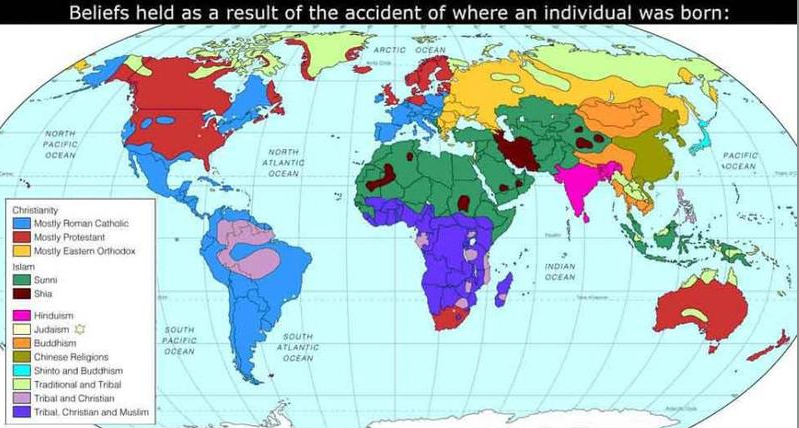
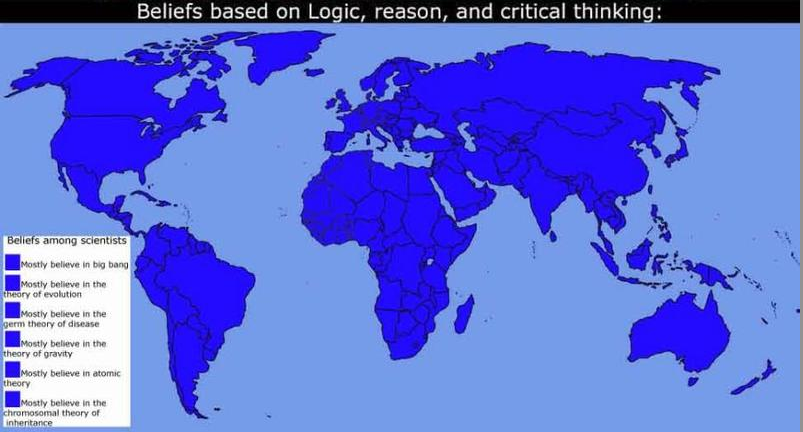
Here's a reason to be a skeptic that holds up at first, but crumbles on reflection:  religious beliefs depend on where a person lives.  Via Jerry Coyne, here are two amusing maps:


If having a belief depends on where you live, the suspicion is that the belief is shaped by non-rational forces instead of being a consequence of the way the world is.  We shouldn't take these kinds of beliefs too seriously, if at all.

And yet, and yet.  The likelihood of believing in human rights, or equality for women, or same-sex marriage, or democracy ... all these beliefs would go on Map #1.  They vary from place to place.  Nevertheless, you could make a case that liberal democratic views on these matters are rooted in the way the world is.  I'm not going to become a skeptic about women's equality, just because the folks in Afghanistan and Saudi Arabia don't believe in women's equality.  So why should anyone take sheer geographical variation as evidence that the tenets of some religion are false?  Bad precedent! 

4/28/12

Who to Trust?

I've been watching the debate between Bart Ehrman and Richard Carrier with fascination.  I'm a fan of Bart Ehrman's, based on reading two of his books--Jesus: Apocalyptic Prophet of the New Millenium and one correcting errors in The DaVinci Code.  Richard Carrier is someone I've noticed over the years peripherally, without paying direct attention to him. People seemed to think he was super-smart. Now Ehrman has written a book excoriating Carrier and other mythicists--people who think Jesus is 100% a myth, not a historical figure. The debate gets enormously complicated, and I'm not about to do the homework it takes to follow every move.  In a situation like this, you have to save time and effort and ask yourself "Who do I trust?"  That's exactly how Carrier would have me approach this, for which I am (of course) grateful.  Carrier writes--
I do not see this as a competition between us as to who is the better scholar, but as simply a matter of who to trust: someone who presents carefully researched, carefully worded, carefully reasoned work on this subject, with a minimum of mistakes (because as I’ve said, I make them, too), or someone who doesn’t.
The part after "who to trust" is tendentious, of course.  Bart Ehrman's books are fantastic, and they show he's a good scholar and perfectly prepared to be a skeptic (he abandoned the Christian faith of his youth).  In rounds one and two of the web-debate, I think Ehrman slaughters Carrier.  But here's what really destroyed Carrier's reputation in my eyes. It so happens that the first thing Carrier wrote after he joined Free Thought Blogs was an astonishingly cocky yet unbelievably stupid diatribe called "Meat not Bad".  The thing was shot through with errors, yet the tone invited the reader to think Carrier was Mr. Smart slaughtering all the dummies. His conclusion: "I think being a vegetarian out of 'compassion' is irrational. I mean that in the classic sense: it’s a non sequitur, and thus illogical. It’s to treat animals like people, which they are not."

You could not read the literature on the treatment of animals, or watch videos put out by reliable groups like the Humane Society, and come away with this opinion. Could not. Yet he holds forth with certitude, and make the other side out to be illogical. This, I take it, is Carrier's modus operandi.  It's exactly what you see in his current debate with Ehrman.  So I have no time for Richard Carrier, but Ehrman's book sounds fun--perhaps just because it's intriguing how some atheists are so determined to move from "No God" to "No Jesus".  I'd like to see this passion for no-Jesus dissected.

4/26/12

Martha Nussbaum on Religious Intolerance

She talks about her latest book The New Religious Intolerance here.  I think she goes too far in the direction of "can't we all just get along?"  What she says about martyrdom made me especially queasy.  People who let themselves be killed during the Holocaust, in solidarity with Jews, have no connection with suicide bombers who blow up other people in the service of "jihad".  And no, we don't have as much reason to worry about orthodox Jews as we have to worry about fundamentalist Muslims.  Nonetheless, an interesting interview, and the book is probably good reading too.

4/25/12

Collective Obligation, Personal Virtue


So here's the puzzle I'm scratching my head about (though I ought to be grading papers):  Each society has a more or less ideal birth rate.  Maybe for the US it's ideal if the average couple has two children.  We don't want a higher birth rate for environmental reasons, among others, and we don't want a lower birth rate for lots of reasons -- because new people will be needed to support the elderly, because people are valuable to each other as consumers, inventors, helpers, etc., and because a new human life is intrinsically good. (If the ideal average strikes you as somewhat less than two per couple, so be it.  Let's not quarrel about details.)

Anyhow, there's this ideal birth rate, but on that basis, what moral judgments should we make?  I can't see saying the person with four children has behaved impermissibly, let alone the person with no children.  To justify this reticence, it helps to think that a society has a collective obligation to maintain a certain birth rate, and to think this doesn't translate automatically into individual obligations.  If our birthrate in 2012 is three children per couple then we've gone wrong, but that's not actomatically to say that specific people with zero or four children have gone wrong. If our collective birthrate is in fact two children per couple, then nobody's gone wrong -- not even someone with eight children. 

But now (getting to the heart of the matter): we ought to say something at an individual level. After all, the birthrate depends entirely on individual decisions. What should we say?  If we say every couple should have two children, that's saying exactly what we decided we shouldn't say.  We want to say something "softer" - but not too soft!  Perhaps after saying what we ought to do collectively, what we need to talk about at the individual level is virtue, not obligation.

But ... what's the virtue?  Perhaps I just haven't read the right literature (recommendations anyone?) but it seems like the critical virtue is not one on the big famous lists of virtues, like the Aristotelian list or the Christian list.  The relevant virtue is being "socially responsible." That is to say, being mindful of what's good for a society as a whole and mindful of the impact of one's personal decisions. 

How are we going to credit people or blame then, if we think in these terms?  If the ideal birthrate is two children, we're not going to blame someone with over two children because they may have been perfectly mindful. If you're an American and you know that our birth rate has been 2.1 for the last ten years, you can have four children without there being anything socially irresponsible about it. You may have known that some childless couple would balance your high fecundity.

But what if our birthrate gets too high or too low? Should we think a childless couple, in a country with a too-low birthrate, is socially irresponsible? That's not to say they're acting wrongly, but even saying they're socially irresponsible sounds too harsh. Maybe we just need a subtle distinction.  They're not displaying social responsibility, in that particular part of their lives, but that's not the same thing as being irresponsible.  Similarly, someone who doesn't join the army doesn't display courage, but that's not to say they're necessarily being cowardly.

The same might be said about a couple who have 4 kids when they know the birthrate in their society is too high.  Not socially responsible!  At some point, though, I suppose we have to stop being delicate and just say "socially irresponsible." There's an important asymmetry here. While it's almost never socially irresponsible to have no children, except "in extremis" (think End of the World scenario), it's not so rare for it to be socially irresponsible to have another child -- your 10th or 15th or whatever.

So:  there are collective obligations, but at the individual level, just virtues and vices, as well as their absences (an important wrinkle).  This is not at all how you'd want to conceptualize every domain of ethics, but it seems right in the case of reproduction. Or so it seems, at the moment ....


4/22/12

The Case for Meat


The New York Times parade of meat-defenses is in -- let's have a look.  One of them is a defense of eating lab meat, not natural meat, so let's throw that out, no matter how well written it is.  I also happen to know who the author is, and she's actively seeking votes. I think that's a no-no in a contest like this.  The idea is to find out which of the six essays appeals most to Times readers, not who has the most friends and supporters.

Then there are essays that make some use of philosophy - perhaps written by philosophers. For What Shall We Be Blamed -- and Why? grants that not eating animals is morally ideal, but says all evils don't have "equal claim to our energies."  Inevitably, we'll do some bad things ("the moral world is tragic") and we need to avoid the worst things first.  So when many things are vying for attention, we may make avoiding meat-eating less than our first priority. A single mother with two jobs and three kids may serve her kids chicken instead of trying to figure out how to make lentil stew.  A young vegetarian may eat the roast beef his mother prepared when he goes home for a family visit.  I hope the judges don't pick this essay, because it gives people a pass to eat meat in pretty rare circumstances.  What's wanted is a more general, frequently applicable defense.

Meat is Ethical. Meat is Bad. makes use of philosophy too, but I think not well.  The author says there's a difference between harming someone by making her worse off during some time period and "making her worse off in some way in her life considered as a whole." The author then says "It is only by harming someone in this second way that something can count as bad."  But this is seriously nonsensical, so we don't need to bother with the paragraph that comes next--on why we should think animals can't be harmed in the second way.  Obviously you can harm do something bad to someone, even if the harm badness doesn't mar her life as a whole.  No reasonable person thinks that smacks, lies, thefts, broken promises, etc., when delivered to humans, only harm are only bad when they harm the victim's life as a whole.  The author goes on to say meat is bad, but only because it horrifies us to think of the animal we killed.  We shouldn't feel horrified (because we don't really harm do anything bad to animals), but we do. "And until we cease to be so we will have a powerful self-interested reason to not eat meat."  A strange conclusion to end with for someone trying to defend eating meat. If the judges pick this essay, I'll eat my hat. [corrections thanks to "anonymous"]

More philosophy.  Sometimes It's More Ethical to Eat Meat Than Vegetables. turns on a principle from Aldo Leopold's land ethic: "A thing is right when it tends to preserve the integrity, stability and beauty of the biotic community. It is wrong when it tends otherwise."  On that basis, the author thinks it's sometimes going to be right (in fact, obligatory) to eat meat, but often wrong. "A well-managed, free-ranged cow is able to turn the sunlight captured by plants into condensed calories and protein with the aid of the microorganisms in its gut. Sun > diverse plants > cow > human."  So--you can treat individuals any way you like, so long as you aren't haring the "biotic community."  This will make no sense to people who take animals seriously as individuals--like most people do, when it comes to their dogs and cats. So I think this fails to make an effective defense of meat-eating.

And now let's talk about the two manure essays.  I think one of these is going to win.  This is the Deal We've Made is nice and straightforward. The author says "the domestication of animals and the cultivation of vegetables go hand in hand."  You have to enrich the soil to grow vegetables, and animal manure plays a crucial role. Then there's an argument about "the deal" we've made --"we humans create an environment in which the plant or animal can thrive, we encourage reproduction and, in exchange, we harvest a portion of the crop."  The author wisely points out that we have to live up to our end of the deal.  "It's not enough to simply ensure the safety and survival of my animals. As fellow sentient creatures with whom I am engaged in a partnership, I have a responsibility to show both respect and benevolence, in life and death."  So: no factory farming allowed, but it's ethically defensible to eat meat from well-treated animals.  If you're eating vegetables grown in manure, your diet depends on meat-eating, even if you don't eat meat.  So how could a vegetarian diet be any more ethically defensible than a meat diet?  I think this is a good question.

We Require Balance. Balance Requires Meat. makes some manure points too, but I prefer "This is the Deal" for two reasons.  One is that the "deal" talk is essentially ethical, so the "deal" author does a better job of making an ethical case for eating meat.  The other problem is that in the "Balance" essay focuses explicitly on organic farming, whereas the "Deal" argument centers on any plant farming that uses manure at all. The "Balance" reasoning is:  we must confine ourselves to organic farming; organic farming requires manure; manure comes from the animals we eat.  I don't think we can really feed 7 billion people with organic-only farming, because the yields per acre are too low.  So this defense of meat eating rests on an unstable foundation.

So: "This is the Deal" gets my vote. But here's the question I'm left with.  What percentage of plant farming involves animal products as fertilizer?  What would manure-free conventional agriculture be like? (Let's not add the restriction "organic" -- as I said above, I don't believe the world can go all-organic.)  Could we work toward a world in which plant farmers don't depend at all on animal agriculture?  Would a future like that be viable? If plant agriculture not only does depend on animal agriculture, but must depend on animal agriculture, then I think "This is the Deal" makes a pretty formidable argument.

So:  which essay did you like best?

**

p.s. Some people don't care for this contest,  but I do.  Most people who think about meat eating a great deal are against it, particularly people who write about it (as journalists or philosophers), so it's interesting to have an airing of possible defenses.  It's also useful to have the winnowing of defenses done by people like Peter Singer and Michael Pollan.  This raises the level of discussion, eliminating defenses that are flat-out speciesist, or wrapped up in hopelessly unimpressive ideas about human privilege.  None of the final six essays say anything like "Humans are rational and self-aware; so they have rights and animals don't; so animals are on the menu. " Thank God! With long and careful thought, most people will ultimately not find that sort of thing to be a convincing or satisfying defense of meat-eating.  I think the final six essays do include some of the thoughts that stand the best chance of surviving careful reflection about the ethics of meat.

4/15/12

The Case against Kids

Overall, Benatar, and Caplan all covered in The New Yorker.  I'm looking forward to reading this ....

4/14/12

Coyne v. Haidt

I thought it was not so nice of Jerry Coyne to dismiss Jonathan Haidt as "a bit of a woo-ish self-help guru". In fact, both unnice and not reality-based. Haidt's book The Happiness Hypothesis is extremely interesting and well-written, and no less valuable because it does have a self-help element (I use it in a course I teach). And that's saying nothing about his extensive and influential research on morality and disgust.  Haidt is a mere "faitheist" (he is an atheist) in Coyne's eyes because he's not a religion-hater.  Outrageous! But Haidt turns out to be above the fray.  He responds to the substance of Coyne's post in this long and interesting comment.  (My extra-curricular reading list is getting horribly long.  Mooney and Haidt and E. O. Wilson's new book.)

Children Come from Us


pics on Sodahead
I've been thinking-writing about why people want to be parents -- what are the most central motivations and satisfactions?  This is a hard thing to think about without being constrained by a sort of political correctness.  The politically correct view, I think, is that we have children to enjoy nurturing them.  That's PC because nearly everyone who wants to be a parent can have that.  Single people, gay couples, infertile people ... everyone has access to the experience of raising a child, if they're willing to adopt.  But then, is that politically correct enough?  Some will be touchy about an account of why people parent that suggests that parents have something that's unavailable to people who are voluntarily childless.  We need to identify the good of being a parent in some utterly neutral way that leaves nobody out.

Abrupt segue: I'm thinking about reading Chris Mooney's new book The Republican Brain, and Jonathan Haidt's book The Righteous Mind, because I wonder whose side I'm on.  Mooney thinks there's something especially distorting about brains on the right, while Haidt thinks liberals and conservatives are guilty of their own distortions.  This comes to mind because the pressure to discuss parenthood in a way that's politically correct -- that leaves no one out -- is a peculiarly left phenomenon.  If someone wrote a book called The Liberal Brain it would have a very long chapter on political correctness.

Anyhow--the politically incorrect thing I'd like to say about parenthood is that people want to have a child who comes from them.  Being the source of a new human being is thrilling and satisfying.  Note: this isn't a question of simply sharing genes. With all due respect to my brothers, it's not thrilling in the same way to have a brother, though you share as many genes with your brother as with a child.  The child, but not the brother, comes from you.  Nor is the joy really a question of shared genes at all.  I enjoy the fact that the kids who come from me both have blue eyes, though I'm a hazel-eyed member of a dark-eyed family  (but apparently a blue-eyed gene carrier).  I enjoy the fact that my daughter joined the choir, though I can't imagine wanting to sing in a group.  I would enjoy the fact that my children come from me even if I didn't have a clue about genes--what's satisfying is 'coming from" itself, not the genetic backstory.

Now, saying all this does make me nervous.  After all, I'm a good liberal, and a good liberal does not want to leave anyone out.  I don't like the feeling of glorifying an aspect of parenthood that some people will have to live without.  When I was trying to become with child 16 years ago, I spent quite some time in close contact with people dealing with infertility.  Some of them were never able to conceive. Some moved on to adoption.  One adopted and then conceived.  There is a lot of pressure to say that whether you adopt or conceive, you wind up with exactly the same thing--a child to nurture. The nurturing is the real treat, not being the source of the child.

Only it's not entirely true. Being the source of a child is thrilling, and I think most people will work for years and years before adopting because most people want to experience that.  So what's a good liberal to do?  Value pluralism to the rescue!  If I say that "coming from" is something people want, it doesn't follow there's nothing else they want.  If you read memoirs of adoption (like Scott Simon's) you can see that the desires and satisfactions of adoption are different, but deep.  He talks about a feeling that might be the counterpart of the "coming from" feeling--it's the feeling that a certain child was "meant to be" yours.  Kismet made that child come into your life.

Now--you might say--the "meant to be" story isn't as true as the "coming from" story.  It's more of a poetic gloss on the experience of adoption, as opposed to having a basis in fact. But maybe what's going on here is real enough--it's the beginning of love and commitment, and really does feel like "meant to be."  Lots of people start romantic relationships with exactly that sense of fatedness.

Perhaps the two feelings--"comes from me" and "meant to be"-- are separate and different roads to the same destination--child of mine.  The liberal in me won't let me say the biological road is better, and maybe it really isn't better.  It's undeniable that adoption has a plus ethically--I don't think we benefit children by creating them, but we do by adopting them.  Perhaps the experience is also every bit as magical--Scott Simon's memoir makes it seem so. In any event, it's important that you wind up with child of mine.  Wanting to nurture a child is obviously one of the big motivations of parents, but nurturing mine is very much at the heart of the experience.

4/8/12

Easter Blasphemy

I thought I'd indulge in some Easter blasphemy ...

Blasphemous thought: do Christians really believe today the son of God was resurrected and saved all believers from their sins? If they really took that seriously, would they honor the occasion by focusing on a giant bunny who brings candy to children?

... but then I read Nicholas Kristof ("God Makes a Comeback"), and I think I'm pretty much in that camp--the camp (including Alain deBotton, Jonathan Haidt, and E. O. Wilson) that says we should recognize the often positive functional significance of religion, and not harp endlessly on the (er) problematic truth values.  Religion knits people together into cohesive groups that at least often do better together.  The Easter bunny business makes me think quite possibly even true believers aren't actually that focused on the serious literally content of religion. "It's the cohesion, stupid!", to mangle a wise political slogan.