


3/3/11
What Not to Say

Why do I bring this up? Because I committed one of these speech crimes recently. I said that the very broad public (as in, the proverbial man/woman in the street) cannot grasp the most advanced ideas in philosophy. You actually need to do some heavy duty reading, or maybe take some philosophy courses, or maybe even go to graduate school, to understand those ideas. As a matter of fact, my colleagues and I sometimes confess to finding the books of other philosophers difficult. We will outright say we can't follow x, y, or z. Of course. In any discipline, there are many levels of difficulty, and for any given audience, some stuff is attainable, and some not.
Once people are offended, they like to fan up their own offense by pretending what you said is as offensive as possible. (This is a strange truth about human psychology.) So my saying some philosophy is too hard for the public square (folks, it's true) got transformed -- mostly at other blogs -- into the assertion that academics should stay in their ivory towers. Never mind that I couldn't possibly have said that, considering that I've written two philosophy books for a "not just professionals" audience. It was "Off with her head, immediately!"
Well, if it must be, it must be. I humbly submit to the will of the people.
X-Phi and Moral Relativism
Massimo Pigliucci talks about Joshua Knobe talking about X-phi and moral relativism in The Philosophers' Magazine.
3/2/11
Animal Stuff
For your interest...
Here's a page of "Top 45 Animal Advocacy Blogs."
I'm reading Simon Fairlie's book Meat: A Benign Extravagance....a very, very detailed book about the environmental ethics of meat. Rhys Southan has a long review. What I have learned from Fairlie so far: it's amazing how a cow takes grass, which we can't eat, and turns it into something we can (apart from moral scruples) eat. Well, it is amazing.
Not sure if I already put a link to Glass Walls here--PETA's latest meat video. I think it's excellent, even if not utterly perfect. But what's perfect? A student of mine said everyone should see it. She's right--so here it is. Pass it on.
Here's a page of "Top 45 Animal Advocacy Blogs."
I'm reading Simon Fairlie's book Meat: A Benign Extravagance....a very, very detailed book about the environmental ethics of meat. Rhys Southan has a long review. What I have learned from Fairlie so far: it's amazing how a cow takes grass, which we can't eat, and turns it into something we can (apart from moral scruples) eat. Well, it is amazing.
Not sure if I already put a link to Glass Walls here--PETA's latest meat video. I think it's excellent, even if not utterly perfect. But what's perfect? A student of mine said everyone should see it. She's right--so here it is. Pass it on.
2/26/11
Angels or Slugs

The Flexible Lexical Rule. Reproduce if and only if you want to, so long as you are reasonably sure that your child will enjoy a life above the lexical level, and very sure that the risk of your child falling below the zero level is very small.The zero level is the level at which a life is not worth living. The lexical level is...well, that's what I want to talk about. "Lexical" connotes "like letters." All of the As come before any of the Bs. In our value systems some things take lexical priority over others. Suppose you are an ardent Apple fan. You are offered both Apple products and Dell products. In ever case, you choose the Apple product. You would rather have one Apple product than any number of Dell products. But when they run out of Apple products (there aren't that many), you're happy to accept Dell products. They do have some value to you. Apple stuff has lexical priority (for you) over Dell stuff.
Do some lives have lexical priority over others? Mulgan thinks so. Suppose God has already created a world with both angels and slugs. (There's already variety in this world, so we don't have to worry about that as a desideratum.) Should God create all the angels he can, before any more slugs? Or is there some kind of an exchange rate? Is creating one angel the same as creating a million slugs? It's plausible to think that angels are lexically prior to slugs. God should exhaust his angel-making powers before making any slugs, but he should go on to make some slugs. (Don't worry about omnipotence--the God talk here is obviously not to be taken seriously.)
Take a more real-worldish application of the idea: Tom Regan's famous case of four adults and a dog on a sinking lifeboat. They all have inherent value and rights, he thinks. In ordinary circumstances, the adults can't eat the dog. But in this unusual situation, where all will die if nothing is done, he says the dog should be thrown overboard. The dog has less to lose, in the way of valuable future experiences. Dog-years just aren't as rich in value as people-years (assuming they're all normal, and other things are equal).
In fact, Regan says it would be better to throw a million dogs overboard, rather than one person. (Why would we need to throw that many? Presumably, they're teeny tiny dogs!) Quick way to capture how Regan values people vs. dogs: he thinks in the lifeboat type situation, people take lexical priority over dogs. We should save all the (normal) people before any of the (normal) dogs, but then we should go on to save dogs (if we can).
Mulgan, then, is saying that some people's lives take lexical priority. The lives above the lexical line are different--they're autonomous lives; the ones below are non-autonomous. Don't worry. That doesn't mean he's for using non-autonomous people as slaves or food. The way Mulgan uses the concept is not drastic. Before creating a child, we ought to be reasonably sure he or she will live a life above the lexical line. Failing that, we can create children below the lexical line, but above the zero level.
Should we buy into the lexical priority of autonomous people? How would the line affect the way we treated people once they are born? Would we have to throw less autonomous people off of lifeboats? Would a special-ed program have to put extra resources into the highest achieving kids, the ones with the best chance of getting above the lexical line? And do less for those way below the line, since they'll never have the super-valuable type of life?
But back to basics. All the angels before any of the slugs? All the people (on the lifeboat) before any of the dogs? Do any lives ever take lexical priority over other lives? This is the most fundamental question, and the one that keeps rolling around in my head.
When the going gets tough, I say "make a poll." Assume angels are like people, only even better. And assume slugs have a tiny bit of mental life--only enough to enjoy a good slither. So what about creating angels and slugs? Four possibilities--
(1) God should create all the angels before any of the slugs, though if he can't create any more angels, he should create some slugs (the lexical view).
(2) It's all the same whether God creates one angel or some vast number of slugs (the exchangability view)
(3) It's all the same whether God creates one angel or one slug (the egalitarian view).
(4) God should create angels only, because slugs have no value (the elitist view).
The poll is in the right column.

2/20/11
Fat Monkeys
Quick last violation of "Saturday only" blogging rule. For people who think or teach or write about animal rights, this story about obesity research using monkeys and baboons makes perfect fodder for discussion. Don't miss it!
Reply to Blackford
Now that I've had a chance to read Russell Blackford carefully, I want to respond to a few things he says about my post, "The Emperor's Gnu Clothes." To recap quickly: I've compared new atheists like Dawkins and Harris to the girl in the original story--they're [admirably!] candid defiers of social convention. In my second telling of the story, other kids along the parade route get revved up and start ridiculing the naked emperor for his corpulence. When adults tell them to be careful how they communicate they just get mad at the adults. So--there's a shift from candor to contempt--aimed both at the emperor and at the adults.
2/19/11
The Greenest Possible World
A couple of nights ago I gave a presentation on the environmental impact of meat for SMU's vegetarian club. Here's the slide show--comprehensible without my voice-over, I think.
The slide show makes an argument--that the future will bring either vastly more factory farming or more plant eating. It cannot bring more traditional farming, with animals grazing under the wide blue sky. Why not? Because 30% of the earth's non-ice land surface is already covered in livestock (26%) and feedcrops (4%). Lovers of wildlife should be extremely concerned. "Mild" animals--billions of grazing cows and sheep--are literally crowding wild animals out of existence. They are also contributing to climate change and depleting valuable resources.
There are lots of cool graphs, charts, and maps in the slideshow, many from the UN report Livestock's Long Shadow--a really fabulous resource.
I think it's quite clear we should eat more plants, but here's what's less clear to me. From a green point of view, how far (ideally) would we roll back animal farming? Would we ideally reduce the 30% to 25%...to 20%...to 15%...or to what? Some animal pastures can be converted to plant farming, with much higher nutritional yields. Plant farming is much more efficient. But some pastures cannot, so that eliminating animal farming on that land means expanding plant agriculture elsewhere. I suspect the greenest possible world feeding 9 billion people (in 2050) couldn't be a purely vegan world.
On the other hand, the greenest possible world will also not be one in which the whole world consumes animal protein at the rate that affluent countries do today. Consumption of animal products has to decline, if 9 billion people are going to be fed in 2050, with any land left for other species. From a strictly environmental standpoint, the moral rule to promote is "eat more plants." It's all to the good for some to eat none, to compensate for others who over-consume. But in the greenest and most egalitarian of all possible worlds (that involve 9 billion people living on this planet), I think everyone will eat a little meat.
That's a surprising conclusion to reach, I think. It's not ethically unproblematic to take the life of any animal, whether or not they have robust rights just like ours. So it's odd to admit that it's got to be done. Perhaps the best diagnosis is this: there are so many humans that our options are tragically narrowed. We simply cannot all survive and also grant animals the full moral status they are entitled to. Going into a future with too many people and not enough land, we cannot completely stop using them as food.
On the other hand, we also can't use animals as food to the degree that we do now. The average American's animal consumption is the highest in the world--250 pounds of meat per year! Consumption of animal products is going to have to decrease, but perhaps not to zero.
Sound right? Look at the charts, maps, and graphs in the slide show, and let me know what you think.
**
"The Emperor's Gnu Clothes" (from January 25) has recently been much discussed (Stangroom, Blackford, Coyne, Schoen, Rosenau). That's for your reading pleasure. I think I've run out of things to say on the topic.
The slide show makes an argument--that the future will bring either vastly more factory farming or more plant eating. It cannot bring more traditional farming, with animals grazing under the wide blue sky. Why not? Because 30% of the earth's non-ice land surface is already covered in livestock (26%) and feedcrops (4%). Lovers of wildlife should be extremely concerned. "Mild" animals--billions of grazing cows and sheep--are literally crowding wild animals out of existence. They are also contributing to climate change and depleting valuable resources.
There are lots of cool graphs, charts, and maps in the slideshow, many from the UN report Livestock's Long Shadow--a really fabulous resource.
I think it's quite clear we should eat more plants, but here's what's less clear to me. From a green point of view, how far (ideally) would we roll back animal farming? Would we ideally reduce the 30% to 25%...to 20%...to 15%...or to what? Some animal pastures can be converted to plant farming, with much higher nutritional yields. Plant farming is much more efficient. But some pastures cannot, so that eliminating animal farming on that land means expanding plant agriculture elsewhere. I suspect the greenest possible world feeding 9 billion people (in 2050) couldn't be a purely vegan world.
On the other hand, the greenest possible world will also not be one in which the whole world consumes animal protein at the rate that affluent countries do today. Consumption of animal products has to decline, if 9 billion people are going to be fed in 2050, with any land left for other species. From a strictly environmental standpoint, the moral rule to promote is "eat more plants." It's all to the good for some to eat none, to compensate for others who over-consume. But in the greenest and most egalitarian of all possible worlds (that involve 9 billion people living on this planet), I think everyone will eat a little meat.
That's a surprising conclusion to reach, I think. It's not ethically unproblematic to take the life of any animal, whether or not they have robust rights just like ours. So it's odd to admit that it's got to be done. Perhaps the best diagnosis is this: there are so many humans that our options are tragically narrowed. We simply cannot all survive and also grant animals the full moral status they are entitled to. Going into a future with too many people and not enough land, we cannot completely stop using them as food.
On the other hand, we also can't use animals as food to the degree that we do now. The average American's animal consumption is the highest in the world--250 pounds of meat per year! Consumption of animal products is going to have to decrease, but perhaps not to zero.
Sound right? Look at the charts, maps, and graphs in the slide show, and let me know what you think.
**
"The Emperor's Gnu Clothes" (from January 25) has recently been much discussed (Stangroom, Blackford, Coyne, Schoen, Rosenau). That's for your reading pleasure. I think I've run out of things to say on the topic.
2/17/11
Female Atheists
So there's a lot of talk about this panel discussion (at the recent American Atheists meet-up in Huntsville, Alabama) at atheist blogs. [Hmm--the video has now been covered up with a complaint-retraction. Too bad--why not let people watch and make up their own minds?!] As near as I can tell, the discussion started here and now it continues here.
Were the goings on unpardonably sexist? To begin with, this wasn't a panel of five men and one woman specifically set up to discuss the under-representation of women in the atheist movement. That would certainly have been ridiculous. It was an "attendees choice" panel designed to respond to attendees questions, whatever they might be. The second question was about under-representation.
The video (see first link) doesn't, to my mind, reveal men behaving badly. It actually just reveals that a regional atheist meeting is run by "just folks." Whereas academic, urban types consistently say "men and women," these people say "guys and girls" or (mostly) "males and females." Good heavens, I bet they don't read the New York Times either! When an audience member gets up and complains about the term "female," the panelists aren't quick enough to point out that they've consistently paired that term with "male." No harm, no foul.
A panelist makes a klutzy joke about calling women "thefairer weaker sex," which reveals that the humor in Alabama isn't quite up to my standards. [4:45 pm: OK, with that change it's more obnoxious.]
As to the one woman on the panel being drowned out. I really don't see that. She's given a chance to speak, but doesn't use it well. She doesn't seem to have much to say or maybe she's just not a confident public speaker. It doesn't look to me as if she's bullied or interrupted.
So--I see no special problem with the session, but what about this issue of women being under-represented in the atheist movement? I know lots of women who don't believe in God, but can't imagine any of them going to an atheist meeting. Why not? I think the belief is just not important to them. It's not central to their lives, doesn't define who they are. They affiliate based on other interests--in culture, politics, books, and (drum roll) being Jewish. But not based on thinking there ain't no deity. That's a big "who cares?"
To get them to go to atheist meetings, you'd have to get them to care more. But would it be good for them to care more? Would they be better off, or would the meetings just be more gender balanced? Hard question!
I'm a little different. Being an atheist is not central to my life and doesn't define who I am. If I want to make the world a better place, I'm going to choose a different focus. But I like ideas, philosophy, debate. For "public intellectuals," atheism is one of the lively subjects of the day. I'm attracted to corners of the internet where atheism is discussed, and likewise I'd be attracted to real world venues. Plus, I teach classes where atheism comes up, and both of my books have a connection to the topic. Plus, I've written a few articles for Free Inquiry and written a fair amount about atheism at this blog.
So: "Pick me, pick me!" I'd be happy to speak at an atheist meeting--about religion and the good life; or about animal rights and atheism; or (fun, fun, fun) about accommodationism. Conference organizers could increase the number of female speakers if they put their minds to it.
Were the goings on unpardonably sexist? To begin with, this wasn't a panel of five men and one woman specifically set up to discuss the under-representation of women in the atheist movement. That would certainly have been ridiculous. It was an "attendees choice" panel designed to respond to attendees questions, whatever they might be. The second question was about under-representation.
The video (see first link) doesn't, to my mind, reveal men behaving badly. It actually just reveals that a regional atheist meeting is run by "just folks." Whereas academic, urban types consistently say "men and women," these people say "guys and girls" or (mostly) "males and females." Good heavens, I bet they don't read the New York Times either! When an audience member gets up and complains about the term "female," the panelists aren't quick enough to point out that they've consistently paired that term with "male." No harm, no foul.
A panelist makes a klutzy joke about calling women "the
As to the one woman on the panel being drowned out. I really don't see that. She's given a chance to speak, but doesn't use it well. She doesn't seem to have much to say or maybe she's just not a confident public speaker. It doesn't look to me as if she's bullied or interrupted.
So--I see no special problem with the session, but what about this issue of women being under-represented in the atheist movement? I know lots of women who don't believe in God, but can't imagine any of them going to an atheist meeting. Why not? I think the belief is just not important to them. It's not central to their lives, doesn't define who they are. They affiliate based on other interests--in culture, politics, books, and (drum roll) being Jewish. But not based on thinking there ain't no deity. That's a big "who cares?"
To get them to go to atheist meetings, you'd have to get them to care more. But would it be good for them to care more? Would they be better off, or would the meetings just be more gender balanced? Hard question!
I'm a little different. Being an atheist is not central to my life and doesn't define who I am. If I want to make the world a better place, I'm going to choose a different focus. But I like ideas, philosophy, debate. For "public intellectuals," atheism is one of the lively subjects of the day. I'm attracted to corners of the internet where atheism is discussed, and likewise I'd be attracted to real world venues. Plus, I teach classes where atheism comes up, and both of my books have a connection to the topic. Plus, I've written a few articles for Free Inquiry and written a fair amount about atheism at this blog.
So: "Pick me, pick me!" I'd be happy to speak at an atheist meeting--about religion and the good life; or about animal rights and atheism; or (fun, fun, fun) about accommodationism. Conference organizers could increase the number of female speakers if they put their minds to it.
2/12/11
Atheism in America

He also gave a talk to a group comprised of SMU undergraduates and faculty, plus members of a local "fellowship of free thought." He explained what atheism is and isn't, and argued that atheists and theists can get along. Atheists come to be overly anti-theist, he said, when they don't try to understand what religion offers people. It doesn't so much offer doctrine as it offers practices --many positive, like expressing gratitude before meals, and creates communities.
Julian was questioned and challenged a bit, but there was no major battle. Which tells me that atheists out in the real world do not look exactly like atheists on the internet. I had the same sense while listening in on a few interviews.
The more that atheists "come out," the more than everyone's going to know one, and the public perception is going to shift. Not only will it shift way from the longstanding misperception that atheists are immoral people--devil worshippers, maybe. I think it may also shift away from a more recent misperception--that new atheists like Dawkins, Harris, etc., have the typical attitudes. More and more, I think not. They really are anti-theists, and I'm not sure that's true of the rank and file American skeptic.
But we'll see--I suspect Julian's article will shed more light.
2/3/11
2/2/11
1/29/11
Tiger Mothers, etc.
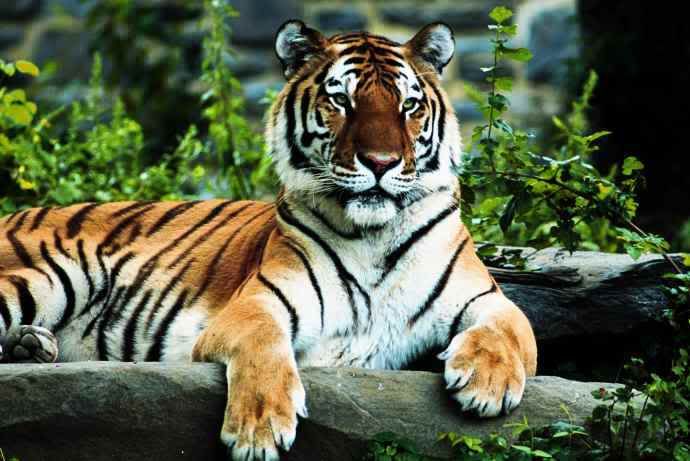
I was planning on blogging about Battle Hymn of the Tiger Mother today, but I'm not quite far enough along. This is the publishing sensation of the month, it seems. By exposing her wildly demanding approach to parenting, and calling it "Chinese," Yale law professor Amy Chua has made herself both a bestselling author and the Wicked Mom of the East. Not ready to write much about it, but so far I'm finding the book both entertaining and thought-provoking. It raises some good questions about what we should want for our kids and also about self-deception. When are you helping your children do their best, and when are you actually creating trophy kids to boost your own self esteem? I think the author, Amy Chua, may not be aware of that real and worrisome distinction. Fortunately, she has a sense of humor about herself, and she does allow a question mark to hang over the whole book. Is this really the way to go, she seems to want us to wonder, even as she sings her battle hymn.
More next week, maybe. Meanwhile, 'round the web. The endless conversation continues. It's been interesting at many points. Latest topic--this article, which shows (tries to show?) a spill-over effect. In regions of Europe with more religious people, both the religious and the non-religious are happier. In regions with more atheists, both the atheists and the non-atheists are less happy. Carol Graham cites this (unpublished) study in the extremely interesting book Happiness Around the World. My interlocutor (Paul W) is not impressed.
Relatedly, I enjoyed this letter from Stephen Asma, whose Chronicle Review discussion of animism has generated lots of discussion in the blogosphere.
I dropped by this morning at Let Them Eat Meat, and found post-vegan contrarianism is alive and well. The book Rhys is discussing (Meat: A Benign Extravagance) looks like one I will need to look at. Benign? Well, maybe not quite. I just discovered this very well-done video, narrated by Paul McCartney--Glass Walls. The vegetarian group for which I'm faculty adviser recently did a "pay per view" event--$1 to each person who would watch the video. Good for them! The group has a cool website too.
Last but not least: does a shaved tiger have any stripes? Thanks to my husband, who is reading The Tiger, I now know the answer.
1/25/11
The Emperor's Gnu Clothes

But first, let's have a story--"The Emperor's New Clothes." The emperor marches along the parade route stark naked [ignore the green underwear in the picture], and the adults ooh and ahh about his finery. One brave girl speaks up and says, naively "The emperor has no clothes!" Good for her! Hurray!
I saw Dawkins and Harris, in the early days of new atheism, as that girl. We're not supposed to speak openly about religion, and what's wrong with it, but they did. I liked their books in just the way I like that girl.
Now we have the sequel: "The Emperor's Gnu Clothes." Other kids were impressed with the brave girl. They started saying the same thing--"The emperor has no clothes! The emperor has no clothes!" Soon just saying he had no clothes lost its appeal. They shouted louder and louder, and called the emperor a fatty and laughed uproariously.
Some of the adults said: "Children. You're right he's naked. The brave girl was perfectly right to say so. But you've gotten carried away. It's time to think this through. Maybe the emperor actually enjoys being naked. Maybe he really doesn't know he's naked, and he can't figure it out when you're yelling at him. Maybe when he looks at you, your clothes look ridiculous to him, too! Control yourselves, think about how you're communicating!"
This made the children very, very angry. They wanted to believe they were just like that first brave girl. They didn't want to see themselves as rude and insulting. So the children went after the adults who had chided them, and called them names, and derided the whole idea of Communicative Restraint and Politeness, which they called crap for short.
Now, you may or may not like my second story. For you, the history of new-gnu atheism may be all girl, no follow-up kids. And so you may think the adults really are out of line. Yet, at least in general terms, the adults are right, and the "gnu" crowd doesn't even agree in general terms. They are downright dismissive toward the whole topic of communication.
That's where today's clarifying posts come in. Jerry Coyne chides Chris Mooney for boldly insulting Birthers, but then not being as forthright about religion. Well of course, it's a different communicative situation. Different topic, different tone. You couldn't both chide him for this and take the issue of how/when/why we communicate the least bit seriously.
Ophelia Benson offers a reason why communicative restraint on the subject of God is not required. It's because the non-existence of God is so obvious. Right, like the emperor was obviously naked. But obviousness is not a reason to dispense with communicative care. Lots of things are obvious (to me) but the way I communicate about them rightly varies from topic to topic, situation to situation. Of course.
Moral of the stories: be the girl, not the crowd. You have to take the issue of how/when/why we communicate seriously to make that distinction.
1/22/11
Can Atheists be Pluralists?
President Obama's speech in Tucson lead to an interesting post by James Croft, a graduate student who is involved with the Humanist Chaplaincy at Harvard. Croft was ambivalent about the religious elements of the speech--
But now, what about standing outside "with face pressed against the stained-glass windows, longing for solidarity with those inside, but unable to cross the threshold"? My reaction is--what's the problem? Just go in.
I mean that quite literally. Just go in. Perhaps that's an impossibility for Croft because he's a Christian atheist, not a Jewish atheist--and yes (surprise, surprise) there really is a difference. For Christians and former Christians, religion is all about belief. There are creeds and confessions and things you've got to believe so you can have eternal life, and I suppose if you're not on board, you must feel like a terrible impostor. For Jews, it's not like that. Yes, strictly speaking there is stuff Jews believe. In fact, I have a book called What Jews Believe. But Jews don't necessarily believe that stuff. And they're not less Jewish for being non-believers.
 In Jewish congregations it's very easy to find atheists, and agnostics, even among the high and mighty and influential. I have known people who even converted to Judaism without believing in God--being in fact flat out atheists. And they still participate, and still find it meaningful. Kids can go through bar and bat mitzvahs (happily!) without believing. Their parents can stand up in front of the congregation, doing their part in the bar/bat mitzvah service, and say "I don't believe" -- I've seen it with my own eyes. Even rabbis can be non-believers. It is OK--really OK--to be a non-believer and be part of a religious congregation.
But Christian atheists seem to not "get" this as an option. Yes, there are aspects of Judaism that are distinctive. But the essence of the thing is not. I don't see why you can't find the experience of being part of a church enriching, without believing in the basic tenets of the faith. You might just like the sense of a refuge from everyday life, the aesthetics of the sanctuary, the feeling of harmony you get from singing and even from standing up and sitting down together (Jonathan Haidt talks about that in The Happiness Hypothesis), the focus on life, death, meaning, and values. If you pick the right church, there will be nothing ethically problematic about the messages, nothing hostile to science. Nobody has to like this sort of thing, of course, but it's not foreclosed as an option for non-believers.
Croft sees it as foreclosed perhaps because he's troubled by a certain notion of pluralism. As he explains, the pluralist writer Diana Eck thinks pluralism means putting God-the-sun at the center of the universe, and seeing other religions as planets orbiting around him/her/it. Members of different religions all seek God, "through different trajectories and paths." Croft says "there's no room for atheists in this solar system." I suppose, to him, crossing the threshold would mean joining a God-centered solar system, revolving around a non-existent sun. It wouldn't make any sense.
But no--that's not how you have to think about entering a church or synagogue. A believer might want to think about members of different religions, and even non-believers, as revolving around God, but obviously a skeptic won't buy into that image. In fact, the image isn't even compulsory for believers. Pluralism can be nothing but the notion that different religions (and non-religions) are wise in different ways. They all have their insights. This is something you can believe without taking any of the supernaturalism seriously.
Actually, that ought to be obvious. There is wisdom and beauty in the Iliad and the Odyssey, even if there's no Zeus and Athena, and there never was a Trojan War, and some of the moral messages of the books are atrocious (like how Achilles and Agamemnon--heroes!--fight over who gets to rape (yes, rape) Briseis. There is wisdom and beauty in the bible, and the Talmud, and the writings of later sages, and the same goes for religious traditions I'm not a part of.
Can religious folk accept a pluralism along those lines, instead of presuming that their God is the center of everyone's religious experience? They actually can. In fact, the rabbi at a friend's synagogue gave a sermon last night about what we can learn from members of other faiths, including from atheists. There was no presumptuous stuff about how everyone else is really (without knowing it) revolving around our God. My son went, listened to this message, and I'm confident he got something positive out of it, even though he's adamantly a non-believer.
So: no need for standing out in the cold. I believe there are (formerly) Christian atheists who see things the same way--perhaps gravitating toward the Unitarian church. There's really no need to stand out in the cold, if you're attracted to the this-worldly elements of religious experience.
"I feel a similar ambivalence regarding the religious elements of Obama's beautiful speech. I am drawn-in by the poetry of his scriptural references, and I am powerfully moved by the image of a celestial Christina jumping in heavenly puddles. I can see that Obama's faith provides him with both courage and hope - essential qualities in a leader facing dark times - and I am challenged by the thought that much atheist writing provides neither. Yet I recognize, too, that I cannot join the ranks of Americans bending knee to pray while remaining true to my beliefs, to myself. I must express my shock and sadness in another way. I'm standing outside the church, my face pressed against the stained-glass windows, longing for solidarity with those inside, but unable to cross the threshold."I like the fact that Croft feels, at worst, left out, and not incensed. There was nothing to be incensed by. The speech had the right elements to console those most in need of consolation. Period.
But now, what about standing outside "with face pressed against the stained-glass windows, longing for solidarity with those inside, but unable to cross the threshold"? My reaction is--what's the problem? Just go in.
I mean that quite literally. Just go in. Perhaps that's an impossibility for Croft because he's a Christian atheist, not a Jewish atheist--and yes (surprise, surprise) there really is a difference. For Christians and former Christians, religion is all about belief. There are creeds and confessions and things you've got to believe so you can have eternal life, and I suppose if you're not on board, you must feel like a terrible impostor. For Jews, it's not like that. Yes, strictly speaking there is stuff Jews believe. In fact, I have a book called What Jews Believe. But Jews don't necessarily believe that stuff. And they're not less Jewish for being non-believers.
 In Jewish congregations it's very easy to find atheists, and agnostics, even among the high and mighty and influential. I have known people who even converted to Judaism without believing in God--being in fact flat out atheists. And they still participate, and still find it meaningful. Kids can go through bar and bat mitzvahs (happily!) without believing. Their parents can stand up in front of the congregation, doing their part in the bar/bat mitzvah service, and say "I don't believe" -- I've seen it with my own eyes. Even rabbis can be non-believers. It is OK--really OK--to be a non-believer and be part of a religious congregation.
But Christian atheists seem to not "get" this as an option. Yes, there are aspects of Judaism that are distinctive. But the essence of the thing is not. I don't see why you can't find the experience of being part of a church enriching, without believing in the basic tenets of the faith. You might just like the sense of a refuge from everyday life, the aesthetics of the sanctuary, the feeling of harmony you get from singing and even from standing up and sitting down together (Jonathan Haidt talks about that in The Happiness Hypothesis), the focus on life, death, meaning, and values. If you pick the right church, there will be nothing ethically problematic about the messages, nothing hostile to science. Nobody has to like this sort of thing, of course, but it's not foreclosed as an option for non-believers.
Croft sees it as foreclosed perhaps because he's troubled by a certain notion of pluralism. As he explains, the pluralist writer Diana Eck thinks pluralism means putting God-the-sun at the center of the universe, and seeing other religions as planets orbiting around him/her/it. Members of different religions all seek God, "through different trajectories and paths." Croft says "there's no room for atheists in this solar system." I suppose, to him, crossing the threshold would mean joining a God-centered solar system, revolving around a non-existent sun. It wouldn't make any sense.
But no--that's not how you have to think about entering a church or synagogue. A believer might want to think about members of different religions, and even non-believers, as revolving around God, but obviously a skeptic won't buy into that image. In fact, the image isn't even compulsory for believers. Pluralism can be nothing but the notion that different religions (and non-religions) are wise in different ways. They all have their insights. This is something you can believe without taking any of the supernaturalism seriously.
Actually, that ought to be obvious. There is wisdom and beauty in the Iliad and the Odyssey, even if there's no Zeus and Athena, and there never was a Trojan War, and some of the moral messages of the books are atrocious (like how Achilles and Agamemnon--heroes!--fight over who gets to rape (yes, rape) Briseis. There is wisdom and beauty in the bible, and the Talmud, and the writings of later sages, and the same goes for religious traditions I'm not a part of.
Can religious folk accept a pluralism along those lines, instead of presuming that their God is the center of everyone's religious experience? They actually can. In fact, the rabbi at a friend's synagogue gave a sermon last night about what we can learn from members of other faiths, including from atheists. There was no presumptuous stuff about how everyone else is really (without knowing it) revolving around our God. My son went, listened to this message, and I'm confident he got something positive out of it, even though he's adamantly a non-believer.
So: no need for standing out in the cold. I believe there are (formerly) Christian atheists who see things the same way--perhaps gravitating toward the Unitarian church. There's really no need to stand out in the cold, if you're attracted to the this-worldly elements of religious experience.
1/15/11
Trees and Chimpanzees

My paper on the great apes is nearing completion...and boy I wish I had more black and white views about this. It would make things easier if I thought chimpanzees had basic rights just like ours, and for that reason, could never be used in biomedical research. Without thinking of them that way, it's difficult to make the case that chimpanzees should be completely off limits, no matter what. Not just when people are doing hideously cruel experiments, or when they're doing pointless, badly designed experiments, or when they're violating the relevant animal welfare guidelines, but permanently, totally, no matter what. How do you argue for that?
It sounds shallow, but I think there's a lot of force to the argument that we simply value chimpanzees in a special way. They're our nearest non-human relatives, they have minds fairly similar to ours, and they reveal interesting things about human origins. Given all that, we want them to be living free lives of their own in the wild, and we're repelled by the thought of chimpanzees (so much like us!) being inoculated with our diseases, repeatedly biopsied, isolated part of the time...and treated as tools for human benefit.
The research advocate will now let out a loud cry. "But what about the people who won't be saved from serious diseases (hepatitis C is the main one studied using chimpanzees), if the NIH is forced to retire its whole chimpanzee population?!" What possible answer can be given to that? Maybe it's not so hard. There are lots of things we will not do to advance medicine. We won't sell off the National Gallery's art collection, for example. We won't offer Dubai the copy of the Declaration of Independence that sits in Washington.
To change the subject slightly...I read somewhere (does this ring a bell with anyone?) that the regal trees that line many French roads predictably distract drivers with their shadows and cause accidents. You could chop them down and save some number of lives every year. But no, losing the trees is not something we're prepared to do to save lives.
When we declare art, the original Declaration, and trees off limits, nobody feels like any one-to-one comparison is being made. It's not "people or art" or "people or documents" or "people or trees." We value people, we value trees...and never the twain shall meet. Surely we can spare chimpanzees in like fashion. It's not a matter of chimpanzees and people becoming equals, any more than we have to think people and trees are equals, when we leave the trees alone.
NB: I don't think chimpanzees are exactly like trees, paintings, or documents. Not even close, because we have direct obligations to them, and not to trees, paintings, or documents. It's interesting, though, that if you leave that out of the picture, you may actually get the strongest possible argument for ending experimentation on the great apes.

My paper is going to center on a real world drama that just recently got resolved. 200 chimpanzees living in Alamogordo, New Mexico, had been requested by the San Antonio National Primate Facility, to be used in Hepatitis C research (they are already using about 160). The 200 had been saved from the notorious labs of the Coulston Foundation, which the USDA charged with numerous animal welfare violations in the 80s and 90s. They live in a federal sanctuary, built just for them on the Holloman Air Force base in Alamogordo. After ten years of retirement, they were going to be sent back to active duty as "medical models." Governor Bill Richardson protested, Jane Goodall and the Humane Society protested, lots of animal rights organizations protested...and last week the NIH changed its mind. The 200 will remain in Alamogordo while the National Academy of Sciences studies the matter for two years.
It's interesting how the narrative here makes all the difference. Nobody's having a fit about the 160 chimpanzees already being used for biomedical research in San Antonio. What captures attention is the drama of the Alamogordo animals being snatched out of a safe haven. They escaped research, only to be sent back? Now that's intolerable.
Well, I'm not immune to a good story. It is intolerable. I'm glad the Alamogordo 200 aren't being shipped to San Antonio. But now the NAS has to put an end to the problems of all the rest. At this point only the US and Gabon (Gabon?!) still support experimentation on chimpanzees. The UK stopped it in 1997, and the whole EU last year. It's time for the US to catch up with the rest of the world.
It's a wrench to change, to make an explicit sacrifice of potential discoveries. But once we've changed, I don't think the loss will be noticeable. We don't experiment on people, and never notice the research advances we've forfeited. Those advances are just...absent, not there. That's what it will be like if we stop invasive research on chimpanzees.
1/13/11
It's the Guns, Stupid


This was a lovely speech, but why do we keep letting these things happen? With all the talk of this factor and that, it seems to me it all comes down to the gun. Why can't we confront the bizarre way that many Americans make gun-ownership a core part of their identity? It's crazy, and it's one of the reasons why this little girl is being buried today.
1/8/11
They Shoot Democrats, Don't They?
And their children too. This article has to be read. There are random acts of violence in this country, but was this one?
Two God Books
"Jesus is the reason for the season," I figured, so this Christmas I asked for Philip Pullman's book The Good Man Jesus and the Scoundrel Christ, and also read The God Dialogues: A Philosophical Journey, by Torin Alter and Robert Howell. Robert is a colleague of mine at SMU, and Torin teaches philosophy at the University of Alabama.
 The God Dialogues is a great book for teaching philosophy of religion to undergraduates, but also engaging and enlightening for civilians. The dialogue goes on between three students traveling around the US--mnemonically named THeo, evA, and GeNe. You guess what position each takes. There is amusing banter among them, but mostly they are the ideal interlocuters. They're clear, they're coherent, they're witty. They even occasionally write out arguments with precision on pieces of paper.
In a book like this, and in philosophy generally, the explainer's job is to present each argument so it makes as much sense as it possibly can. Counterarguments have to be presented charitably as well. The book is a model of impartiality, but the nice thing is that the interlocutors themselves are invested in their own positions. That invites the reader to take a stand too. A more encyclopedic overview of positions tends to make the reader/student just assimilate passively, instead of grappling.
So let's do some grappling. The great thing about the book is that it tells you everything you always wanted to know about certain arguments, but were afraid to ask. True confession: I never quite "got" the modal version of the Ontological Argument. As I recall from the last time I took a dive into the contemporary literature on the subject, it was pretty technical and dense. So I was very happy to be enlightened in no more than a few painless pages.
So here we go... starting at page 90, after Theo the theist has given a quick snapshot of the modal version of the ontological argument.
1. It's conceivable that God exists.
2. If it's conceivable that God exists, then it's possible that He exists.
3. Therefore, it's possible that God exists. In other words, there's at least one possible world in which He exists.
It's easiest to get a grip on necessary facts. 2 + 2 = 4 is necessarily true--true in every possible world. However things might have gone differently, starting 10 years ago, or 100, or a billion, or from the beginning, it still would have been true that 2 + 2 = 4. And maybe the numbers themselves are necessary entities--they exist (in some sense) in every possible world.
Maybe there are even some less abstract things that exist in every possible world. Might we think of space as a necessity? Or maybe time? Or spacetime? OK...that doesn't sound crazy. But what's with the idea of an all powerful, all good being, who exists in all possible worlds? Could we also construct the concept of a necessary book, or a necessary person, or a necessary mountain? But obviously none of that even begins to make sense. Why does it make sense that the omnipotent, omniscient creator of everything would be able to add necessity to his laurels? (And don't say it's just "by definition," because the necessary mountain is also necessary by definition, and that makes no sense.)
Another way of making this point occurs to me. If you already have the Cosmological Argument under your belt, and you think you've shown that a world couldn't get going without God, then God must exist in every possible world--no matter how this world had gone differently, there would still be God. Necessity would be an upshot of the proof, along with God's existence. However, the ontological argument is supposed to work from scratch. It would be useless if you needed a different argument for the existence of God in order to make the Ontological Argument work.
 Eva actually winds up overcoming the Ontological Argument by turning it against itself (see pg. 93). You see, two can play that game. Just take the original and put "doesn't" in front of every "exist" or "exists". The argument now proves God doesn't exist. Eva claims this reverse argument is actually more compelling than the original (see pg. 93-6 for details). But making the reverse argument does saddle the atheist with the view that God is impossible. That's certainly atheism on steroids!
And now for Pullman's novel--if that's the word for it. This is a retelling of the gospel of Jesus Christ, with Jesus and Christ portrayed as twins. Let's just say, interesting! I would call the book a discussion-generator more than a really gripping piece of literature, but it's a great discussion-generator. It would be a good choice for reading groups of all sorts--especially for Christians and former Christians. I think it must help if you know the gospels extremely well, because no doubt much of the excitement lies in seeing all the departures from the original. I don't know the gospels well enough to pick up on every intriguing deviation. The book is ultimately about scripture, and how it comes to be...and if I tell you any more I'll spoil it for you. I had read no reviews at all beforehand, and I was very glad I hadn't.
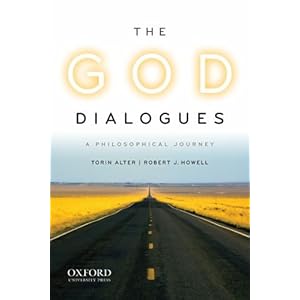 The God Dialogues is a great book for teaching philosophy of religion to undergraduates, but also engaging and enlightening for civilians. The dialogue goes on between three students traveling around the US--mnemonically named THeo, evA, and GeNe. You guess what position each takes. There is amusing banter among them, but mostly they are the ideal interlocuters. They're clear, they're coherent, they're witty. They even occasionally write out arguments with precision on pieces of paper.
In a book like this, and in philosophy generally, the explainer's job is to present each argument so it makes as much sense as it possibly can. Counterarguments have to be presented charitably as well. The book is a model of impartiality, but the nice thing is that the interlocutors themselves are invested in their own positions. That invites the reader to take a stand too. A more encyclopedic overview of positions tends to make the reader/student just assimilate passively, instead of grappling.
So let's do some grappling. The great thing about the book is that it tells you everything you always wanted to know about certain arguments, but were afraid to ask. True confession: I never quite "got" the modal version of the Ontological Argument. As I recall from the last time I took a dive into the contemporary literature on the subject, it was pretty technical and dense. So I was very happy to be enlightened in no more than a few painless pages.
So here we go... starting at page 90, after Theo the theist has given a quick snapshot of the modal version of the ontological argument.
THEO: Surely you think the conclusion follows from the premises.
EVA: Actually, I'm not sure. It would help to have them...
THEO: Written out in premise-conclusion form? Already done.
GENE: Wow. Did you wake up early this morning and prepare for this discussion?
THEO: Well, yeah.
GENE: You bum.
THEO: It's better than spending the morning with my head under a pillow.
GENE: Good point.
THEO: Thank you. The argument has two parts. The first establishes God's possibility, and the second infers His actuality. Here's the first part:
2. If it's conceivable that God exists, then it's possible that He exists.
3. Therefore, it's possible that God exists. In other words, there's at least one possible world in which He exists.
GENE: Okay.
THEO: And here's part two:
4. If it's possible that God exists, then it's necessary that He exists. In other words, if He exists in any possible world, then He exists in all possible worlds--including the actual world.
5. Therefore, God exists in the actual world. In other words, God exists.
5. Therefore, God exists in the actual world. In other words, God exists.
GENE: I think there's a little verbal magic going on here.
Eva the Atheist makes an interesting concession right away--if you want to block this proof, you're going to have to ramp up your atheism. You're going to have to reject the first part of the argument, and deny that it's even possible that God exists. You would have thought atheists just believe God doesn't exist, not that he couldn't exist. The argument thus succeeds in a strategic sense--it pushes the atheist toward a position that seems too strong.
Or does the atheist have to go that route? I found myself wanting Eva to accept the first part of the argument, but challenge premise 4. The whole idea of God as a necessary being strikes me as peculiar. Theo explains it like this--
THEO: ... If God existed contingently, then His existence would depend on the way things turned out--on luck, or in any case on something other than Himself. But God, as a perfect, being, simply does not depend on other things. God is a being that depends on nothing but Himself. (p. 87)
And then on the next page like this--
THEO: ... If God exists, the it's impossible that he would have failed to exist. You're not like that. You do exist, but you didn't have to exist--your parents might never have met. (p. 88)
Maybe there are even some less abstract things that exist in every possible world. Might we think of space as a necessity? Or maybe time? Or spacetime? OK...that doesn't sound crazy. But what's with the idea of an all powerful, all good being, who exists in all possible worlds? Could we also construct the concept of a necessary book, or a necessary person, or a necessary mountain? But obviously none of that even begins to make sense. Why does it make sense that the omnipotent, omniscient creator of everything would be able to add necessity to his laurels? (And don't say it's just "by definition," because the necessary mountain is also necessary by definition, and that makes no sense.)
Another way of making this point occurs to me. If you already have the Cosmological Argument under your belt, and you think you've shown that a world couldn't get going without God, then God must exist in every possible world--no matter how this world had gone differently, there would still be God. Necessity would be an upshot of the proof, along with God's existence. However, the ontological argument is supposed to work from scratch. It would be useless if you needed a different argument for the existence of God in order to make the Ontological Argument work.
 Eva actually winds up overcoming the Ontological Argument by turning it against itself (see pg. 93). You see, two can play that game. Just take the original and put "doesn't" in front of every "exist" or "exists". The argument now proves God doesn't exist. Eva claims this reverse argument is actually more compelling than the original (see pg. 93-6 for details). But making the reverse argument does saddle the atheist with the view that God is impossible. That's certainly atheism on steroids!
And now for Pullman's novel--if that's the word for it. This is a retelling of the gospel of Jesus Christ, with Jesus and Christ portrayed as twins. Let's just say, interesting! I would call the book a discussion-generator more than a really gripping piece of literature, but it's a great discussion-generator. It would be a good choice for reading groups of all sorts--especially for Christians and former Christians. I think it must help if you know the gospels extremely well, because no doubt much of the excitement lies in seeing all the departures from the original. I don't know the gospels well enough to pick up on every intriguing deviation. The book is ultimately about scripture, and how it comes to be...and if I tell you any more I'll spoil it for you. I had read no reviews at all beforehand, and I was very glad I hadn't.
1/5/11
God Books
The kids are back in school, so it's time to get Focused, and I'm going back to Saturday-only blogging. This Saturday I'll be talking about two God books--The God Dialogues, by Torin Alter and Robert Howell (great fun), and The Good Man Jesus and the Scoundrel Christ, by Philip Pullman (interesting). Stay tuned.
1/3/11
Open Thread
This post by Benjamin Nelson lead to a long discussion, which is continuing elsewhere. Maybe there's more to say here (and maybe there isn't). Nothing inflammatory please. I'm just thinking constructive conversation might be a possibility. Somehow the beginning of January seems like the time for it.
1/2/11
Catholic Abortion Ethics

A Catholic hospital in Phoenix was recently disenfranchised by the Catholic church for authorizing an abortion in the case of a woman with a life-threatening pregnancy. Even assuming the mother and fetus would have died, had the pregnancy continued, Catholic ethics says the fetus couldn't be killed to save the mother. We must never intentionally kill an innocent person, even to bring about "the greater good."
It's worth thinking a bit about where the biggest problem with the Catholic position lies. There are two parts to the position: one is that the fetus is a person, no different from a baby or an adult. The other is that we must not kill person A to save person B. Rather, we should let both A and B die.
You get the Catholic position on abortion when you add together the two parts. The result is an intolerably perverse view, but wherein lies the problem? I think part one is the problem, not as much part two.
In fact, in real life situations where the alternatives are "kill A to save B" or "let both die" most of us will think "let both die" is at least sometimes preferable. First, imagine a mother is on a sinking lifeboat with her adopted baby. She knows the baby can't possibly survive--she has no food to give her (or whatever). If the mother throws the baby overboard, the lifeboat will stop sinking and she might survive. I think it's at least ethically coherent for the mother to think--no way, I can't do that.
Another scenario--a mother is holding a crying baby as she hides from the Nazis. She knows that if she is discovered, there will be no hope for either of them. So either she smothers the baby to save herself, or she lets them both be discovered and killed. I can certainly see it as at least coherent if she decides she will not kill her child.
Now, in both these cases, it's the mother who sacrifices herself to avoid killing her child. You might think--that's one thing, but a third party would have a very clear duty to kill the child to save the mother, especially if that's what the mother wanted. Suppose in the second scenario the mother can't bring herself to smother the child, and she asks a bystander to do it--someone whose life is not at risk (for some reason). Now we have a situation a lot like the one a doctor is in, when asked to provide an abortion for a potentially terminal mother.
I don't find it utterly beyond the pale if the bystander says "No, I cannot kill that innocent child. Better to let the two die, than for me to kill one to save the other." This is probably not the right view, all things considered, but it's not just a crazy, mind-addled view. You could have that view based on sheer moral reflection, and without any brain-washing by crazy clerics.
So I don't think part two is what makes the Catholic position on abortion so super-crazy. The problem is really part one. The fetus is not in fact a baby, but only a baby-to-be. To my mind, that means a certain level of care and reflection should precede terminating a pregnancy, but the situation is actually nothing like the three scenarios above. A Catholic mother (or any other) who let herself die rather than abort a fetus really would be delusional, I'm afraid, and a third party at a Catholic hospital even more so.
But you could at least say this for them--if there really were a full grown baby in the picture, refusing to kill it to save the mother would be an ethically comprehensible stance--not sheer irrational poppycock.
1/1/11
Happy New Year!


"2011" sure has a futuristic sound. It's like we might finally have arrived at a time futurists were talking about a long time ago. From the sound of it, you'd think people might be walking around with little mobile video phones and such. Wait...
I hope you will pardon just a little navel-gazing. Courtesy of Blogger, here are the top 10 posts here in 2010 (they began this service in June, so the ranking excludes earlier posts).
 |
| CLICK TO ENLARGE |
You can see the blog doesn't have a huge readership, but I've got some readers, and I appreciate everyone of you (sob, smile). I sure do get extra readers when I write about atheism and especially when I involve myself with Giant Kerfuffles. That sounds like a huge, fat, amorphous green thing, which isn't a bad description of the whole "TJ" affair.
How nice that "Pescatarian" got (and continues to get) so many readers. All the views for "The Moral Landscape" reveal something interesting. Just because people aren't commenting on a post doesn't mean it isn't being read.
Happy New Year!
Subscribe to:
Posts (Atom)