4/20/10

Francione vs. Smith

Here (see 4/16 podcast) is a debate between Gary Francione and Wesley Smith on the Michael Medved show.  I reviewed Smith's book recently and I've blogged before about Francione.

They start by agreeing on the distinction between "animal welfare" and "animal rights."  Either you support business as usual, but want the usual things to be done nicely, or you think that animals are persons with the rights we usually attribute to persons.  Both are invested in the dichotomy, but for opposite reasons. 

There really is a middle path.  In fact, when Francione makes his argument against eating animals, he doesn't rely on rights talk. He simply says:
(1) It's wrong to inflict unnecessary suffering on animals.
That's an irresistible principle.  It makes for an irresistible argument against meat-eating considering that what we obtain from eating animal products is (usually...in most cases...) just pleasure and convenience.

Wesley Smith fails to respond, instead repeating some familiar bromides about how meat-eating is natural.

Francione quickly forgets he's talking to a defender of the status quo, and starts attacking a completely different foe--Humane Society style animal advocacy (or "welfarism," as he misleadingly calls it). 

Francione comes back to Smith's assertion that it's natural to eat meat.... but Medved wants to talk about medical research. Now it starts to be a problem for Francione that he opened with the irresistible principle.  By any measure, some medical research is necessary.  So how can it be wrong?

Francione back-pedals.  Moral justifiability doesn't turn on what's necessary or unnecessary after all!  He grudgingly concedes that some research is "empirically necessary" and "beneficial"...but no, that's not enough. It appears that he believes the irresistible principle, but also believes:
(2) It's wrong to inflict necessary suffering on animals.
Observation: when someone asserts (1), there's an "implicature" that they reject (2). That's part of what makes (1) so irresistible.  When you assert (1) and then (2), it's a whole new ballgame--the "animals are persons with rights" ballgame.

Next:  a change of subject and a reminder that Smith and Medved are capital "C" Conservatives.  Smith is bothered that Francione believes in a woman's right to abort a fetus but not the right to eat a chicken.  Francione points out that the rights-holding fetus is inside the rights holding woman, whereas the chicken isn't.  There's a difference. He throws in some stuff about racism and patriarchy that elicits derision.

Smith brings up PETA's Holocaust on your Plate campaign.  Colonel Sanders vs. Hitler.  Francione says he isn't interested in ranking evils.   It's all wrong.

Medved:  In Exodus, Moses kills the overseer who is beating an innocent slave.  We generally think that human beings are obligated to kill others and risk their own lives to stop the suffering and death of human beings.  Are human beings obligated to do the same to stop the suffering and death of animals?

Francione: Moses shouldn't have killed the overseer. (Smith points out that Francione is a pacifist.)

Medved shifts the focus from killing bad people to sacrificing yourself to prevent their misdeeds. What about sacrificing yourself to save 1000 people. If that's obligatory, must you do the same to save 1000 animals?

Francione: You could save 1000 right now by donating your organs at a hospital.  It's not obligatory, but it's admirable.  

OK, but would it be just as admirable to sacrifice yourself to save 1000 animals as it would be to sacrifice yourself to save 1000 humans?  Francione won't be cornered into answering such questions.

Francione comes back to the idea that it's wrong to impose unnecessary suffering on animals.  99.9% of our use of animals is unnecessary, he says.    It seems a tad disengenuous to keep pushing (1) when he also believes (2). It makes is seem as if he's just applying common sense, when in fact he has a revolutionary view of animals as persons with basic rights as strong as ours.

Smith pipes up about the main claim of his book--animal advocates are undermining human exceptionalism.

Francione:  what is special about humans is our ability to love, feel compassion, reach out, help the vulnerable other.

It really is the height of irony when people like Smith blow the trumpets about human specialness, which to a great degree consists of our extraordinary moral goodness (he says), and then use that to defend hideous acts of cruelty.   Please.  

Medved to Smith: How would we be worse off if the status of animals changed?

Smith: if we see ourselves as just another animal in the forest, we will act like that.

This is one of the very implausible themes of his book.  It's strange how people throw around predictions without any evidence to support them.  Are animal advocates really a more "animalistic" bunch than the rest of us?  I had not noticed that. 

He goes on to say: we'd be worse off without meat, medical research, wool coats, horse riding, etc.

Surprise revelation during this debate:  conservative commentator Michael Medved is close to being a vegetarian (he only eats fish).  Based on that and his line of questions in the interview, I'm going to recommend my book to him (what chutzpah).  Animal ethics without equality--I think that's his stance, and that's what I argue for.

4/19/10

Notes from a Conference


Feel like a traitor to my tribe.

Standing ovation for Laura Bush (very pretty)... can I do it?... gotta do it ... not for GWB, though. Just can't.

They met with cyberdissidents this morning.

The thrill of celebrity--have I succumbed?  Laura talks about "freedom fighters"...echoes of Ronald Reagan.  "Women's rights are human rights."  The Amnesty slogan from a few years back.

George Bush comes to podium.  He sounds so much like...George Bush!  Couldn't not stand up.  It was manners, not admiration.  One guy didn't stand up.  Is this the place to protest past policies?  Accepting invitation = observing rules of etiquette.

After opening remarks, George leaves, Laura stays.  Is he incurious, like they used to say?

Conference is about internet freedom.  Presenters from "Freedom House." What's Freedom House?  Lots of brochures and handouts.  Keep wondering--what's the connection to burnishing GWB's image?  Is there one?

Ethan Zuckerman is a good speaker, but I'm not sure what he said.  Twitter is bad, he seems to say.  On the other hand, Twitter is good. "Digital space as the new public sphere."

Secret service people follow Laura Bush even to the bathroom. 

The most secure network for dissidents is the cellphone network. Governments aren't going to shut it down.

Proxies not the answer to gov'ts messing with ISPs.

Panel of cyberdissidents...they have various professions, but most are here because they're bloggers.  Blogging as radical act...

Two are ashed-in in Europe, but on screen via skype. 

Some of the dissidents are "live twittering" the event while onstage.

Tons of cameras, lovely auditorium. Too bad I must reenter real world to teach and miss fancy lunch.

Instinct to reciprocate is powerful.   Appreciated invitation, enjoyed event.  How could I blog about it? Seems so ungrateful.  Must limit snark.

Blogging as act of freedom. Must do it, despite questionable etiquette.  I'm a cyberdissident!

Not really.  It was fun. Came out valuing internet and cellphones more. Now if my students would just top using them in class to go on facebook.

[No, I didn't live blog this.  It just looks that way.]

4/18/10

Choosing to Limit Our Choices

From a review of the book The Art of Choosing, by Sheena Iyengar, in today's New York Times:
Iyengar began her scholarly exploration of choice with an undergraduate research project. She suspected that religiously observant people who obey lots of behavioral restrictions would feel unable to control their own lives and thus pessimistic. To test this hypothesis, she interviewed more than 600 people from nine different religions, ranging from fundamentalists to liberals. She surveyed their religious beliefs and practices, asked questions to test optimism and had them fill out a mental health questionnaire. What she found surprised her.
“Members of more fundamentalist ­­faiths experienced greater hope, were more optimistic when faced with adversity and were less likely to be depressed than their counterparts,” she writes. “Indeed, the people most susceptible to pessimism and depression were the Unitarians, especially those who were atheists. The presence of so many rules didn’t debilitate people; instead, it seemed to empower them. Many of their choices were taken away, and yet they experienced a sense of control over their lives.”

In retrospect, the result seems obvious. Even many atheists would agree that believing that God cares about you or that your life is part of a cosmic plan can be a powerful source of hope (or, to put it pejoratively, a crutch). Meaning is as important as choice. Besides, Iyengar conducted her survey in the United States, where people are free to switch religions and often do. If keeping kosher or refraining from alcohol makes you feel constrained and helpless, you can abandon those strictures. The only people left in the restrictive groups are those who value the rules. In a modern, liberal society, religious observance does not “take away” choice. It is a choice.
Question for Sam Harris:  if ethics is all about promoting well-being (as he's arguing in a forthcoming book), can it be ethical to try to turn theists into atheists?   Would people really be better off if they were "freed" from religion?  There's a fine line here. I wouldn't hesitate to take a skeptical position in a philosophical debate. I am a skeptic!  It's proselytizing that bothers me--really working to convert the masses. It's not at all clear to me this would be for the good, and Iyengar's book seems to bolster that hunch.
Unlike “provocative” books designed to stir controversy, “The Art of Choosing” is refreshingly thought-provoking. Contemplating Iyengar’s wide-ranging exploration of choice leads to new questions: When is following custom a choice? How costly must a decision be to no longer qualify as a choice? Did Calvinism spur worldly achievement because its doctrine of predestination removed all choice about the hereafter? Do con­temporary Americans adopt food taboos like veganism because they crave limits on an overabundance of choices?
Well, veganism is not just a taboo--if the paradigm of a taboo is the rule certain south sea islanders have against women eating in public. It's an ethical proscription.  However, it's fascinating to consider whether vegan and vegetarian diets also satisfy a craving for choice-reduction.
Human beings, Iyengar suggests, are born to choose. But human beings are also born to create meaning. Choice and meaning are intertwined. We use choice to define our identities, and our choices are determined by the meanings we give them, from advertising-driven associations to personal relationships and philosophical commitments. Some meanings we can articulate, while others remain beyond words. “Science can assist us in becoming more skillful choosers,” Iyengar cautions, “but at its core, choice remains an art.”
This goes on my list of books I need to read.

4/17/10

Ashed In

Live in Europe?  Feeling ashed in?  Tell us about it.  After 9/11, it was noticeably odd to have no plane noise overhead and no contrails. Is it noticeably quiet in the UK and elsewhere?  In the summer, we're planning on flying to Paris. Dear Icelandic Volcano, Calm down.

14 billion, not 6,000

Here's the question du jour at atheist blogs:  if a science teacher explains that the universe is 14 billion years old, may she explicitly draw out the implication that the universe is not the age the bible implies it is--6,000 years old?  May the teacher say, "Since it's 14 billion years old, the bible is wrong about the age of the universe"?

One side says: weird, weird, weird. How can it be forbidden to go on from (1) to (2), (3), and (4)?

(1) The universe is 14 billion years old.
(2)  The bible says it's 6,000 years old.
(3)  If it's 14 billion years old, then it's not 6,000 years old.
So, (4) The bible is wrong about the age of the universe

All the fun started with Michael DeDora here (you can find out what the initial issue was there) and the insults started with PZ Myers here, then there was this from Massimo Pigliucci, and this from Jerry Coyne, and then this from Ophelia. 

Here's the other side.  First, therere's the problem that saying (2), (3), and (4) picks on one religion.  Hindus and Buddhist believe in a universe with an infinite history (or so I recall).  How can it be right to spend time attacking biblical ideas, but ignore Hindu and Buddhist rivals?  That doesn't sound very even-handed.

Second, there's a problem with (3).  Different religions have different ideas about religious truth.  Scientific truth is one thing, "sacred truth" is another, some say.  So the earth is 14 billion years old, but it's also (in some sense)  6,000 years old. So some reject (3).  Now, that may be poppycock, but could it really be a science teacher's job to get into it? What training do public school science teachers have in these philosophical matters?

Third, there's a question of the deal we've struck on these issues. Many fundamenentalists really don't like having (1) taught in school, because they think (2) and (3) are true, and they don't like the implication that (4) is true.  As I understand it, the deal we've got now is--science teachers get to say (1), if they don't say (2), (3), and (4).  Now, to many religious parents, they're already getting the raw end of the deal.  They know their kids are going to be thinking (2), (3), and (4), even if only (1) is openly stated.  So the deal is fragile and fraught, and there are frequent battles about it.  In that context, is it really wise to ask for more?

Fourth, as a parent, I'm rather sensitive to what's crammed down my kids' throats during school time.  I think I'm entitled to be the primary shaper of their attitudes on religious and moral matters.  Occasionally teachers stray into these private, family areas, and I don't think "Oh wonderful, my kids are being asked to critically scrutinize their beliefs." Not at all, because lower level education is rarely about crticial thinking. The teacher is right (actually, more often wrong when they get into religious and moral matters), and that's that.  What I think is "butt out."  To be consistent, I must take the side of religious parents who would want a science teacher to butt out and say no more than (1).

4/16/10

Everything You Think is False

Doesn't it sometimes seem that way?  Recently I learned that extremely poor people are reasonably happy and optimistic. I also read that developing countries spend less on health care themselves, as a result of foreign donations.  So a dollar sent is not exactly a dollar added to existing resources. I'm teaching an article in my environmental ethics class that shows how abolishing hunting reduces the amount of wildlife in African countries, and allowing hunting increases it.

Now I learn (thanks to Dom) that kids in orphanages aren't destined for lives of misery and sorrow, but actually do better than average in adulthood.  This is all very annoying, because it means that you basically can't reason about any moral issue without first digging through piles and piles of research. And that's not what philosophy is supposed to be like!  Whatever happened to the comfortable armchairs we were promised in graduate school?

Anyhow, here's the post (from a "hot shot research assistant") about orphanages.  The author concludes that parents have an obligation (if utilitarianism is true) to give up their "tots." This reminds me of the paradox of retirement in Saul Smilansky's book 10 Moral Paradoxes.  Are you in the bottom 50% of a "helping" profession?  (Does philosophy count?)  Then it seems you're obliged to quit and let someone better take your job. 

I'm going to run the orphanage business by my kids when they come home from school and see what they think.  If I play my cards right, I should be able to get them to say that I am an exceptional parent, and I'm not just permitted to keep them but obligated.  I'm going to take this slowly and choose my words carefully. 

Note, if I'm not so exceptional, I just have to send them packing "if utilitarianism is true."  A philosophy graduate student recently interviewed at Let Them Eat Meat (the blog is my new guilty pleasure) says utilitarianism is "the laughing stock of ethics."  I really don't think that's true.  Utilitarianism may not be "the moral truth, period," but it's a point in logical space that all ethicists return to over...and over...and over again.  This sums up my attitude toward utiltitarianism:  "How could it be true?  But then, how could it not be true?"  The back and forth stimulates lots of further reflection about the nature of morality.

4/15/10

The Argument from Marginal Cases

In an otherwise very positive review of Animalkind (thank you!), Elisa Aaltola chides me for not accepting the argument from marginal cases.  So...let's talk about it!

The argument from marginal cases is really a family of arguments.  You start with a spectrum of cases, perhaps thinking of every creature as standing in a line according to ability.  

Cog and Chimp are just alike, as far as capacities go.  From the fact that we feel equal concern for Norm and Cog, the argument tries to leverage equal concern for Norm, Cog, Chimp, and Mouse.  Here's an example of this sort of argument (this is inspired by Tom Regan, but not directly from his writing).
(1)  Norm and Cog have the same inherent value and thus the same basic rights, despite their huge differences.
(2)  That must be because they share sentience (Regan actually talks about a slightly more advanced but ill-defined attribute--being a "subject of a life").
(3)  But Chimp has sentience too.

(4)  So Chimp has the same inherent value and basic rights as Norm and Cog.

(5)  Mouse has sentience too.

(C)  So Mouse has the same inherent value and basic rights as Norm, Cog, and Chimp.

If this were a good argument it would be prove a lot.  If you thought Norm had a basic right to life, it would prove that Cog, Chimp, and Mouse do too.  That would foreclose many things we normally consider permissible, like experimenting on Chimp or Mouse or eating them, if human survival were at stake. 

Is it a good argument?  We're to affirm (1), which is fine, but I think that affirmation is not simple.  There's a lot going on in our heads when we think Cog has all the same basic rights as Norm.  A lot of this is pretty recent stuff.   If you go far enough back, disabled people actually were seen somewhat as animals are today.  They were used in medical experiments for the benefit of the rest of us (not incessantly, but occasionally), and some were even put on display at fairs.  Amazing, but true.

What we have now is a "championing" mentality.  How dare anyone not give Cog the same rights as Norm?  We identify with Cog, becuase we've been taught to stop thinking of people with disabilities as "other".  We now realize that there are no immutable lines between "us" and "them." If I wind up in an accident or suffering from Alzheimer's disease, I will be disabled. 'That could be me" opens the door to all sorts of caring moral emotions.  So--there's  a lot going on in our heads when we accept (1).

But that stuff is thrown out at the next step.  We are told that Cog's sharing Norm's basic rights rests on nothing but his being sentient like Norm. We are not allowed to see any complexity in our reaction--like its being partly a matter of seeing the capacities Cog does have, and partly a matter of sympathy, and partly a matter of wanting protection for our own relatives some day, and partly a matter of knowing that could be us some day.  We are to abandon all of that and just settle for the idea that Norm and Cog have the same basic rights because they are both sentient.

But how plausible is that? Those who make arguments like this never explain how you get from simple sentience to immensely powerful rights. On the face of it, there's a huge gap to be bridged.  Having basic rights is a hugely significant thing.  Rights are like a magnetic charge that attracts and repels.  If you have rights, that forces all sorts of adjustments on everyone else.  At the very least, they have to "give you your space," however much that may inconvenience them or set back their serious interests.  Sheer sentience can do all that?

In my book I imagine some tiny little creatures called Pangfish. They have limited sentience, consisting in nothing but the ability to suffer headaches.  When the headaches go away, their consciousness fades out.  That's their whole conscious life. I find it utterly fantastic to suppose that on such a slim basis they could have the sort of inviolability that would force me to choose death rather than eating them. Or that would force a medical researcher to let thousands of people die, rather than extracting some life-saving chemical from them.

So I buy (1), but not (2), and that stops the argument from successfully supporting the conclusion.  I think we need a better explanation why Norm and Cog have the same rights, one that refers to things they have in common internally, but also to our emotions, "the social contract" we have as members of one community, self interest, and so on.  I grant that's a hodgepodge, but I think it's better than the obviously inadequate explanation offered by (2).

What I'm saying does not leave Cog out in the cold (obviously).  It also does not leave Chimp and Mouse out in the cold.  The details are discussed at length in my book, but based on what capacities they do have, we do owe them respect, and that does force us to make careful decisions about what we may and may not do to them.  Furthermore, sheer sentience does make some difference. We should not gratuitously cause pain.  If I'm going to eat Mouse because my life depends on it, I shouldn't cause him more pain than necessary.

In short, I don't buy the argument from marginal cases in my book because I think it's very weak. In fact, I'd go further. I find it rather offensive, and so do the students I teach.  The idea that some people are "marginal" offends them.  People with disabilities have only recently been raised in status--in fact, in earlier versions of Animal Liberation, they are referred to as "mental defectives"!  (Good heavens.) Most people in our society do think that animals are "just animals." So the "Cog= Chimp" equation is more likely to demote Cog than to elevate Chimp.  Finally, it's inane to think that animals are like humans, but just less capable. Chimpanzees have capacities and a way of life all their own.  My book champions animals without making any comparisons between them and people with disabilities, and I think that's all to the good.

Animalkind Review

From Times Higher Education--

Philosopher Jean Kazez takes as this book's starting point the difficult, highly relevant, and often avoided question: "How should we treat animals?" She approaches the question from different angles, which one by one coalesce into a coherent argument. This work reads as a journey into animal ethics, within which the author, together with her audience, is seeking to find the right answer.
First, Kazez looks at how we have valued and treated our non-human kin in the past and present. Viewpoints from different cultures, biblical interpretations and grand old philosophers are briefly analysed. After this, attention is placed on the nature of the beast, as Kazez takes a deeper look at what types of minds animals have. The third part concentrates on ethics, and finally, in the fourth part, she reminds us of the context of the question: how what we do to domestic animals affects wild animals and ecology in general.
Kazez has many highly plausible things to say. She attacks the intellectually lazy anthropocentric tradition, according to which animals have very few and very primitive cognitive capacities. The fascinating spectrum of animal capacities is brought to the fore, and the reader is quickly convinced that even if they are instinctual, animals are also highly cognitive creatures, capable of thinking, feeling and awareness. She also argues that animals should be given significantly more respect (all due respect, as she says in the playful tone that runs throughout the book) than contemporary society is willing to admit. We simply cannot treat beings with minds as mere matter, and the horrors to which animals are subject are inexcusable.
What is interesting is that Kazez combines two notions that are usually alien to each other. On the one hand, she argues for ethical vegetarianism and veganism. On the other, she maintains that, while much animal research may lack justification, research that is necessary for the basic welfare of human beings can be justified. We should give up animal products because in the contemporary world they are unnecessary for survival, cause a great deal of suffering and are harmful to the planet - however, vivisection is justified when absolutely necessary.
Overall, the arguments she presents are intelligent and convincing. But she does get into trouble when she seeks to justify vivisection. Most specifically, Kazez fails to explain away "the case from marginal arguments". If we believe it is morally unjustifiable to use human beings of very low cognitive ability in experiments, why is it permissible to use animals of a higher cognitive ability? Why is biology (species) so important here, when in other contexts it is highly unimportant (biological sex, "race", age, etc)?
Kazez is rather brief in her argument, but the gist is that we favour "unfortunate" humans because of sympathy, and we have sympathy because we could, ourselves, end up like them. Ultimately, we save the mentally impaired because of self-interest. This is rather cynical. One could say that "unfortunate" humans (perhaps an ill-chosen term) have value in themselves and deserve respect regardless of our self-interest. There is reason to hold on to the argument common in animal ethics: inherent value is based on the capacity to experience one's existence. This renders experimentation on both humans and animals dubious. Kazez would have done well to explore the philosophy of animal rights more thoroughly.
Setting aside this criticism, Kazez has written a persuasive book. It may not satisfy more radical thinkers and activists, but it will offer brain food for those who follow the taken-for-granted ways of treating animals. Kazez writes in an enjoyable and accessible fashion, and wit and humour are used generously. Combined with many fruitful arguments, this makes the book a good read for anybody curious about whether it is, indeed, morally justifiable to eat one animal and love another.
Reviewer: Elisa Aaltola is lecturer in philosophy, East Finland University, and fellow, Oxford Centre for Animal Ethics. She is the author of Elainten Moraalinen Arvo (2004), Animal Individuality: Cultural and Moral Categorisations (2006) and is currently writing a book on the ethics of suffering.

I'm going to discuss why I don't accept the argument from marginal cases in another post, but I want to quickly set the record straight on disabilities.  I don't deny that people with severe impairments "have value in themselves and deserve respect regardless of our self-interest."   There is a level of respect owed to each human and animal, and a value we have to recognize, regardless of self-interest.  However, this value is not constant. Its basis is not the minimal fact of "experiencing one's existence."  There are differences that make a moral difference.  For example, if we must eat some animal for dinner, better it should be a rabbit than a chimpanzee.  Is it the same with people--better to rescue the "normal" before the impaired after a natural disaster?  I argue that a second factor kicks in here.  We ought to think about what we would want for ourselves, if we're ever in that position, what we would want for family members, descendants, and those we identify with. There's a "social contract" component to between-humans morality.

Respect is rock bottom and non-negotiable.  But according the same respect to all, regardless of differences--that's a choice. I think it's a reasonable choice when it comes to our treatment of other people.  But not when it comes to animals.  We really should eat the rabbit before the chimpanzee.  Before you say "speciesist!" think about the word. Speciesism is a bias or prejudice.  If there's a reasonable case for "equalizing" people but not animals, to think so is not speciesist.  "Cynical"? I see myself more as struggling to explain things that are hard to explain.  I'd rather say that "all creatures are created equal and endowed by their creator with inalienable rights," but I'm afraid that just doesn't strike me as true.

Stay tuned for a post about the argument from marginal cases.  It amuses me that some THE editor (surely) mangled the phrase and called it "the case from marginal arguments."  Marginal argument indeed!  I think it's relied upon much too much int the animal ethics literature.

4/14/10

Manure

So I've been thinking about manure a bit (unfortunately).  It started when I made my latest attempt to plant a vegetable garden.  Last time I tried this, I wound up with a very tired daughter, 3 green beans, one tomato, and a gigantic cucumber.  I wanted to do better, so sprang for the cattle manure at the garden shop. 

On the way home, the stench in the car stimulated thoughts about whether the manure was really a good idea.  Though putting manure in soil doesn't feel like putting a hamburger in your mouth, it isn't much different.  You are supporting the meat industry when you pay for byproducts of the meat industry. 

Which got me thinking:  should vegans buy organic vegetables?  It seems not, unless they're specifically marked "vegan" and grown in soil enriched by vegetable matter.

Which got me thinking some more: why not human manure?  There's no shortage of it.  In a vegan utopia, would that be the solution to the problem of soil enrichment?

This seemed really pie-in-the-sky, but then I went to a lecture about genetically modified food.  Dr. Pia Vogel gave a very balanced presentation of the pros and cons of GM agriculture, industrial agriculture, and organic agriculture.  A worry about organic agriculture is that farmers are starting to fertilize with human manure.

They are?  The organic vegetables at Whole Foods are grown in our crap?  Yes, she said that the city of Houston takes sewage and turns it into organic fertilizer pellets. Now, from what I can see, the stuff is not actually being used yet on organic farms.  The Houston crap is spread on grazing land and used in landfills.  But apparently there are companies that do sell human "biosolids" to organic farmers and gardeners like me.

Eww? Dr. Vogel said we should worry about human poop containing drugs, hormones, and antibiotics we consume.   So: not actually such a good idea.  But animals are fed all that stuff too, except the very small number raised organically. So using animal manure isn't smart either, unless you happen to have your own private cow.

Horrifyingly enough, it's starting to look like the perfectly ethical gardener would skip all the manure, and choose between low-yield vegetable compost and inorganic fertilizer. Or even make use of GM crops (some day available to gardeners?), which can be easier on the environment.

The head spins. Meanwhile, the garden has been planted.  It turns out the stench was not from the cattle manure, but from composted cotton plants we had bought as well.  All odors have now disappeared and we have shoots!  This year I am bound and determined to have a vegetable garden that actually yields vegetables.

By any means necessary!

4/12/10

The Philosophy of Pepperoni

So...you're a vegetarian and your pizza arrives with pepperoni on top, contrary to your order.  Julia Galef watched a friend face this dilemma, and disapproved of her for throwing out the pepperoni.  Considering that the order has been placed, and there was no undoing the damage, she thought that was irrational.

Here's what she doesn't get.  If you haven't eaten meat for a long time, it can both taste good and seem unpleasant.  Best guess: that's why the friend spurned the pepperoni.

But more interestingly, there's also this:  When you choose a rule to follow, you have to consider the rule's content, but also the rule's followability.  Giving up animal products is a discipline, for most people.  It takes self-control.  Take the rule "never eat pepperoni."  That's a little overbroad, contentwise.  It generates more abstinence than necessary, ethically speaking.    Yet it's a great rule for many people, because it gets you out of the habit of eating pepperoni. It removes pepperoni-eating as an issue. 

The alternative is "never eat pepperoni unless the meat would otherwise go to waste."  It seems to make sense, but it isn't very followable.  If you eat pepperoni on messed up orders, and off your friends' leftovers  you'll be stimulating your yen for pepperoni.  Adopting that rule is likely to generate less abstinence than necessary, ethically speaking. At least for pepperoni coveters, the simple rule is the way to go.

I would have thought this was obvious.  In lots of areas of life, we follow over-broad rules. You follow a rule against stealing to keep you on course not to steal when it really counts.  You follow a rule against lying because most of the time it's important not to lie. We wind up being more restrained than we really need to be, but it's for the best. (And we can still make exceptions, of course, when it's really important to do so.)  Not eating pepperoni on that pizza is the same kind of thing.  It keeps you on course to turn down pepperoni next time it actually matters.

4/10/10

Reader, I Bought It

Lierre Keith’s book, The Vegetarian Myth, that is. I confess, I bought it because the author got pied by angry vegans and that made me curious.  (This is a lovely example of wrongs that don’t harm. I believe the book is doing very well largely because of the pieing.)
First, the book’s style. Sometimes it reads like recovery literature.  In her 20 years of being a vegan, Keith suffered mightily, both from countless health problems and moral torment.  Sometimes it reads like the literature of religious awakening.  Out of the darkness of veganism, she is reborn into the light of meat-eating. There’s also a coming-of-age component.  Before she was a child, now she has “adult knowledge.”   This recovered, enlightened, knowledgeable adult now speaks to us as a prophet, a healer.  She issues fervent commandments.  She tries to save us from our agony, our childishness, our stupidity.
Phew. So what’s the adult knowledge she wants to share so we too can be saved?  I’m going to distill, here, but I’d say her primary message is that life comes from death.  To wit:  there are worms and little creatures in the soil, mice in our fields, predators in forests, bacteria in the rumens of cattle, and such like. Not only does life come from the death of animals, but it also comes from the death of plants. Thus, any diet we can choose will involve the death of plants and animals.  Keith didn’t know these things during her 20 years of wandering in the vegan desert.  Now that she’s found it out, she wants us to know too.  
But what does it all mean? Isn’t there a difference between eating cows and eating carrots?  No, she says.  Part of her adult knowledge is a wildly anthropomorphic view of plants.  On her view, plants make choices.  Apple trees want us to eat their apples, and want us to defecate on the ground, so that the seeds can become new apple trees.  If we don’t do this, then we’re not doing what the tree wants.
Keith even thinks plants are sentient. So are all the tiny creatures in the soil. Which makes me think: there is adult knowledge even in a dictionary.  Look it up!  A sentient apple tree would consciously want things and feel things.  It might, for example, enjoy the gentle tug when someone picks an apple, feel pleasantly lighter after the picking, perhaps get mad at people for defecating in the wrong places.  Sentience means feeling. 
All signs are that feeling takes place in brains.  No brains in apple trees, no feelings.  No brains in bacteria, no feelings. It probably also takes a brain with a  certain amount of sophistication for there to be feelings.  It does not at all go without saying that worms, because of their nervous systems, have feelings.
As to values, I’m equally unimpressed.  In Keith’s universe, there’s absolutely no difference between driving a spade into the ground and accidentally killing a snail, and driving recklessly down a busy street and killing a child.   This hyperegalitarianism is essentially mystical and religious, not rational, and certainly not enlightened.
Some readers of this book are going to feel much better tucking into their next hamburger and ignore everything else. In fact, Keith preaches a gospel of abstinence. It’s just that she’s changed her mind about what we should abstain from.  From being super-vegan, she goes super-green.  Don’t have children, she says. Don’t drive a car.  Don’t live in a city. Don’t live in a place where food can’t be grown locally.
And there’s more.  Don’t support agriculture. You heard that right—the crime of crimes is planting annual crops.  So: no wheat, no oats, no corn, and (for God’s sake!) no soybeans.  Eventually topsoil is damaged, so agriculture isn't sustainable.
So:  build yourself a little hut, get yourself a goat and some chickens.  I’m pretty sure she’ll let you have a garden, but only if you fertilize with goat and chicken manure.  Heaven forbid that you should walk into the Home Depot garden shop.
What next?  If “Thou shalt be green!” replaces the ten commandments and the categorical imperative and the greatest happiness principle, how may I fill my time?  If we mustn’t ship in oatmeal from across the country, may we ship in books?  Can I have a computer if it’s manufactured in China?  Do I have to dress in skins?
Does your ultimate greeniac have a goat or not have a goat?  I think that’s the fascinating (or not so fascinating) question this book is really about. She says: get the goat.  It’s good for you too. She never met a low-carb salesman she didn’t love.
But what about the goat?  Remember:  vegetables are sentient. Apple trees get mad when we use flush toilets. So the goat matters, but not especially.
I say: the goat matters, and yes, especially.  The city folk matter, because there’s a ton of them.  There’s no point in contemplating the end of agriculture, because you need it to feed 7 billion people. And let’s not kid ourselves: it’s complete nonsense to think that our giant herds of livestock are easy on the earth, while crops are brutal.  Livestock needs lots of space. They displace wildlife. They use tons of water and erode land.  We’re already using 1/3 of the earth’s non-ice land surface for livestock.  Responsible environmentalists know that we need less meat, not more.
Putting aside animal issues, this book raises an interesting question:  if the ultimate green life is not a good life, do we have to choose it anyway to keep earth habitable for as long as possible?   I don’t really think so.  What the point of chugging away in our gardens, childless and with only the provisions that we can get within bicycling distance?  I think I’d get tired of reading the super-local poets and having quilting bees or whatever it is that’s supposed to fill my time.  There’s a reason people gave up that life 10,000 years ago.  They preferred a different one.  I prefer a different one. If we really can't live a good life on earth forever, then so be it.
Reading this book made me want to run out and buy Thomas Friedman’s book Hot, Flat, and Crowded, with all it's clear-eyed realism. We’re not going back in time, we’re going forward.

4/8/10

Consider the Oyster

Here.  A great little essay on the reasons to be vegan, but not to be a purist.

You know you're online too much when...

My publicist at Blackwell tweeted yesterday about the "twettle," a kettle that seems to send you a tweet when your water has boiled.  I thought it was ironic that she tweeted that this was depressing, and then I got to thinking about whether it's depressing at all.  In fact, the internet does seep into our lives in a disconcerting way.  The other day I was doing some gardening, and I was struck by how...well, how 3-dimensional everything was. You "get around" in gardening in a completely different way than you get around the internet.  Duh. 

The funny thing is that spending a lot of time online makes "surfing" and "following links" and "googling" seem like the default. In fact, recently I was looking around the house for a lost...who knows what?  (We constantly seem to lose things around here.) And it actually crossed my mind that I ought to be able to just google it.  What better way to find what you're looking for?   Searching in the real world is just so crude. You have to walk from room to room, open drawers, lift up stacks of stuff.   Last thing I need:  a twettle.

4/7/10

Let them Eat What?

OK, so I disagree with Rhys Southan about some important things, but he's a good interviewer and he has a wickedly funny blog.  His interview with me covered all sorts of interesting topics.

As to my being a symbol of the resistance.  You can find out what he's talking about (colorfully) starting here and then in all these posts.

So, who is Rhys Southan?  After I agreed to do the interview, I googled him. (My son tells me that's doing things in the wrong order.)  He cowrote and codirected "Who is Jim Holt?" a musical play that I read about a while back after googling philosophy writer Jim Holt (no relation). Next for him was a play called "Stuck in Delaware," about a woman with warrants for her arrest in every single state except Delaware. 

He's an ex-vegan (after nine years of being a vegan) and a former cook at Angelica's Kitchen, the famous vegan restaurant in New York. He's also a former intern with Reason magazine and with John Stossel (ohhhhh....now I get it). For the moment, he lives in Dallas. Next for him: finishing a screenplay, moving to Los Angeles, and then (obviously) it's on to Iceland.  

Here's how the interview began:
How long have you been vegetarian?
I’ve been a vegetarian for 17 years. I became a vegetarian not long after seeing The Animals Film. I’d been thinking about these things for years, but the disturbing images in that movie made me “ready” to make a change. The truth is, though, that I didn’t actually make the change until I met my husband some months later. He was already a vegetarian, but more for health reasons. I talked him into the idea that the moral reasons were more important.  link

4/6/10

Sam Harris Derives "Ought" from "Is"

Here.   Basically it goes like this (cutting to the chase):

(1) x IS an action or practice that will produce the worst possible misery for everyone.

So (SURELY!!!!  COME ON!!!)

(2) x OUGHT not to be done.

Why, you might wonder, should we want to derive an ought from an is? We could just recognize rock bottom normative facts, like--

(3) We ought not engage in actions and practices that will produce the worst possible misery for everyone.

Harris paints himself into this corner by being so determined to extract ethics from science.  He wants it to be the case that scientists come up with facts like (1) and thereby get their hands on ethical conclusions like (2).  If we just started by knowing things like (3), we wouldn't know them as a matter of science.  You don't find normative claims like (3) in science books.

Why's it so important to him to get ethics out of science?  Because he's trying to woo the public away from the belief that ethics is derived from religion.  Science is an impressive alternative source for ethics.  It would be harder to convince the public that we can do away with religion as a foundation for ethics if Harris simply said we all know things like (3).

But maybe we do just know things like (3). And maybe saying so is less problematic than saying (1) entails (2). Logically, it just doesn't.  Even if we do know things like (3), without relying on science, that doesn't mean science has no role to play.  Armed with the knowledge of (3), we need to figure out what does and doesn't produce the worse possible misery for everyone.  Science could certainly help us with that question.

4/4/10

Pig 05049


Here's a really interesting sounding exhibit and book: Pig 05049.  It details everything made using one pig's body--all 185 products.  Bill Buford's response here is (I gather) that traditional farmers have a more personal relationship with their pigs, but the killing is just as awful; furthermore, if you're going to kill an animal, you ought not waste any of its body.  So--pig 05049, ho hum? I would say the French pig Buford ate for dinner was better off being able to graze around in a wide open field, while pig 05049 had no real life at all.  Surely we should prioritize letting animals have lives over avoiding wastefulness.

4/3/10

Tithing Atheists

In an interview, Templeton Prize winner Francisco Ayala defended religion as a salve for the poor, and Jerry Coyne had this to say--
As P.Z. has noted, none of us are boorish enough to preach atheism to our dying religious grandmothers. Indeed, religion does bring some hope and meaning: that’s why it is strongest in those societies that are most dysfunctional (e.g., the work of Gregory Paul and others). But religion is also a potent source of poverty, misery and disease (look at AIDS in Africa, for instance, or the effect of Islam on the suppression of women, or of Catholicism on the abuse of children), and by and large it’s an excuse to do nothing. Without faith, we have only ourselves to look to, and, rather than blaming God, we must realize that we have to roll up our sleeves and fix those problems ourselves.
Many problems here. Religion is strongest both in dysfunctional societies and in highly functional societies--like ours. Some religions seem to increase prosperity (Protestantism, Judaism), some seem to decrease it (Islam, Catholicism).

Worse problem: his assertion that religion is "an excuse to do nothing." Apparently not, since some of our most vibrant philanthropists are religious. Tracy Kidder's biography of Paul Farmer is a must read in this regard. It's also true that many of the largest philanthropic organizations are religion-based--like World Vision.

Worst problem: the bit about how, "without faith, we have only ourselves to look to, and, rather than blaming God, we must realize we have to roll up our sleeves and fix those problems ourselves." It seems it doesn't work that way. Today a New York Times article reports that secular households "give less on average than do religious households." Why is that? An atheist by the name of Dale McGowan has an interesting theory, as the article reports.
From a practical standpoint, atheists almost entirely lack the communal infrastructure of religious people--the system of congregations, the pattern of weekly meetings--that enables philanthropy.
It's easier to get involved in good works and give regularly if the opportunities present themselves regularly, and doing good is intertwined with other pleasant activities.

So what's an atheist to do? A. Become a non-believing participant in a religious congregation. That makes varying amounts of sense depending on the religion. B. Get the communal aspect of giving in another way. For example, join your local chapter of Amnesty International and go to the monthly meetings. C. Overcome stasis without anyone's help. Go on, write that check to Oxfam. You know you should. D. Link arms with other non-believers and give to an organization like Foundation Beyond Belief, run by McGowan.

I like what McGowan says here--
One of the things I'm trying to get past is a dismissive attitude about why religious people give--that it's out of fear, a fear of God or a fear of damnation. It's out of a human need. And we secular humanists have to have enough self-confidence to look at what they're doing right as well as wrong.
Indeed. Religious folk don't sit around blaming God. That's nonsense. Quite possibly for sheer reasons of being better organized, they're the ones more likely to fix problems. It doesn't hurt to give credit where credit is due.

4/1/10

Seeing and Believing


Would you find this more/less beautiful depending on which sentence you believe to be true?

A.  The color is the result of dye being added upstream as an April Fool's joke.
B.  That's the color of blood--the result of a huge massacre upstream.
C.  The color is a natural result of minerals stirred up by heavy rains.

Not tellin' which is true (yet). Photo credit:  Rochelle Coffey, National Geographic.

UPDATE: OK, it's C.  The picture made me think of a passage about how we value wildness in an article by Ned Hettinger and Bill Throop.
Imagine how visitors to Yellowstone would feel about Old Faithful if they thought that the National Park Service put soap into the geyser to regulate and enhance its eruptions...People value more highly what is less subject to human alteration or control than a more humanized variant of the same phenomenon.
I react as they predict--believing A would make me find the scene less beautiful than believing C.  Of course, wildness is not an "absolute value."  If I believed B (and believed the massacre was a matter of normal predation), I'd find the color disturbing, not beautiful.  But wildness is something I (we) value.  That colors my thinking about lots of issues...

Quick segue to Matzoh Ball soup.  Seriously. Three ways to make it--

A.  Use fake chicken stock--tastes just like the real thing.  Lots of strange words in the list of ingredients.
B.  Use real dead chickens.
C.  Make rich vegetable stock from scratch.

Is the fakery of A unappealing, like the fakery of dyeing the falls red?  Is the carnage of B unappealing, like the massacre turning the falls red?  Is C the ethical aesthete's best choice? 

3/31/10

Science and Ethics

Some bits from Sam Harris's super-long response to his critics, with my comments--
My claim is that there are right and wrong answers to moral questions, just as there are right and wrong answers to questions of physics, and such answers may one day fall within reach of the maturing sciences of mind.
Maybe one day everyone will agree on some naturalistic story about right and wrong, like "right actions maximize happiness."  If that day ever comes, we'll be able to turn to scientists to find out what's right and wrong. However, to get to that point, you have to struggle with which account of right and wrong is correct.   The folks who do the struggling are not doing science; they're ethicists, philosophers, judges, writers, you and me.
Some of my critics got off the train before it even left the station, by defining “science” in exceedingly narrow terms. Many think that science is synonymous with mathematical modeling, or with immediate access to experimental data. However, this is to mistake science for a few of its tools. Science simply represents our best effort to understand what is going on in this universe, and the boundary between it and the rest of rational thought cannot always be drawn.
Uh oh. If science "simply represents our best effort to understand what is going on in this universe," then it's going to cover practically anything.  Ethics is easily going to turn out be part of science, but then so is theology, at least as far as theologians are concerned.
Many people seem to think that because moral facts relate entirely to our experience (and are, therefore, ontologically “subjective”), all talk of morality must be “subjective” in the epistemological sense (i.e. biased, merely personal, etc.). This is simply untrue.
Good point.
When I speak of there being right and wrong answers to questions of morality, I am saying that there are facts about human and animal wellbeing that we can, in principle, know—simply because wellbeing (and states of consciousness altogether) must lawfully relate to states of the brain and to states of the world.
The tricky part is the equation.  How would we know which facts about wellbeing are relevant to questions of morality?  Not by doing science. 
Many of my critics piously cite Hume’s is/ought distinction as though it were well known to be the last word on the subject of morality until the end of time.  
I sympathize with Harris's impatience.  It's a perfectly respectable position in metaethics to say there are facts about morality, Hume notwithstanding.  "Cognitivism" (the view that there are such facts) is probably the majority view. (Note:  "facts" doesn't have to mean "scientific facts.")
In fact, I believe that we can know, through reason alone, that consciousness is the only intelligible domain of value. What’s the alternative? Imagine some genius comes forward and says, “I have found a source of value/morality that has absolutely nothing to do with the (actual or potential) experience of conscious beings.”
The thing is, there are lots of different states of mind that could be relevant to a theory about rightness, and lots of ways to use them to build different theories.  It ignores all the complexity to say "consciousness is the only intelligible domain of value."
And those philosophical efforts that seek to put morality in terms of duty, fairness, justice, or some other principle that is not explicitly tied to the wellbeing of conscious creatures—are, nevertheless, parasitic on some notion of wellbeing in the end (I argue this point at greater length in my book. And yes, I’ve read Rawls, Nozick, and Parfit).
OK, so in some way, shape, or form rightness has something to do with consciousness.  It doesn't follow that the science of consciousness is going to tell us what rightness has to do with consciousness. We need ethicists for that!

I worry that a public intellectual like Sam Harris is waging battles that don't put him in the best possible position to do good metaethics.  The public respects religion and respects science. If you're going to pull morality out of the religion column, an effective way to make that palatable is to put it in the science column.  But does it really belong in the science column?  By all means, not yet.  And it's at least possible not ever.

There are metaethical options that dissociate ethics from science.   It could just be that "torturing babies for fun is wrong" is true like "2+2=4" is true.  Though pain is a natural phenomenon studied by science, wrongness might just be a property beyond the scope of empirical science, like mathematical equality is. For purposes of wooing the public away from religion, certain kinds of metaethics just won't do.  But they might be worthy of consideration anyway, if the goal is just figuring out the truth.

"Science Can Determine Moral Values"

More about Sam Harris, who argues (here and in a forthcoming book) that "science can determine moral values"--

Harris's real goal is to face down critics of his anti-religious stance in The End of Faith.  If you don't have God, the argument goes, you can't have morality.  That concerns Harris a lot, because he very much wants to have morality.  What drives his first book is a horror at appalling things done in the name of religion--the 9/11 mass-murder, honor killings, the slaughter of innocents prescribed by God in the bible, etc.  "But if God does not exist, everything is permitted!"  Harris wants to answer that sort of critic.

So:  morality is objective, he thinks. In other words, honor killings are really wrong, and not just wrong to us, while permissible for others, elsewhere.  There are robust, non-negotiable truths about morality.  And they're not based on anything up there in the sky. Those are his intuitions, and they're mine too.  But now how does science enter into morality?

Let's have a vivid example, and not one of the overworn ones. In the February issue of National Geographic I read an amazing story that mentioned (among many other things) a practice called "mingi killing."  The Kara people of Ethiopia have a belief that babies have to be killed under certain conditions, including when their top teeth erupt before their bottom teeth.  Otherwise the mingi might spread, causing bad luck.  The author tells of a woman who bore and killed 12 children. How?  "Sometimes the child is abandoned in the bush, its mouth filled with earth; sometimes it is hurled into the river."  You'll be glad to know the Kara king recently decided to ban this practice, at the urging of the Ethiopian government and NGOs.

OK--so mingi killing is morally wrong, and was wrong even before it was abolished by the king.  That's what Harris would probably say, and I agree.  The religious moralist wonders how we can be entitled to that view, if we don't countenance a supreme being who objects to mingi killing. I'm just guessing what will be in Harris's book, but I'll bet he's going to say it's pretty weird to look skyward for a reason why mingi killing is wrong.  The wrongness doesn't proceed from some supernatural realm.  It's right here in our world--in the Kara tribe, to be exact. You can see the wrongness by looking closely at the facts themselves--babies, killing, parents, what it's like to have dirt in your mouth, etc.

So how is science supposed to help?  More guessing.  What would the NGOs have said to discourage mingi killing?  They might have gone into the science of tooth development, making clear that it's equally normal when top teeth erupt first.  They might have collected some data to show that tooth eruption patterns make no difference at all to future events.  If the Kara thought babies don't suffer when abandoned or drowned, they could have given them evidence that they do.  Surely they knew that parents didn't like exposing their kids (they don't) but I suppose they could have gathered data that showed the trauma lasted for years, or that relatives were affected as well. It's possible that the impact on the tribe wasn't fully understood.

So--for the Kara to see the wrongness, they don't need religion, they need science.  So, perhaps, the argument goes.  But here's what bothers me.  All that science could be persuasive, but it will have leverage only if the Kara already believe something like this basic principle--

(P) It's morally wrong to kill a baby if you have no good reason to do so.

The science relates to whether they have a good reason to kill these babies, and whether they have good reasons not to.  But the science doesn't tell them whether or not to accept this principle.  To decide, you need to delve into some difficult issues.    Do babies really count, just like adults?  There are reasons to say they do, reasons to say they don't.  If they do count, just what is it that makes killing wrong?  There are reasons to say this, reasons to say that.   I think reasonable people, after a long careful discussion, will converge on agreeing to P.  It's the most reasonable thing to think. But science isn't going to prove it.

So--yes to the idea of objective wrongness.  Yes to the idea that it doesn't rain down from the heavens. Yes to the idea that science can be enormously helpful in revealing what's right and wrong.  But no, science does not, all on its own, determines moral values.  There's also such a thing as rational reflection on right and wrong, which can be fruitful, progressive, and gradually generate consensus. That's what secularists have to proffer as the alternative to religion-based ethics.  Sadly, "rational reflection" doesn't have quite the stellar image of "science," but the truth is, we can't discover what's right and wrong without it.

3/30/10

Is Meat Green?

No, it's not, but how ungreen is it?  In my book I relied on a statistic from the UN report "Livestock's Long Shadow"--livestock account for 18 percent of greenhouse gases, " a larger share than transport."  An animal scientist has now challenged the statistic, saying it misleads. In the Columbia Journalism Review, Curtis Branard writes:
The problem Mitloehner highlighted is that the FAO performed what’s called a full “lifecycle analysis” for the livestock industry. In other words, it added up emissions from things like fertilizer production and land-use change in addition to those from cow burps and manure. It did not do the same for the transportation industry, however, tabulating the emissions from fossil-fuel combustion, but not from automobile manufacturing or road construction, for instance.
As Branard notes, Mitloehner and the media are making much too much of this problem.  If the comparison is misleading, it doesn't follow that we should stop worrying about how meat contributes to climate change.  (He also says that reporting on Mitloehner ought to be more transparent about funding he receives from the beef industry.)

Looking back on how I read the statistic, did I really misunderstand it?  Perhaps not, because I saw it for the first time in an article by Mark Bittman.  He juxtaposed it with other statistics:
A study last year by the National Institute of Livestock and Grassland Science in Japan estimated that 2.2 pounds of beef is responsible for the equivalent amount of carbon dioxide emitted by the average European car every 155 miles, and burns enough energy to light a 100-watt bulb for nearly 20 days.
What's being compared in that passage is generating 2.2 pounds of beef (which does take fertilizer, land, burps, and manure) and driving a car for 155 miles (not manufacturing it).  I think I read the FAO statistic the same way.  Generating meat produces greenhouse emissions comparable to driving planes, trains, and automobiles.  But yes, people who read the "Livestock's Long Shadow" statistic as a lifecycle-to-lifecycle comparison would have gotten the wrong idea.

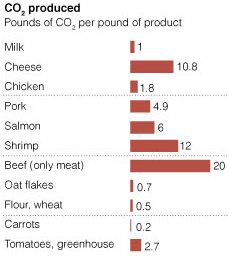
Over here, Don Le Pan wonders why environmentalists don't promote veganism.  But if your concern is just the environment, why would you?  Wouldn't this be like telling people to buy bicycles instead of just encouraging them to buy smaller cars?  To be green, you'll want to eat leass meat, but also make distinctions between different animal products, as the chart (from this article) makes clear.   Of course, climate change isn't the only "green" issue.  But just concentrating on that, it makes a big difference whether you eat chicken or beef.

3/29/10

Capitalism, A Love Story

OK, it's a bit simplistic (our alternatives are not "democracy" or "capitalism") but Michael Moore's latest movie is worth seeing and thought-provoking.  It happens when I saw it over the weekend I was at the height of my latest rant about the Catholic church and its problems with pedophilia, secrecy, gender, sexuality...and a lot of other stuff.  (Isn't it obvious the pope should resign?)  So it caught me off guard to see the Catholic priests in this movie--men who help laid off workers, identify with the poor, and talk passionately about social justice. In fact, Michael Moore confesses that he once wanted to be a priest himself, and he's pretty clearly a believer--at least in the moral message of Christianity--and a church member.  Moore needs to do a documentary on religion--wouldn't that be interesting?

3/28/10

Animal Stories

Nice line in the New York Times Book Review today from Rebecca Goldstein--"ambivalence is a sign of an interesting mind."  It worries me when someone responds in a simple, clear, confident way to an issue that's in fact difficult and complex.

The New York Times covers the treatment of animals a lot.  I'd say the gray lady is ambivalent.  And maybe that's all to the good--because the animal question really is difficult and complex. Today's stories touching on animals--

First we've got a big story about small, traditional farmers in New England having a hard time delivering meat to the locavore market.  It seems there aren't enough slaughterhouses (and mammals have to be slaughtered in USDA approved facilities).  So animals wind up having to be transported hundreds of miles away, which defeats the "humane" label and also yields lower quality meat.   Reaction: (A) meat is murder, or (B) quick, somebody build a new slaughterhouse?  I appreciate the way the article triggers the question.

Second, a paean to hunting in the magazine's "Lives" column.  82 year old half-blind food writer Betty Fussell goes deer hunting with her son, who calls hunting "earning your food."  She says--"Although I've spent a lifetime buying, cooking and eating food, this would be the first time I'd ever hunted and sought to kill.  Others had always done that for me."  Okay....so hunters confront the reality of killing animals.  That's honest of them.  Upside of eating wild animals: they did get to have much better lives before dying, compared to factory farmed animals. Downside:  the killing can be sloppy.   Question--if a half-blind woman is allowed to run around shooting deer in the woods, hardly "humane slaughter," then pray tell:  why can't those humane farmers in the previous story shoot their own pigs?

The "sensitive hunter" story is a very predicable genre.  Inevitably there will be allusions to Native American rituals. People are going to thank The Great Spirit for the dead animal, and they're going to get really mushy about how close they feel to the animals they kill. This article doesn't disappoint.  "Even though I long ago abandoned my forefathers' Calvinist God, it's him I thank for the fellow creature I've killed."  Question: how much does that make up for the problem that the deer doesn't get to enjoy the rest of her day, or life?

Finally, mother and son sit down to eat the heart at dinner time.  Just to let us know they are not brutes, she mentions that she skipped the garlic, onions, and barbecue sauce usually called for in recipes for deer heart.  No, they just used "salt and pepper in order to taste the grilled flesh pure."  Well, that was decent of them!  She adds "Men use fire; other animals don't." (So?)  And then:  "But I have never felt the bonds of creaturehood so intensely." Somebody at the New York Times really ought to put a moratorium on this sort of thing. Either that, or make the next person who indulges add a paragraph about how this bonding thing is supposed to work.  (Am I missing something because I never experienced the ritual of holy communion?  Or because I don't belong to one of those tribes that goes in for funerary cannibalism?) It seems to me, you really aren't entitled to feel good about your bonds with a deer after you've deprived her of the rest of her life.

OK--so we've got nice animal farmers and touchy-feely hunters. What else?  We have vegan pancake making from Richard Melville Hall (aka Moby).  (See picture above.) We also have an interesting reference to vegetarians and vegans in an article about extremism.  The author says that "in groups organized around a cause, it's the most extreme members who rise quickest."  His example:  "Among vegetarians, vegans are accorded high status."

Yes, I accord vegans high status, unless I'm focusing on the online abolitionist vegans.  They are not just deeply committed to animals, but contemptuous of anyone who falls even a notch or two below their standards.  I suspect tolerant, pragmatic vegans are accorded high status by most animal advocates (most of whom are neither vegetarian nor vegan).  Or so I would think. We need a New York Times story that digs into that question.

3/27/10

Jonathan Balcombe

To buy or not to buy... I'm thinking about reading Jonathan Balcombe's book Pleasurable Kingdom or his latest, Second Nature.  I rather like the topic of the first book--pleasure and happiness in (non-human) animals.  People with ethical concerns tend to focus on animal pain, and lose sight of the good experiences animals enjoy.  The book seems to be "positive psychology" for the animal kingdom, but without the self-help overtones. Cool!

I'm a tough customer, so I listened to an interview with Balcombe to help me make up my mind. Here he is on the Diane Rehm show.  He's really articulate and knowledgeable, but this is my reservation:  there's never a moment in the entire interview when he seems skeptical or puzzled.  Isn't it actually rather difficult to get a grip on animal minds?  For that matter, isn't "animal ethics" a difficult subject? Hmm.

Anybody out there familiar with Jonathan Balcombe's books and willing to comment?  UPDATE:  Taking the plunge....will report back on this book later!

3/26/10

Why have children?

I am starting a new book about parenthood--or perhaps I should say, to be cautious, a new manuscript.  (Whether it winds up being a book remains to be seen!) 

For the longest time, I've been stuck on the most basic of basic questions--What's a good reason to have children? I'm also interested in the more straightforward question--why do people have children?  But let's focus on the more "normative question"--what makes sense as a reason to have a child (in today's world)?  Here are your options:

(1)  To benefit myself in some way (care to specify?)
(2)  To benefit the child.  (explain!)
(3)  To benefit other people (eg, to benefit a sibling)
(4)  To make the world a better place (in a sense different from any of the above).
(5)  No reason necessary. (Why not?)  

I mainly just want to listen.  Any comments will be appreciated.