8/4/17

Goodreads Giveaway

Enter the giveaway for my book!

Goodreads Book Giveaway

The Philosophical Parent by Jean Kazez

The Philosophical Parent

by Jean Kazez

Giveaway ends September 04, 2017.

See the giveaway details at Goodreads.

Enter Giveaway

7/31/17

The Metaphysics of Pregnancy


I wish I'd read this Aeon article on the metaphysics of pregnancy on time to include the topic it raises in my book, The Philosophical Parent.  Suki Finn asks a great question, which is explored in a forthcoming article in Mind by Elselijn Klingma: is a mother a container for her fetus or is the fetus part of her?  They've definitely succeeded at two things: making the metaphysics of pregnancy seem fascinating and making the part view seem like at least a contender.

Let's first list the possibilities, along with some sub-options.

I. On the container model, the mother contains the fetus, which is "a distinct entity in its own right" (Finn, Aeon). I would add that if the mother is a fetal container, there are many kinds of containers.  Something inside a container can be non-dependent on the container—like a watch in a drawer.  But something in a container can be completely dependent—a brain in a vat needs its container. Containment plus connection is a possibility, and surely that's the possibility most relevant to pregnancy. (I used to have an ipod charger that both contained the ipod and connected it to a charger. It wasn't quite as cute as the one on the right.)

II. On the parthood model, the fetus is a part of the mother, like a tail is part of a cat (Finn, Aeon). Finn is not saying the fetus is really tail-like.  That example is just supposed to clarify what we mean by a part. If a fetus is a part of its mother, there are many sorts of body parts.  A kidney, a freckle, a tumor, some fat, some blood, a hand, a nose, the lower half of my body—they're all parts.  If you settle on the parthood model, your next question will be "what kind?"  Important clarification made by the authors: the parthood model doesn't rule it out that the fetus is a human being, or even a person.  The fetus might be a part of a human that's also a human being, like the mother. (More on that below.)

III. The parthood and container models are stated in such a way that they're mutually exclusive.  That's because on the container model, the fetus is not a part, but rather "a distinct entity in its own right."  Why not, though, contemplate an inclusive option? Could a fetus be both inside a container and a part of the mother?  I don't see why not.  Take a Russian doll.  The innermost doll is contained by the outer dolls.  At the same time, the innermost doll is part of the Russian doll. If it's missing, the Russian doll is incomplete.

The container model seems to be the received wisdom among philosophers, Finn and Klingma both say. In fact, I would say there's something a bit alien or even yucky about the notion of the fetus as a part of the mother. If fetuses grew on trees, we'd surely think of them as parts of trees (like apples are parts of trees).  It's a little weird to think of a fetus as being even remotely like a pre-plucked piece of fruit. Why?  Maybe that doesn't comport with what we see as the separateness and dignity of the baby-to-be. That dignity may not have to do with lofty notions like personhood and humanity. It might have to do with not-so-lofty notions of animalhood.  At the level of sheer gut feelings, I also find it odd to think of a fetal kitten as a pre-plucked piece of fruit.
These are real pears!!!
http://bit.ly/2we7aFo

But that's just a matter of initial gut feelings.  There are also some serious worries about the possibility of a human being having a part that's a human being, or a cat having a part that's a cat.  Finn discusses a puzzle about a person who's sitting in a chair, about to have a haircut.  Is the person minus the hair that's about to be a cut a part of the person who still has her hair?  If so, there would be two persons sitting in the chair, which is absurd. We can rule that out by postulating a "maximality principle":  a whole of a certain kind can't have a part of the same kind.  But that will stop a fetus, assuming it's a human being (at least at some point in gestation) from being a part of its mother.

I agree with Klingma (in the Mind article) that it seems odd to postulate the maximality principle in order to solve the haircut problem, and then apply it to the very different circumstance of pregnancy.  It's also true that we can easily think of things of kind K that clearly do have parts of kind K.  See picture on right.

All in all, I think Finn and Klingma make a convincing case that parthood is a contender.  I still think, though, that the container model (option II) is a contender.  There are a lot of features that make a fetus appear to be an entity distinct from the mother, and contained by her uterus, which is contained in her body.  I don't see why its connection to her, through the umbilical cord, and its total dependence on her throughout most of gestation, must make it a part of her. Think ipod in dock or brain in vat.

I'm pulled in both directions, which I think counts as success for Finn and Klingma. They have at least succeeded in making their case that there are two models worthy of consideration here, and not just one.

7/29/17

I Don't Recommend Parenthood

In which I recommend visiting Iceland, but don't recommend visiting the land of parenthood.  At the Oxford University Press blog today.  Fun fact: "I don't recommend" doesn't mean "I recommend not"!

7/27/17

I get mail

I'm still receiving email about my op-ed in the Dallas Morning News yesterday.  There have been about 30 friendly, supportive messages.  Wouldn't it be nice if the other 5 were friendly but in disagreement?  But no, what I've received from critics is all tirade, no reasoning.  It's as if they were deliberately trying to give me data to support my final hypothesis--that the bathroom bill simply comes from outrage over something conservatives can't understand.

A number of these e-critics seem to have exploded before reading the whole op-ed. They fulminate about the sentence "Why are bathrooms ground zero?" (when it comes to separating people based on biological sex) as if I had stopped there. But no, I didn't. That question is a lead-in to the next paragraph:
If there's a smart case for SB 3, there needs to be some sort of harm done by letting trans folk use the same bathrooms as cis folk. I suspect supporters of the bill think, deep down, that it's harmful for a cis woman or girl to suspect there may be a trans woman in the next stall because, well, because that person may be making use of a penis. 
And what of that argument?  To find out how I assess it, you have to go on to the next paragraph.  Generally, comprehension of an op-ed requires that you keep going, paragraph after paragraph.  Yes, that is how it works.

I'm awfully surprised that some of these low-comprehension email critics  are actually pretty accomplished people. In fact, some of them are very accomplished people. It's been fascinating reading their fulminations, but honestly it would have been even more fascinating if they'd actually read my op-ed and responded coherently.  I'm actually genuinely curious how conservatives think about these issues.

But credit where credit is due. I found this comment (by Brian Baldwin) at the DMN website interesting. It's not from a conservative, but from someone who does a rather nice job (I think) of entering the anti-trans mindset.  He describes what's going on in more detail than I did and offers some good food for thought.

7/26/17

The Bathroom Bill

I have an op-ed about the Texas bathroom bill in the Dallas Morning News today. In case you can't get past the paywall, I've copied it below. Sadly, SB 3 did pass in the Texas senate last night, but it hasn't been voted on in the house yet.  Possibly even worse, today Trump announced he plans on banning transgender people in the military (though the Pentagon says this is the first they've heard about that). It's puzzling that conservatives feel the need to go after trans people in this way.  In the column I cast about for arguments they might want to use, but in truth I think it might be the psychology of anti-trans animus that most needs explaining.


Why the smartest argument for the bathroom bill isn’t smart at all

One of my jobs as an ethics professor is to figure out what the best case might be on each side of any contentious issue. And so I find myself earnestly trying to understand what drives the proponents of Senate Bill 3, the bathroom bill. What's the very smartest thing they can say in support of it?

Take the proponents' explicit motivation, to stop would-be sexual predators from taking advantage of transgender women being in the women's room. The idea is that cis (non-trans) male opportunists could dress like women and get away with their incursions because trans women can be seen in women's rooms.

This can't be the smartest argument for SB 3, because it isn't smart at all. Imagine that trans men started using the women's room, as SB 3 requires. There would be people in the women's room who look just like men — sporting beards, even. Now cis male predators wouldn't even have to put on a dress before making their incursions into women's rooms.

No, if they've given it any thought, proponents of the bathroom bill can't really be trying to keep male predators from invading women's rooms. What they might really be thinking is that human beings fall into two natural kinds, with no possibility of movement from one box to the other. Bathrooms are ground zero for the separation.

But this, too, fails to impress. Parents already bring children of the other sex into the bathroom. Single occupancy bathrooms get occupied, alternately, by men and women. And besides, if we let the two kinds into the same airplanes, supermarkets, and churches, what's the problem with letting them into the same bathrooms? Why is the bathroom ground zero?

If there's a smart case for SB 3, there needs to be some sort of harm done by letting trans folk use the same bathrooms as cis folk. I suspect supporters of the bill think, deep down, that it's harmful for a cis woman or girl to suspect there may be a trans woman in the next stall because, well, because that person may be making use of a penis.

I wouldn't want to dismiss anybody's feelings, but we do need to consider all the feelings. Imagine, if SB 3 passes and people comply with it, the feeling of being a trans woman walking into a men's bathroom, being stared at and feeling threatened with verbal or physical abuse. Or being a trans man walking into a women's room, and being told you're in the wrong place. Or not drinking, in the Texas heat, because you want to avoid having to use the bathroom. Can our legislators really be asking us to be more concerned about the mere thought that there's a penis in use in the next stall over?

Finally, you might support SB 3, out of compassion for pre-trans kids: you (allegedly) want to make life harder for trans people to discourage the next generation from jumping from one gender box into another. This is a preposterous defense on many levels, but I'll just mention the dangerous slippery slope this would put us on. What measures will gender conservatives dream up next, to keep everyone in their proper box?

Try as I may, I can find nothing smart to say on behalf of SB 3. I suspect it simply functions to allow conservatives to express outrage about a phenomenon that they don't understand and can't (yet) get used to. It serves no coherent purpose and deserves to fail.

Jean Kazez teaches in the philosophy department at Southern Methodist University. She is the author of The Philosophical Parent: Asking the Hard Questions about Having and Raising Children. She wrote this column for The Dallas Morning News.


7/25/17

The Bathroom Bill

I'll have an op-ed about the Texas bathroom bill in the Dallas Morning News tomorrow. It's already online.  Short version: I can't think of a single good argument in support of the bathroom bill.

7/20/17

The Music of Parenthood

One of the main ideas in my book The Philosophical Parent is that children are second selves but separate. This may seem like a dubious, dangerous, narcissistic view, but I don’t think so. Loving another as yourself doesn’t have to lead to imposition and domination.  It can even make us receptive. I’ve particularly seen this in our family’s history when it comes to music.  (I discuss the view with respect to more consequential matters in the book.)

Here goes, from the earliest days onward:

LITTLE KIDS
At first there were certainly impositions. A friend suggested Burl Ives as a much better alternative to Raffi, the “Bananaphone” guy. And so we were able to cut back a bit on Raffi and listen to great songs like “Big Rock Candy Mountain.” On the other hand, my tastes did change in response to theirs. Our kids (boy-girl twins) were obsessed with Thomas the Tank Engine, playing with the trains and watching the videos. The theme song sounded to me—no, not annoying, but like the uplifting soundtrack to their childhood.

By the time our kids were five, we parents decided we’d allowed our kids take over the airwaves long enough—this was before people plugged into their own private devices—and wrested back control with a lot of Beatles music. After that, there was a parting of the ways. Our kids expressed a mysterious hatred for the Fleet Foxes, cared little for Arcade Fire. Old loves of ours, like Leonard Cohen, were anathema.*

Meanwhile the two of them had discovered radio Disney and various now unmentionable and relentlessly cheerful hit-makers. By age 10, we could meet on the same ground by listening to Coldplay but on the whole there was our music and there was their music.

TEENAGERS
Then, when they became teenagers, things started to change. “Love the Way You Lie”, the Eminem song (featuring Rihanna), reverberated through our house in 2010—with lyrics that are an affront to feminism and ethics. I analyzed it, criticized it, condemned it … and loved it! Just as surprisingly, Kanye West’s egomania was not a barrier to my becoming enthralled with My Beautiful Dark Twisted Fantasy, which my son played constantly for the next year.

A year later, my daughter started playing what at first sounded like sheer cacophony to me: lots of Animal Collective (example: “For Reverend Green”) and Neutral Milk Hotel. What my kids liked, I listened to differently, and very often liked too. Later on, my tastes expanded still more—to Bjork, Sigur Ros, Sufjan Stevens, and on and on. And then, briefly, there was a period of perfect convergence—with Arcade Fire, Fleet Foxes, and an occasional Leonard Cohen song on the household playlist.

EMPTY NESTERS
Once my children left home for college two years ago, I wondered what would become of my musical tastes. Had they been permanently transformed? I find I still love the music they got me to listen to. But my pre-parenthood musical tastes are reasserting themselves. Yes, we are all going to see Sigur Ros and the Fleet Foxes this summer, but I’m listening to more opera, more classical music, more of my beloved female singer-songwriters, like Aimee Mann.

THE POINT!
If children are like second selves to their parents, that doesn’t mean we tyrannically control every inch of their lives. It means we easily put ourselves in their place, and are therefore open to experiencing their cares, concerns, and preferences. We try to see through their eyes, hear through their ears, but we keep our own eyes and ears as well. We are influencers, at least for a while, but out of identification, we are also influenced.


*My son can still recite this haunting lyric: “And just when I was sure that his teachings were pure, He drowned himself in the pool, His body is gone but back here on the lawn, His spirit continues to drool” (One of Us Cannot be Wrong) Thanks a lot!

7/14/17

Having Fewer Children Because of Climate Change

You care about climate change, so should you have fewer children?  Here's an article in the Guardian that argues for this, and the accompanying graphic.


The pitch here is to the individual. Like you might decide to recycle or wash in cold water or eat less meat, in response to climate change, the idea is that you should decide to have a smaller family, in response to climate change.  

I find this way too simplistic, for many reasons.

Many of the circles on the graphic have no downside. It's all good, if people recycle. However, it would be problematic if a lot of people had fewer children.  If you had one child instead of two, and so did a lot of people for the foreseeable future, that one child would be facing a very troubled future. She would be more burdened with responsibility for older members of society than we are at the present, and as she aged, she would suffer from there not being enough people to meet her needs. If the population decrease were dramatic, it could easily be true that her future would be far more marred by the population decrease than by climate change. It's notable that in countries (like Japan) where there is concern about climate change, but also a shrinking population, the shrinking population is seen as a curse, not a blessing.

Now you might say that these worries are misdirected. Very few people are actually going to have fewer children for environmental reasons. But if that's true, there has to be another worry. The children of the people who procreate less are more likely to care about environmental issues--people do tend to pass on their beliefs and values.  But then, you have to worry that governments are going to be less likely to take needed action on climate change when the voting population shifts to being created by the least environmentally concerned people.  For environmentalists to have fewer children might leave us with a world of Trumpians marching toward total eco-disaster.  Well, maybe!  (I'd like to see someone make a dystopian movie with this premise.)

Let's dig a little deeper.  It's interesting what's on the graphic and what isn't.  You can certainly suggest to people that they buy hybrid cars and wash their clothes in cold water, but certain things are beyond the pale.  There's no circle for ending your life at age 40. But that circle would be huge (about half as big as the one-less-child circle).  There's no circle for refusing medical care after the age of 70, even though that tends to involve a lot of energy and resources.  That would also be a big circle. Some sacrifices can't be expected--they're of a different order altogether.  Sacrificing a second child is that sort of sacrifice for many of us. Why?  My new book explores this in the first several chapters.  Even without a long further story, you can see the graphic is odd. It's not clear skipping child number two should be on the graphic, side by side with changing lightbulbs and washing in cold water.

Bottom line: I don't think any individual should think "I must have fewer children, because of climate change," especially if they live in a society where procreation is already at the replacement rate. Climate change is a problem but population shrinkage is also a problem, so it's not at all clear that one is the best solution to the other.

But if you do live in a society with a growing population, it's another story.  In that case, there may be ways for change to take place without individualistic moralizing.  Such a society shouldn't valorize huge families and shouldn't stigmatize people who have no children or very small families. In ballooning societies, it's all to the good, environmentally, if people don't think of having a family as their primary vocation.  I'm just not convinced that it's either convincing or reasonable to say, even to those people, "you should wash in cold water, recycle, and skip your longed for second child."


7/13/17

Choosing life, choosing death

Julian Savulescu and Peter Singer take a position that seems right to me on the question of Charlie Gard--see their opinion on the matter here. They think the parents ought to be allowed to take the baby to New York for further treatment. But their reasoning puzzles me. Here's how Savulescu and Singer support their stance on Charlie Gard: in cases of "reasonable disagreement, we believe that we should accede to the wishes of the parents and err on the side of a chance of life. The alternative is certain death." I'm puzzled because "acceding to the wishes of the parents" can't always go along with "erring on the side of a chance of life," since some parents prefer death.

There's a moving example of this in a (New York Times) Stone column written by Gary Comstock. In this case there was probably reasonable disagreement, but the parents' wish was to let their baby die. What then? Should the wishes prevail, or should we "err on the side of a chance of life"? I wonder how serious Savulescu and Singer are about the second part. Should we "err on the side of a chance of life" even against the preferences of parents?

How decisive is it that parents prefer life, or don't prefer life, in these kinds of tragic cases which involve reasonable disagreement? If Charlie Gard's parents turned around and decided they wanted to withdraw life support, I wonder what Savulescu and Singer would say. Now "acceding to the wishes of the parents" would mean supporting them, but "erring on the side of a chance of life" would mean wresting away control. I think parents get to make these decisions (when there is reasonable disagreement), and not just when they choose life.

7/6/17

The Charlie Gard Case

http://nyti.ms/2su9HcY

The basic facts of the case are covered here.

Dominic Wilkinson has written an interesting commentary at the Practical Ethics blog--he sides with the decision of the UK court, which has been upheld at higher levels. He argues that there is too much suffering involved in continued treatment, considering the tiny chance of further treatment being beneficial. Julian Savulescu thinks, by contrast, that the parents ought to be able to bring the child to the US for experimental treatment, which has been offered by a US physician and has already been crowd-funded online. He's written several commentaries on the case, here and here.

Wilkinson links to a very interesting paper he (and others) have written on the difference between the legal approaches to these kinds of problems in the US and UK. They write that courts in the UK apply a best interests of the child standard, whereas in the US, courts give more weight to parental preferences and patient autonomy. However, he says the emerging consensus among medical professionals and ethicists in the US is that the best interests of the child standard is the right one.

After years of shifting standards on medical treatments, there is now a strong consensus in the medical and ethical literature in the United States that it is the best interests of the patient not the desires of the family or the personal predilections of the physician which ought to prevail. That standard does not rest on autonomy or an attempt to determine what the patient would have wanted, but solely on a concern for the patient's welfare. Such protection is particularly important with regard to infants and children because with it they are now seen not merely as the pawns of parents, but as patients in their own right. The implication is that although parents may continue to be involved in decision making for their children, they do not have an absolute right to refuse— or to require—medical treatment for their child. It is the child's best interests, and those alone, that are to be the focus and goal of medical treatment decisions made on behalf of children. 
Children are not "pawns of parents,"  the authors say. In his most recent blog Wilkinson says it another way:  children are not "property of their parents."  It seems to me that if we leave it at that--not pawns, not property--and say nothing more about what children are to their parents, then it's very hard to make sense of a part of the approach Wilkinson supports. Why is it that, though parents don't have an "absolute right to refuse," they "may continue to be involved in decision making for their children"?

There is some kind of special entitlement of parents to their kids that is not respected if we seriously, literally, across the board, adopt the best interests of the child standard. If we really did so, in all domains, many parents wouldn't even be allowed to have custody of their biological children, considering the availability of better equipped adoptive parents. But no--they're your children, so you get to keep them and you have quite a lot of decision making power when it comes to the way they are raised and treated.  I believe this is the consensus, both in the US and the UK.

But there are limits.  When parents start to make decisions that are too extremely at odds with professional medical judgment, they lose their prerogatives. So it's not that the best interests standard is the only one, and is allowed to prevail in every situation. It starts to trump everything else when the stakes start to be greater. Parents are not allowed to make terrible medical decisions on behalf of their children.

If that's right, the question in the Charlie Gard case is not simply whether it would be better for Charlie to be taken off of child support, but whether it would be glaringly, obviously better.  Are the parents making a huge mistake by trying to take him to the US, a mistake of the type that should remove them from making the ultimate decision?

Elysha Waldman, a palliative care pediatrician, sides with the parents in this New York Times op-ed. She says parents get to decide, but not no matter what.  US courts do sometimes step in and insist on what's in the best interests of a child, she points out. Unfortunately, she sides with the parents for the wrong sort of reason.  She doesn't say that taking Charlie to the US makes some medical sense.  She writes:
In the end, it doesn’t matter that Charlie Gard has become a household name. He is, ultimately, the child of Connie Yates and Chris Gard and they know better than hospitals or the courts about what is best for their terminally ill son.
No, parents don't magically possess a better understanding of what's best for their children than anyone else.
For me to think think the parents should decide, I'd have to think what they want does make some medical sense.  From all I have read, it sounds like they want to make a bad decision (Wilkinson is convincing about this), but I'm not sure if it's bad enough that they should lose the usual prerogatives that come with being parents.

6/29/17

Compassion or Indignation?

Conservatives in the house and the senate are trying to get rid of the  Affordable Care Act's individual mandate, the requirement that everyone must purchase health insurance or pay a fine.  When you get rid of that, you reduce the number of relatively healthy people who would have been in insurance pools, so that those who remain have greater needs and have to pay higher premiums.

Liberals who think we need the individual mandate tend to talk the language of compassion.  "These poor, benighted people are sure they won't need medical care, but they could be blindsided by some catastrophic illness or accident or crime.  So they may be in trouble down the line, in addition to those who may wind up with no health insurance, because they can't afford the premiums." But there's another way to talk about the problem with getting rid of the individual mandate. Conservatives--and they're the ones in power, so we have to care about how they think--tend to care a lot about people being freeloaders and deadbeats and welfare queens and moochers. We're supposed to work hard and pay our own way, not depend on others.  In fact, it strikes me that this indignation over dependency is one of the most deep-seated elements of the Republican outlook. And so if we can talk about the individual mandate in terms of dependency, that would presumably be very convincing to many Republicans.  They'd have a reason to retain the individual mandate that didn't involve caring about people and their health problems.

But surely there is a reason to insist on the individual mandate that has nothing to do with compassion, and everything to do with indignation.  People who decide not to get health insurance, but wind up with a catastrophic medical problem, do wind up being deadbeats and freeloaders and all the rest--if you want to use that very colorful, judgmental language.  They wind up using the health care system that they didn't care to pay for, before they needed it.  There it will be, all ready for them, and they will not have paid their fair share for it.  Not only will it be available, not at all to their credit, but if they're sent bills post facto, they may never be able to pay them.  Conservatives should be appalled, considering they are appalled by all sorts of other dependency and freeloading and irresponsibility.

Of course, you don't want to be disingenuous, speaking a language you don't actually take seriously.  But liberals can talk this talk--if fact, they do so on occasion, just not so much in the context of the Obamacare debate. You're speaking this language if you think everyone ought to have their kids vaccinated, instead of counting on the herd immunity that's conferred when most other people have their kids vaccinated.  If you can get indignant about non-vaccinating parents, you can get indignant about people who don't plan for unexpected health problems and get themselves health insurance.

Why on earth do conservatives not see the similarity between their old enemies the welfare queens and deadbeat dads and the like, and the healthy folks they want to liberate from having to purchase health insurance?  I think they don't see it because the prototype of an uninsured person is a healthy, white, male independent contractor. They like the feisty independence of these people, but this can easily be reframed. Feisty independence? No, these are just freeloaders, people letting others create the system of care they themselves may ultimately need.

Sure, I'd rather speaking about care and compassion, but let's frame the issue about the individual mandate in the way that resonates with the people who have the votes!


6/23/17

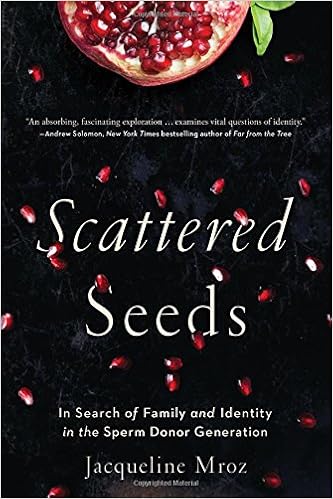
Scattered Seeds

One of the key ideas in my new book The Philosophical Parent is that we see children as self-like because they "come from us"—in one of several senses.  I can't state this as any kind of a universal truth, but it tends to be true, and I think it's with good reason that we see children this way.  We're not delusional.  However, I do have to acknowledge some factors that either intensify the perception of children as self-like or decrease that perception.  I talk about sexism, poverty, high infant mortality rates, and so on.

One factor I didn't write about much is the attitude of sperm donors, egg donors, and surrogate children to offspring who did come from them, but with the understanding that someone else would be the parent.  That understanding is no doubt one of the factors that can decrease the perception of children as self-like.  Another factor that didn't cross my mind is the sheer number of offspring a person has. This issue comes up particularly in conjunction with sperm donation.  I didn't realize it until I recently heard Jacqueline Mroz on the radio talking about her new book Scattered Seeds, but sperm donors can have incredible numbers of children.  She talks about men making donations three times a week for years, and each donation being split into 10 or 20 portions.  The result is that some sperm donors have as many as 200 offspring!

Is there anything troubling about a sperm donor having 200 children?  In early chapters of the book Mroz focusses on Wendy Kramer, mother of a donor-conceived child, founder of the Donor Sibling Registry, and a critic of the sperm bank industry.  Kids very often want to know about their biological father or even meet him. They see their origin as central to who they are.  Most sperm donors are open to being found and having a relationship of some sort with their offspring, but the worry is that the man's willingness is likely to be reduced, when he has not 2 or 10 or even 20 children, but 200.  You just couldn't experience meeting your offspring as anything terribly profound if you went through it 200 times.  Thus, some donor conceived offspring are doomed to feeling like a mass-produced product, in relation to their biological fathers.  Kramer favors federal regulation, record-keeping, and limits on the number of children a donor can produce.

Whenever Kramer is the focus, Mroz seems rather worried about the sperm bank industry and seems sympathetic to restrictions.  But in the last chapters of the book, the angst goes away.  She focuses on the offspring of Todd, an Apple Executive with 200 offspring.  He treasures all his offspring, inviting them for lavish get-togethers, giving them gifts and traveling with them, but restricting himself to a rich uncle sort of role, not crossing the line into playing an inappropriate father role. It's all good, from the kids' perspective too.  They don't see the father-child relationship or the sibling relationship being diluted or cheapened; they don't feel like mass-produced commodities. They feel like a clan, as opposed to a family.  Though they are actually half-siblings with the other 199 offspring of Todd, they regard each other like most of us regard cousins. As long as we're willing to expand our conception of family and kin, no harm done.

I'm not sure why she ends this way, as if this case were more representative, rather than ending with some of the more painful stories in the book--stories about donor fathers who want more of a relationship than their offspring desire, stories about kids who write Father's Day cards that they put in a box year after year, stories about marriages that fall apart, because donor fathers get more involved with their offspring than their wives can tolerate. If there were a limit of 10 children per donor, just as many parents would get to experience parenthood and just as many children would get to enjoy existing.  Wouldn't some of the problems with donor conception be alleviated?  Why not support more regulation?

Overall, this is a really interesting book, but I wish it had better "back material." It has no bibliography, so it's not easy to look up the books and articles Mroz references. It also has no index, so you can't look up, for example, all the references to Wendy Kramer or to other people who are discussed in multiple chapters.  It has endnotes, but instead of citing sources in the usual way, so people can consult them, Mroz always uses urls, some of them many lines long. (Where urls are appropriate, why not use a url shortener?)  Also, there are also a few errors here and there--doesn't she mean to say that George Washington was infertile, not impotent?  In one place the word should be "motility", not "modality".  But now I'm being picky!

6/21/17

Disussion Guide

A guide to The Philosophical Parent suitable for reading groups is here:  Illustrated Discussion Guide.  One of the illustrations, which were created by Becky Groves, is below.

5/24/17

Slaves and Grandmothers


The cover story in this month's Atlantic, "My Family's Slave," raises so many interesting questions.  Over time, Lola becomes very much like a family member, but not quite, as the family doesn't bother to meet her basic needs.  The story made me wonder how we would react if Lola actually were the author's grandmother.  Would her endless labor to support the family be more acceptable and admirable, or would we just think she was a grandma-slave? What difference do family relations make?

5/9/17

A Failure to Engage?

I thought the conflagration about Rebecca Tuvel's transgenderism-transracialism article was dying down--with academic norms prevailing.  The editor of Hypatia, Sally Scholz, expressed firm, unwavering support for Tuvel.  The associate editors who apologized for the article were very clearly shown to be not in a position to represent the journal.  Tuvel's colleagues expressed support for her.  Colleagues and friends rallied to her side in respected publications.  The right and the good were prevailing, I thought.

But no, the not right and the not good are back in town, in the form of this article by one of those who wrote the original letter calling on Hypatia to retract Tuvel's article. Shannon Winnubst wants to "reclaim a narrative spinning increasingly out of control." The right narrative, on her account, is one about how Tuvel's essay got published, despite its "arrogant disregard" for the relevant fields of philosophy.  Hypatia failed Tuvel, she says, by letting "subpar scholarship" be published in a "flagship journal."  It also failed the field of feminist philosophy. The community of scholars tried to help the benighted scholar at conferences, but to no avail.  Her article got published, despite not engaging in the right way with "critical race theory and trans studies."  And then, people began to be harmed, according to the associate editors at Hypatia, who apologized for "the harms that the publication of the article on transracialism has caused."

5/3/17

Transgenderism and Transracialism

Another day, another controversy in the philosophy world.  The latest is about "In Defense of Transracialism," an article by Rebecca Tuvel, which was published in the feminist-journal Hypatia. A petition complaining about the article, signed by over 800 academics, enumerates a bunch of alleged problems with the article. The journal (or "a majority of associate editors") has apologized for publishing the article, though hasn't retracted it.

My take on the whole thing is that Tuvel's article is seen as dangerous not really because of her minor faux pas, where language is concerned, and also not really because she doesn't engage with the "right" literature, but due to "fear of modus tollens syndrome."

4/28/17

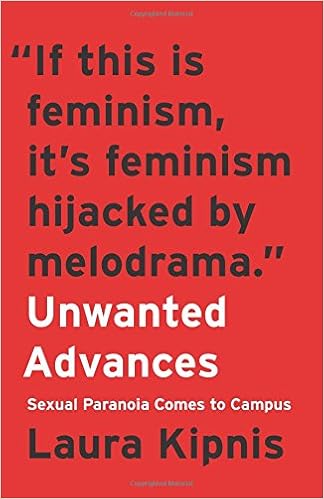
Laura Kipnis's Controversial Book

I thought I'd write a few posts about Laura Kipnis's controversial book Unwanted Advances:  Sexual Paranoia Comes to Campus.  I listened to the audio version of the book, so can't go back and check passages.  This will have to be a bit impressionistic.

Half the book is about several Title IX investigations that happen to involve philosophers. The other half is a general response to the way sexual behavior is currently constrained on college campuses, due to Title IX and campus policies.  Today I'm going to write a bit about this second, general response.

Kipnis thinks Title IX intrudes too much on the messy business of sex and romance both between students and between students and faculty.  She has a lot to say about how student-faculty relationships can lead to student-faculty marriages, and about how students are not simply exploited by powerful professors, but can be attracted to them. In fact, they can find their power and status attractive. Why is that always so terribly bad?

11/13/16

Proper Indignation


There's a passage from Aristotle that's been coming to my mind constantly since the election.  It's about the virtue of proper indignation.
For the properly indignant person feels pain when someone does well undeservedly; the envious person exceeds him by feeling pain when anyone does well, while the spiteful person is so deficient in feeling pain that he actually enjoys other people's misfortunes. (Nicomachean ethics, Book II ch. 7)
Proper indignation?  Yes.  How could Trump be rewarded with the presidency--the highest conceivable honor--after being a racist birther, after a lifetime of being a con-artist and an exploiter of women, after bullying all of his opponents, after demonstrating total absence of relevant knowledge and showing himself unfit for the office in every way, after lying incessantly and in fact showing total disregard for the difference between truth and falsehood, after losing every debate, after inciting violence and bigotry, after using dirty tactics against Hillary and all of his other opponents, after not revealing his tax returns, after Trump University, after .... This is the ultimate in doing well undeservedly, and we're going to be witnesses to this injustice every day for the next four years.

11/7/16

Top Ten Horrors

I'll go with the New York Times' estimate that there's only a 16% chance of Trump winning tomorrow, but it still fills me with horror.  16% of a really bad prospect is a really bad prospect.  I've been thinking about why this horrifies me so much--what are the worst things about a Trump future?  My top 10 list:

  1. A completely unfit, unqualified con-man wins instead of a clearly qualified and competent woman. Two messages: knowledge and skill don't matter ... men have a huge advantage over women.
  2. The man who promoted birtherism for five years is rewarded for it.  Message: racism and outrageous outright deception are perfectly acceptable.
  3. 20 million people lose their health insurance and everyone else loses all the benefits of the Affordable Care Act, because Trump and other Republicans say "repeal and replace" but actually have no replacement.
  4. Deportations of immigrants, no path to citizenship, an end of welcoming desperate refugees into this country.
  5. Supreme Court turns more conservative for many decades, with resulting threats to reproductive rights and marriage equality.
  6. Unstable, brash, ill-informed commander-in-chief, sure to make the world a much more dangerous place.
  7. International climate change agreement abandoned, posing serious risks to generations to come.
  8. An exploitative, demeaning attitude toward women and girls becomes normalized by the fact that the world's most honored leader exemplifies it.
  9. The repulsive way Trump ran his campaign--non-stop lying, name-calling, threatening to imprison his opponent, abusing the media, total lack of civility--all of that now the norm.
  10. Miscellaneous nightmares:  Michelle's garden mowed down, the White House sprayed gold, Trump vampyric wife and children haunt Washington......
OK, enough.  I'M WITH HER!

10/21/16

Is it selfish to procreate instead of adopt?

Adam Ferner asks this question in a video publicizing the procreation forum in the new issue of The Philosophers' Magazine (which I guest-edited)--it's a question that is addressed by many of the authors that contributed to the forum (Gerald Harrison & Julia Tanner, Sarah Conly, Bernard Prusak, Tina Rulli, Elizabeth Bricker, Rivka Weinberg).

I won't try to summarize the debate in the forum--you should subscribe to the magazine so you can read it!-- but can't resist responding to Adam's question.  For another response, have a look at the various points Denise Cummins makes here.  As an adoptive mother and cognitive psychologist, she has a lot of relevant expertise and experience.

Adam's response is Yes--procreating is selfish, because (roughly) adopting benefits an existing child in need of parents, whereas procreating brings a brand new child into existence, a child who would not have been in need of rescue if they'd remained non-existent. And on the other hand, adopting provides just as much of the most important kinds of satisfaction for parents.  So far procreating just sounds irrational.  It starts to seem selfish if you add that people choose procreation (despite the superiority of adoption) out of some sort of selfish preoccupation with their "lineage".