Showing posts with label ethics. Show all posts
5/24/17
Slaves and Grandmothers
The cover story in this month's Atlantic, "My Family's Slave," raises so many interesting questions. Over time, Lola becomes very much like a family member, but not quite, as the family doesn't bother to meet her basic needs. The story made me wonder how we would react if Lola actually were the author's grandmother. Would her endless labor to support the family be more acceptable and admirable, or would we just think she was a grandma-slave? What difference do family relations make?
7/24/15
Accutane Ethics
But maybe ... (Note: I truly love the Louis C.K. "Of course...but maybe" routine. Do watch if you haven't seen it. Start at 34:00.) Enter: David Boonin's new book The Non-Identity Problem and the Ethics of Future People, reviewed here by Molly Gardner. At least in the review, the focus is on a slightly different sort of case. Boonin contemplates Wilma, who can either conceive now and have Pebbles, who will be blind but will have a life worth living, or take a pill for two months and have Rocks, who won't be blind. Boonin embraces the argument that concludes it wouldn't be wrong to conceive Pebbles. Here's how it goes--
According to Garnder, Boonin's book looks at all sorts of ways of rebutting this argument and finds them all wanting. So we should just accept the conclusion. It really wouldn't be wrong to conceive Pebbles.
There's an Accutane version of the argument, and I would rather see that be the focus for two reasons. First of all, Wilma and Pebbles are just cartoon characters--literally. These issues have a different feel when they come up in real life. Thousands of women are right now considering whether to heed their doctors' warnings about conceiving while taking Accutane. It's easy to give Wilma the green light to conceive Pebbles, but surely not so easy to give a real woman the green light to conceive on Accutane. I'm not sure we're thinking seriously about these things until we're thinking about real people's decisions.
The Accutane version is more real world-ish, and also has some parameters that may make a difference to our intuitions. In the Accutane scenario, a drug causes the undesirable features--the malformed ears. In the Wilma scenario, a drug causes the desirable features--sight, rather than blindness. Unconsciously, what might make someone accept (C) in the Wilma argument is the intuition that nobody has to go out of their way, taking special drugs, to have a "better" child. It might not really be that the conclusion gains whatever plausibility it has from the argument's explicit premises.
So let's look at an Accutane scenario. Mary is thinking about ignoring all the warnings and conceiving in July while taking Accutane. If she does so, she'll have a baby we'll call "July"--a baby with malformed external ears. If she waits until she's finished taking the drug, she'll have a different baby we'll call "December," one with normal ears. Is it wrong to conceive July? The argument parallel to the Wilma argument would go like this:
Now that we're talking about real decisions in the real world, not cartoon characters, the conclusion looks quite a bit more amazing, even thought the abnormality in question is far more minor. Or so it seems to me. I would be absolutely amazed if the wisdom of our best ethics gave permission to Accutane users to ignore all the warnings and conceive while using the drug. That would be incredible.
So what's going on here? July is not worse off for being born--P1 seems right. So she's not harmed by being conceived--P2 seems right. Let's ignore P3, since even if it were false, that's not the heart of the matter, surely. If July is not harmed by being born, then she's not wronged--that's what P4 says. OK, that seems plausible. That leaves P5. If an act wrongs no individual could it still be wrong?
Yes. Mary wrongs no individual yet she causes more suffering than necessary. The suffering of July about her ears--surely inevitable--just didn't need to be. It would have been no worse to create December, and creating December would have eliminated that suffering. Usually what matters is harming individuals, wronging individuals and moral categories of that sort, but it doesn't seem surprising that in the special area of procreative ethics, other principles kick in. "Cause no more suffering than necessary" is that sort of non-individual-specific principle. Not that this is the only principle relevant to procreative decisions--the one and only master principle--but it seems relevant if you're a woman wanting to both clear up your acne and have a child. Refusing to wait six months to conceive is wrong because you'll thereby cause more suffering than necessary.
I bet somewhere in Boonin's book this response is discussed and disparaged--I will have to read the book and find out. Truth be told, I'm sure I'd shift to some other explanation if I could be convinced that this one was wanting, because what I'm absolutely sure about is that Mary shouldn't conceive while taking Accutane. That's what's so extremely evident, not the reasons why.
5/20/14
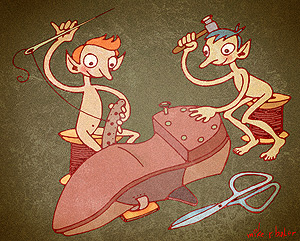
The Elves and the Cobbler
Here's a scenario from Garrett Cullity's article "Moral Free Riding"--
The Enterprising Elves
On the first day in my newly carpeted house, I leave my shoes outside. In the morning I am delighted to find they have been extraordinarily well repaired. I am less delighted when I receive the bill. (p. 10)
This is supposed to be the same type of situation as Robert Nozick's radio thought experiment, which is meant to show there's not always an obligation to pay for benefits nonvoluntarily received.
I say "Right" about this scenario--I don't have to pay the elves--but it seems to me that outright requesting benefits is more than what's needed for there to be an obligation to pay. Consider this continuation of the story of the elves:
The Enterprising Elves and the Cancelled Cobbler
After putting on my shoes and tossing out the bill, I stroll to my cobbler's shop and cancel my monthly shoe repair appointment.
That seems to change things. If I were indifferent to the elves' services and had no monthly plan with the cobbler, I could indeed toss out the bill and never look back. But in fact I welcome their services. Now at this point in the story, it's hard to say I have to pay for the elves' work. Should I pay the elves even though they invaded my cobbler's turf? Should I pay my cobbler, even though he didn't repair my shoes? But consider this:
The Elves Come Back
A month has passed and as usual I leave my shoes outside my door. The elves once again repair my shoes. I no longer have a standing appointment with my cobbler. Once again I toss out the bill.
To my my mind, now the unrequested repairs do have to be paid for. True, I didn't request the repairs, but I welcomed them and my behavior shows I'm counting on the elves to show up. If I'd really wanted to avoid the obligation to pay the elves, I would have had to keep my shoes inside. If I couldn't do that--remember the carpets--then I needed to show I was not counting on the elves by maintaining my appointments with the cobbler and paying his bills. But it just can't be that I may continue to receive the repairs, having arranged my life accordingly, but I don't have to pay for them.
Extrapolation to vaccination ethics ... well, long story. We'll save that for another day.
The Enterprising Elves
On the first day in my newly carpeted house, I leave my shoes outside. In the morning I am delighted to find they have been extraordinarily well repaired. I am less delighted when I receive the bill. (p. 10)
This is supposed to be the same type of situation as Robert Nozick's radio thought experiment, which is meant to show there's not always an obligation to pay for benefits nonvoluntarily received.
I say "Right" about this scenario--I don't have to pay the elves--but it seems to me that outright requesting benefits is more than what's needed for there to be an obligation to pay. Consider this continuation of the story of the elves:
The Enterprising Elves and the Cancelled Cobbler
After putting on my shoes and tossing out the bill, I stroll to my cobbler's shop and cancel my monthly shoe repair appointment.
That seems to change things. If I were indifferent to the elves' services and had no monthly plan with the cobbler, I could indeed toss out the bill and never look back. But in fact I welcome their services. Now at this point in the story, it's hard to say I have to pay for the elves' work. Should I pay the elves even though they invaded my cobbler's turf? Should I pay my cobbler, even though he didn't repair my shoes? But consider this:
The Elves Come Back
A month has passed and as usual I leave my shoes outside my door. The elves once again repair my shoes. I no longer have a standing appointment with my cobbler. Once again I toss out the bill.
To my my mind, now the unrequested repairs do have to be paid for. True, I didn't request the repairs, but I welcomed them and my behavior shows I'm counting on the elves to show up. If I'd really wanted to avoid the obligation to pay the elves, I would have had to keep my shoes inside. If I couldn't do that--remember the carpets--then I needed to show I was not counting on the elves by maintaining my appointments with the cobbler and paying his bills. But it just can't be that I may continue to receive the repairs, having arranged my life accordingly, but I don't have to pay for them.
Extrapolation to vaccination ethics ... well, long story. We'll save that for another day.
5/19/14
When is freeriding wrong?
One reason we ought to vaccinate children is because otherwise we'd be receiving the benefit of other kids' being vaccinated for free--we'd be freeriders. On top of that, we may have to vaccinate simply to protect our own children or for altruistic reasons--to protect vulnerable people the child comes into contact with. But if you are a member of a society with high rates of vaccination, the "No freeriding!" reason will be a major one, at least with respect to many standard childhood vaccinations (on the various ethical issues raised by different vaccinations, see this very useful article). So it's important to figure out when freeriding is morally wrong--and whether it's wrong when vaccination refusers do their refusing.
Certain scenarios make it pretty clear that freeriding isn't always wrong. Robert Nozick's example of the freeriding group radio refusenik is a nice example of permissible freeriding. Generally speaking, it just can't be that an aggressive neighborhood association can saddle me with endless obligations to contribute to their collective schemes. Likewise, an enthusiastic PTA may generate any number of projects that do have benefits for all, but we wouldn't want to say they have the power to make it obligatory for parents to pitch in on all of these things. The basic intuition here, I think, is that there's a difference between receiving benefits you requested and receiving benefits that come unbidden. But what about these unbidden benefits? There are cases and then there are cases.
Here are three that involve individual rather than collective benefits, but I think they're illuminating nevertheless:
If benefits must be requested for you to have to pay for them, then you have to pay only in Case #2. My intuition, though, is that you have to pay in both Case #2 and Case #3. You didn't request the subscription you go on enjoying in Case #3, but your actions are tantamount to requesting it. Your actions show you'd be prepared to pay, if it came to that. After all, you're on standby, ready to do differently, if you're ever threatened with losing the benefit. You paid for a subscription before you got lucky, so presumably you'd pay again, if the free copies stopped arriving.
This analysis carries over pretty well to cases where one benefits from a collective project. I don't have to support the neighborhood radio show because, though I may enjoy it, I'm not on standby, ready to do differently if my non-participation threatens the show. I'm prepared for the show to fail. Some goes for many (but not all!) PTA projects. I'm not on standby, ready to do any differently. Vaccination is different. Many refuseniks would presumably participate, if their non-participation threatened the immunity of their child's school. The vaccination refusenik is therefore not just a benefitter from but a welcomer of immunization. In fact, more than that: the refusenik is poised to participate more, if others participated less.
Now, collective projects are more puzzling. The magazine subscriber in Case #3 is prepared to pay, if paying is needed to keep the magazine coming. He's on actual standby, ready to take out his wallet. The vaccination refusenik is not on actual standby, but only on "hypothetical" standby: she would be prepared to vaccinate, if (contrary to fact) that were ever needed to preserve herd immunity. Arguably, though, the same moral flaw is on display in both cases: putting yourself on mere standby, while others actually pay for a benefit you value, makes you an exploiter of actual payers.
If you're not on standby, but ready to see an unrequested product disappear or a collective project fail, that's another matter. We might still judge you harshly--for having terrible judgment about the worth of the project--but you wouldn't be a freerider. You might even be something worse, but you wouldn't be a (bad) freerider.
Certain scenarios make it pretty clear that freeriding isn't always wrong. Robert Nozick's example of the freeriding group radio refusenik is a nice example of permissible freeriding. Generally speaking, it just can't be that an aggressive neighborhood association can saddle me with endless obligations to contribute to their collective schemes. Likewise, an enthusiastic PTA may generate any number of projects that do have benefits for all, but we wouldn't want to say they have the power to make it obligatory for parents to pitch in on all of these things. The basic intuition here, I think, is that there's a difference between receiving benefits you requested and receiving benefits that come unbidden. But what about these unbidden benefits? There are cases and then there are cases.
Here are three that involve individual rather than collective benefits, but I think they're illuminating nevertheless:
Case #1 - The Accidental Subscription. Suppose due to a mistake somewhere, you wind up being sent a subscription to Rolling Stone. You receive it every week and read it, not bothering to contact the magazine to let them know their error. (Real life example!)
Case #2 - The Requested Subscription. In this scenario you get Rolling Stone because you requested it.
Case #3 - The Double Subscription. In the third case, you have a requested subscription, and then an accidental subscription starts to arrive. You think "Lucky me!" and cancel your paid subscription. You continue enjoying the accidental subscription without paying for it.
If benefits must be requested for you to have to pay for them, then you have to pay only in Case #2. My intuition, though, is that you have to pay in both Case #2 and Case #3. You didn't request the subscription you go on enjoying in Case #3, but your actions are tantamount to requesting it. Your actions show you'd be prepared to pay, if it came to that. After all, you're on standby, ready to do differently, if you're ever threatened with losing the benefit. You paid for a subscription before you got lucky, so presumably you'd pay again, if the free copies stopped arriving.
This analysis carries over pretty well to cases where one benefits from a collective project. I don't have to support the neighborhood radio show because, though I may enjoy it, I'm not on standby, ready to do differently if my non-participation threatens the show. I'm prepared for the show to fail. Some goes for many (but not all!) PTA projects. I'm not on standby, ready to do any differently. Vaccination is different. Many refuseniks would presumably participate, if their non-participation threatened the immunity of their child's school. The vaccination refusenik is therefore not just a benefitter from but a welcomer of immunization. In fact, more than that: the refusenik is poised to participate more, if others participated less.
Now, collective projects are more puzzling. The magazine subscriber in Case #3 is prepared to pay, if paying is needed to keep the magazine coming. He's on actual standby, ready to take out his wallet. The vaccination refusenik is not on actual standby, but only on "hypothetical" standby: she would be prepared to vaccinate, if (contrary to fact) that were ever needed to preserve herd immunity. Arguably, though, the same moral flaw is on display in both cases: putting yourself on mere standby, while others actually pay for a benefit you value, makes you an exploiter of actual payers.
If you're not on standby, but ready to see an unrequested product disappear or a collective project fail, that's another matter. We might still judge you harshly--for having terrible judgment about the worth of the project--but you wouldn't be a freerider. You might even be something worse, but you wouldn't be a (bad) freerider.
5/15/14
Nozick's Group Radio Thought Experiment
Here's a fun thought experiment from Anarchy, State, and Utopia (Robert Nozick), with a few variants at the end:
Do I have to take my turn and produce a radio show? Surely not. We can't be lassoed into obligations that easily--just because some group of people decides to jointly bring about a public benefit.
My thought is: OK, I agree with Nozick about that scenario--you don't have to produce the radio show on your appointed day. But what's going on here, and how is this different from other cases in which you are a nefarious freerider for refusing to contribute to a joint enterprise you benefit from but didn't request or initiate?
Do I have to take my turn and produce a radio show? Surely not. We can't be lassoed into obligations that easily--just because some group of people decides to jointly bring about a public benefit.
My thought is: OK, I agree with Nozick about that scenario--you don't have to produce the radio show on your appointed day. But what's going on here, and how is this different from other cases in which you are a nefarious freerider for refusing to contribute to a joint enterprise you benefit from but didn't request or initiate?
5/14/14
A Vaccination Antinomy
Background: Mary and her daughter Violet live on an island with a vigorous voluntary vaccination program. There is nearly 100% compliance, so the population has herd immunity against serious disease X. There are periodically a few immigrants who may carry X, enough to necessitate continuation of the vaccination program. But not enough to destroy herd immunity. The rare refusers don't vaccinate because their children have special medical problems, but Mary isn't in that category. Vaccination records are confidential. The public at large won't know what Mary decides to do.
Here's an argument that Mary should vaccinate Violet. To do otherwise is to unfairly freeride on the other citizens. After all, Mary does believe in the vaccination program and does desire its benefits. She is only contemplating not vaccinating Violet because the others have vaccinated their children. If she goes through with it, she will be taking advantage of everyone else. She will be making an exception of herself, acting as she would not want others to act.
Here's an argument that Mary shouldn't vaccinate Violet. The vaccination is painful, and also poses slight risks. So Mary has to be able to justify the harm she would do to Violet. But she can't. We may harm our children a little or even a lot, to prevent a more serious harm to them. We may harm them a little, to prevent a very serious harm to others. But this case fits neither description. Having her vaccinated would not benefit Violet, since she's already immune to X. It wouldn't benefit anyone else either, since the whole population is immune. It wouldn't even benefit others by encouraging them to keep vaccinating their children, since records are confidential--no one will know if she doesn't vaccinate.
Note: in the real world, people aren't caught in this bind. We don't know there's herd immunity against any particular disease. We can always justifiably think vaccinating a child has some chance of benefitting both the child and others. (And by the way, my own children did receive all the routine vaccinations plus others.)
The scenario isn't real, but it also isn't far-fetched. People could be sure their community has herd immunity against X, and it seems to me these two arguments would genuinely compete for our attention in such a situation. Though I initially lean toward argument #1, it does strike me as strange for a parent to have a child jabbed, in the full knowledge that this is "for fairness" and without benefit to the child or anyone else. Thus: puzzlement.
Here's an argument that Mary should vaccinate Violet. To do otherwise is to unfairly freeride on the other citizens. After all, Mary does believe in the vaccination program and does desire its benefits. She is only contemplating not vaccinating Violet because the others have vaccinated their children. If she goes through with it, she will be taking advantage of everyone else. She will be making an exception of herself, acting as she would not want others to act.
Here's an argument that Mary shouldn't vaccinate Violet. The vaccination is painful, and also poses slight risks. So Mary has to be able to justify the harm she would do to Violet. But she can't. We may harm our children a little or even a lot, to prevent a more serious harm to them. We may harm them a little, to prevent a very serious harm to others. But this case fits neither description. Having her vaccinated would not benefit Violet, since she's already immune to X. It wouldn't benefit anyone else either, since the whole population is immune. It wouldn't even benefit others by encouraging them to keep vaccinating their children, since records are confidential--no one will know if she doesn't vaccinate.
Note: in the real world, people aren't caught in this bind. We don't know there's herd immunity against any particular disease. We can always justifiably think vaccinating a child has some chance of benefitting both the child and others. (And by the way, my own children did receive all the routine vaccinations plus others.)
The scenario isn't real, but it also isn't far-fetched. People could be sure their community has herd immunity against X, and it seems to me these two arguments would genuinely compete for our attention in such a situation. Though I initially lean toward argument #1, it does strike me as strange for a parent to have a child jabbed, in the full knowledge that this is "for fairness" and without benefit to the child or anyone else. Thus: puzzlement.
5/13/14
Freeriding and the PTA
For purposes of writing a book chapter about vaccination ethics, I've been thinking about freeriding. Never mind vaccination for the moment. Let's talk about flowers.
A long time ago the PTA at my kids' elementary school did a lovely job of planting bushes and flowers in front of the school. We paid our PTA dues, but that's it. By the usual definition of "freerider" I seem to be one--I received the benefit of the planting, but didn't fully pay for it, since I did none of the labor. My reasons for not helping seem to acquit me, though, which goes to show that "freerider" isn't automatically pejorative. A "freerider" is not necessarily a freeloader, a moocher, a cheat. There are innocent freeriders and guilty freeriders.
So, my reasons. I benefited from the flowers, but really just by accident. I couldn't help but pass by them when taking my kids to school. I can't say that I wanted to see them planted, beyond a casual "that's nice." I wasn't doing so little to help because others were doing so much. Had they done less, so there would have been no flowers, I would have done just as little. To be a bad freerider, I have to (a) benefit from a public good without fully paying but I also have to (b) endorse the good--care about it, want it, as opposed to merely receiving it. There are some things we all must be presumed to care about -- clean air, good health, etc. -- but flowers aren't among those things. I can't be accused of self-deception if I say I didn't care (much) about the flowers.
Suppose I had really cared about the flowers but lots of people wanted to plant them. In that case, my contribution would have been gratuitious or worse. I would have been in the way, or might have crowded out another eager worker. To be a bad freerider, I'd have to meet conditions (a) and (b) but also something like (c): I could contribute without excluding those for whom helping is a privilege (assuming for me it's not).
Then we need a condition having to do with self-harm. A bad freerider meets conditions (a), (b), (c) and also (d): I could contribute without causing excessive harm to myself or others. Of course, I might have a slightly aching back afterwards, and my child might be slightly less happy during my absence. But I'm excused if helping is going to mean having a heart attack or abandoning my sick child, or what have you.
Again, never mind vaccination. I'm pondering, for the moment, whether this is a good enough definition of "bad freerider" for purposes of deciding when you have to participate in PTA activities and when you don't.
A long time ago the PTA at my kids' elementary school did a lovely job of planting bushes and flowers in front of the school. We paid our PTA dues, but that's it. By the usual definition of "freerider" I seem to be one--I received the benefit of the planting, but didn't fully pay for it, since I did none of the labor. My reasons for not helping seem to acquit me, though, which goes to show that "freerider" isn't automatically pejorative. A "freerider" is not necessarily a freeloader, a moocher, a cheat. There are innocent freeriders and guilty freeriders.
So, my reasons. I benefited from the flowers, but really just by accident. I couldn't help but pass by them when taking my kids to school. I can't say that I wanted to see them planted, beyond a casual "that's nice." I wasn't doing so little to help because others were doing so much. Had they done less, so there would have been no flowers, I would have done just as little. To be a bad freerider, I have to (a) benefit from a public good without fully paying but I also have to (b) endorse the good--care about it, want it, as opposed to merely receiving it. There are some things we all must be presumed to care about -- clean air, good health, etc. -- but flowers aren't among those things. I can't be accused of self-deception if I say I didn't care (much) about the flowers.
Suppose I had really cared about the flowers but lots of people wanted to plant them. In that case, my contribution would have been gratuitious or worse. I would have been in the way, or might have crowded out another eager worker. To be a bad freerider, I'd have to meet conditions (a) and (b) but also something like (c): I could contribute without excluding those for whom helping is a privilege (assuming for me it's not).
Then we need a condition having to do with self-harm. A bad freerider meets conditions (a), (b), (c) and also (d): I could contribute without causing excessive harm to myself or others. Of course, I might have a slightly aching back afterwards, and my child might be slightly less happy during my absence. But I'm excused if helping is going to mean having a heart attack or abandoning my sick child, or what have you.
Again, never mind vaccination. I'm pondering, for the moment, whether this is a good enough definition of "bad freerider" for purposes of deciding when you have to participate in PTA activities and when you don't.
1/25/14
Creation Ethics
I love the Frankenstein allusions in Parental Obligations and Bioethics: The Duties of a Creator, by Bernard Prusak. I also recently read that novel, precisely to think about parental ethics. The basic idea of Prusak's book is that creators have special obligations to their creatures, like Dr. Frankenstein did to his monster. Frankenstein was wrong to abandon the poor creature at birth (he runs out of the room when he wakes up, unlike in the touching picture above). It would be wrong if a couple deliberately produced children for others to adopt, we think (don't we?). But why? What are the grounds for parental obligation?
Prusak proposes a "causal theory" of parental obligation, in contrast with a voluntary commitment theory, on which you are obligated to raise a child only by the fact that you voluntarily took on that project.
men and women acquire parental obligations to a child by voluntarily acting in such a way that the coming-into-being of this child was a reasonably foreseeable consequence in the normal course of events (p. 24)The causal condition is supposed to be a sufficient condition for having parental obligations, not a necessary condition. Frankenstein meets the condition, so has parental obligations to the monster. And procreators meet the condition when they bear children. At least, usually. Suppose a man winds up fathering a child because of a broken condom or a flawed vasectomy. Was the sheer act of having sex an act with the coming-into-being of a child as a reasonably foreseeable consequence? I'm not sure, but I think that's the idea.
Anyhow, here's what I have misgivings about. The causal theory makes A have parental obligations to B in a highly diverse range of cases. The causal theory by its very nature doesn't separate the case of making your own child (in the usual way) from other cases of creation. Frankenstein is the parent of the monster, on this account, no less than I am the parent of my children. The problem, I think, is that we seem to have a special class of creator obligations to those that we create in the way parents create their children. That way of creating makes a child practically like a second self (as Aristotle puts it); and the parent, to the child, is a sort of second self too. The causal theory says nothing distinctive about the parent-child case, but should.
The adoption puzzle is a great puzzle. Why shouldn't a couple deliberately produce babies for others to raise? On Prusak's causal account, the producers have obligations to parent the children they produce. But how to make this more compelling? He says parents, by creating a child, saddle the child with the mixed blessing of existence. The child is owed an explanation and defense that can only come from the parent, as the responsible party.
If life is not an unequivocal good, then procreation is not a morally innocent undertaking, and it makes sense to think that a procreator has much to answer for in bringing a child unbidden into being. (p. 42)Frankenstein ought to take care of the monster, not entrust him to someone else (p. 36):
In other words, it was Frankenstein's fault that the monster existed, so only Frankenstein could help him become reconciled to his existence. And parents general ought to be available to help children become reconciled to existence.
I'll buy this as the reason why Frankenstein must take care of the monster (which he doesn't--he runs out the room the moment the poor monster wakes up!). But our lives aren't fraught with "burden's and travails" in the same way. I've been around for 16 years to help my kids cope with the fact that they exist, and haven't been called upon to do so. I hypothesize that these kinds of discussions rarely take place, and so it can't be that parents have a prima facie obligation to raise their own children in order to have them.
So, what is the problem with the deliberately relinquishing couple? I think it has to do with what makes ordinary parenthood distinct from Frankenstein-style creation. Biological parents can legally transfer their rights and obligations to adoptive parents, but can't, at will, completely sever the tie between parent and child that makes one seem like a second self to the other. So the parents are likely to be troubled-- they will either suffer or delude themselves. And the child is likely to be troubled, in a long-term irresolvable way, by the transfer. And it will be especially hard for such a child, compared to a regular adopted child, because he'll know this was intended by the parent, not accidental.
That may not be 100% satisfying as a complete explanation why having whole children for others is bad, but it seems part of the complete explanation. And better--more generally applicable--than the idea that biological parents need to be around to help their children understand why they were born.
There are tons of juicy issues in this book, and it has a great bibliography--I am currently working my way through some of the titles, starting with a book about child abandonment by historian John Boswell. My most serious complaint--why the ludicrous $130 price-tag? If it weren't for that, I'd be saying "go read it!"
9/26/13
Killing to Survive
I've watched far too many episodes of "Breaking Bad" in the last few weeks, and just about my only defense is that the show does provide lots of food for thought about ethics. Spoiler alert! If you're trying to catch up before the season finale on Sunday, don't read this post.
Lots of people get killed in the show, and many of the killings are done for purposes of self-preservation. The killings make it clear that self-preservation is one thing, self-defense another. You might plausibly say killing in self-defense is always justifiable, but clearly killing to preserve yourself is very often wrong. Take for example Todd killing the boy on the bike. It was a matter of self-preservation, because the boy had witnessed the train heist, but not self-defense (the boy was not on the attack), and the killing was obviously very wrong. When Walt poisons Brock, nearly killing him, that was self-preservation (he did it to get Jesse to help him find the evil, murderous Gus), not self-defense (the boy was not on the attack). When Walt watches Jane die, his rationale had to do with self preservation, but she was not attacking him--it was not self-defense. We may have some degree of sympathy for a person who kills for purposes of self-preservation, but we certainly don't excuse them in the way we do when people kill in self-defense.
OK, strange segue: when it comes to killing animals, we don't make this sharp distinction between self-preservation and self-defense. I can kill an animal in self-defense: if a bear attacks me, I can attack the bear to protect myself. But it's also true, we think, that a perfectly innocent rabbit could be killed, if I were lost in the woods and had to kill to survive. We can't kill innocent, non-attacking humans for purposes of self-preservation, but we can kill innocent, non-attacking animals for purposes of self-preservation. Surely we can. That means that if animals have rights at all, they are not as robust as human rights. They are overridden in cases of self-defense and self-preservation, whereas human rights are overridden only in cases of self-defense (focusing just on those two circumstances).
The interesting thing is that even staunch defenders of animal rights often grant the self-preservation exception, and I'm sure they don't grant it across the board, excusing every killing for self-preservation in a drama like "Breaking Bad." Without putting it this way, they actually agree that animal rights are less robust than human rights. Case in point: in the book Zoopolis, Sue Donaldson and Will Kymlicka say it is permissible for us to kill animals when it is necessary for survival, though they think all animals have basic rights. They don't explain this in terms of animal rights being particularly overridable, but instead say people struggling to survive aren't in the "circumstances of justice" where rights must govern our decisions. But I very much doubt they think the struggle to survive always puts us outside the "circumstances of justice". They believe starving Eskimos are not in the "circumstances of justice" with respect to seals, but I doubt they'd say Walter White wasn't in the "circumstances of justice" with respect to Brock and Jane. Survival motives give us a prerogative to dispatch animals for self-preservation, and less of a prerogative to dispatch humans for self-preservation -- in fact no prerogative at all.
So--why are animal rights more overridable? What's that really all about? I offer an answer in my book Animalkind, but truth is, I'm still thinking about. I find it a very hard question.
Lots of people get killed in the show, and many of the killings are done for purposes of self-preservation. The killings make it clear that self-preservation is one thing, self-defense another. You might plausibly say killing in self-defense is always justifiable, but clearly killing to preserve yourself is very often wrong. Take for example Todd killing the boy on the bike. It was a matter of self-preservation, because the boy had witnessed the train heist, but not self-defense (the boy was not on the attack), and the killing was obviously very wrong. When Walt poisons Brock, nearly killing him, that was self-preservation (he did it to get Jesse to help him find the evil, murderous Gus), not self-defense (the boy was not on the attack). When Walt watches Jane die, his rationale had to do with self preservation, but she was not attacking him--it was not self-defense. We may have some degree of sympathy for a person who kills for purposes of self-preservation, but we certainly don't excuse them in the way we do when people kill in self-defense.
OK, strange segue: when it comes to killing animals, we don't make this sharp distinction between self-preservation and self-defense. I can kill an animal in self-defense: if a bear attacks me, I can attack the bear to protect myself. But it's also true, we think, that a perfectly innocent rabbit could be killed, if I were lost in the woods and had to kill to survive. We can't kill innocent, non-attacking humans for purposes of self-preservation, but we can kill innocent, non-attacking animals for purposes of self-preservation. Surely we can. That means that if animals have rights at all, they are not as robust as human rights. They are overridden in cases of self-defense and self-preservation, whereas human rights are overridden only in cases of self-defense (focusing just on those two circumstances).
The interesting thing is that even staunch defenders of animal rights often grant the self-preservation exception, and I'm sure they don't grant it across the board, excusing every killing for self-preservation in a drama like "Breaking Bad." Without putting it this way, they actually agree that animal rights are less robust than human rights. Case in point: in the book Zoopolis, Sue Donaldson and Will Kymlicka say it is permissible for us to kill animals when it is necessary for survival, though they think all animals have basic rights. They don't explain this in terms of animal rights being particularly overridable, but instead say people struggling to survive aren't in the "circumstances of justice" where rights must govern our decisions. But I very much doubt they think the struggle to survive always puts us outside the "circumstances of justice". They believe starving Eskimos are not in the "circumstances of justice" with respect to seals, but I doubt they'd say Walter White wasn't in the "circumstances of justice" with respect to Brock and Jane. Survival motives give us a prerogative to dispatch animals for self-preservation, and less of a prerogative to dispatch humans for self-preservation -- in fact no prerogative at all.
So--why are animal rights more overridable? What's that really all about? I offer an answer in my book Animalkind, but truth is, I'm still thinking about. I find it a very hard question.
9/21/13
Mini-problems: The case of the lost notebook
I am fond of using mini-problems in ethics classes--tiny little every day questions of not very great significance. The point of discussing them is that they don't arouse any distracting emotionality, and people don't "identify" with particular solutions (like they do when it comes to matters like abortion and gay marriage). So you can have a dispassionate, exploratory discussion. What's more, I think it's actually good for us to take such problems seriously, when they come up in real life. After all, it's not every day that a really serious, earth-shattering moral problem lands in our laps. We need to prepare for the day when doing the right thing is going to matter a lot.
So much for the preamble. Here's a mini-problem I ran into recently-- My daughter desperately needed a sketchbook to do a quick assignment for her art class. She'd been counting on using last year's sketchbook, but couldn't find it. It was 9:30 pm, and we thought Target was our best bet, but it closed at 10. We raced to Target and found one sketchbook in the art supplies section, but it looked a bit damaged. We could find no other, so took it to the cash register. The cashier could find no price-tag, so sold it to us for a dollar. When we got home, my daughter discovered the notebook had notes on the first few pages. It was actually someone's lost notebook, not Target merchandise. If she returned it the next day, she'd have nothing to bring to art class, and she was sure she'd be penalized. If she kept it, the student would never recover his lost notebook. There was no phone number in the book, but there was a name. What would have been the right thing to do?
7/19/13
It's a Matter of Respect
Some long drives in the past week gave me time to think about animal welfare regulation just a little more. In my past posts, I attempted to think about the ethics of welfare regulation "ad hominem" -- in the technical sense (see sense #2, here). That is, starting from my opponent's premises. My opponent draws a very sharp line between rights and welfare. Being raised as food violates a pig's rights, and then there is the separate question of the pig's welfare--how miserable or happy is the pig, hour to hour? My opponent is bothered by over-attention to welfare issues, because the rights violation is the underlying problem.
Now, I think even with this sharp dichotomy, there's a good case for welfare regulations, as I initially argued here (before I saw the Francione-Friedrich debate), but that post was, as I say, "ad hominem" (in the technical sense!) -- I was going along with an approach to animal ethics that isn't actually my own, and thinking about where it leads (and doesn't lead). But what about how these issues look from my own standpoint?
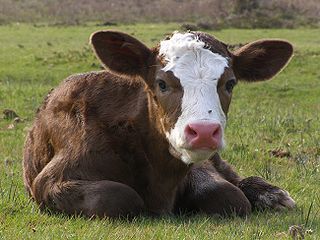
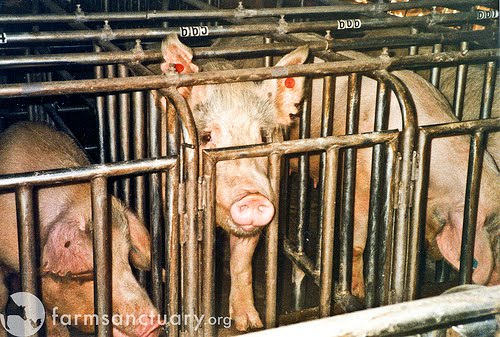
The primary thing we owe to animals (I argue, in my book Animalkind: What We Owe to Animals), is respect. Animals in extreme captivity are disrespected because they can't be themselves--pigs can't be pigs, fish can't be fish. A calf who can't so much as turn around is treated not as an animal but as a meat machine (to use Ruth Harrison's excellent phrase). We may need to supplement respect-talk with compassion-talk, but I think respect is primary. And it's appropriate even when we are uncertain what an animal is feeling. Do animals habituate to horrible environments and stop feeling or caring? Even if they did, that wouldn't make those environments OK -- they're still disrespectful.
Suppose a zoo gives the animals more space, or an animal farm releases a pig to a group pen or pasture. On my view, this isn't a superficial change-- a change to mere welfare, as opposed to rights -- it's a change to what really matters. It's more respectful. The animal is now at least more able to exercise his or her natural capacities. Now, very small changes aren't worth huge amounts of effort or money, so on this respect account, we can still debate how to focus animal advocacy. But an increase in liberty is a meaningful change, not a surface change.
Now, imagine we gradually make life better for a pig. We respectfully increase the size of the pen, then we respectfully allow the pig out doors, and we respectfully allow herd behavior, etc. We don't clip ears or dock tails, and so on. Nevertheless, the day comes when the animal is slaughtered and turned into barbecue (aside: Dear Michael Pollan, I am not enjoying the description of a pig barbecue in part I of your new book Cooked). How can any of the previous improvements be respectful if the last stage is so disrespectful?
You could try to make a case that killing animals doesn't harm them, but I think that's false (see Animalkind, p. 128-31). No, it's clearly harmful and disrespectful to kill an animal for the pleasure of a good barbecue (even assuming this pleasure runs pretty deep -- and we should allow that it does). But respect comes in degrees--you have done far more of what you should, if you allow an animal to exercise his or her natural capacities prior to death. I don't think the purpose of the whole system (using animals for our benefit) annuls all the apparent progress. And in any case, the whole system doesn't have to be completely brought down, in the name of respect. I'm prepared to countenance situations in which respectful people will pursue their own good at the expense of animals--i.e. situations in which harming or killing is a necessary evil. (Animalkind embraces this "necessity" standard and gives examples of justifiable use.)
Anyhow, the point is that on some views in animal ethics, we can help animals in two radically different, incommensurable ways--by securing their rights and by improving their welfare -- with one way running deeper than the other. But on other views, there's just one basic parameter--such as respect. So we do better by animals on the very same parameter, whether we give them more liberty or go much further and save them from all exploitation. This sort of "one parameter not two" approach can take many forms. The respect approach in my book is one; the capacities approach in Martha Nussbaum's book Frontiers of Justice also eschews any sharp rights/welfare distinction; and of course utilitarians take a one parameter approach, with that one parameter being well-being (rights, they say, are "nonsense upon stilts").
Because I think in terms of respect, I don't really feel at home with the whole welfare vs. rights debate -- it's not really my debate. For that reason, this could very well be my last post on the subject. Time to get back to ... well, all sorts of philosophy-stuff on my desk, but mostly packing.
7/10/13
Dueling Analogies
Alright, one more post on animal welfare regulations (like Prop. 2 in California, which requires animal housing large enough so the animal can turn around). In my last post I talked about five cases in which progressives have supported both "revolution" for victims of an injustice and reform. I argued that victims want both and are entitled to both. Animals are entitled to both too, if they matter as individuals (and yes, they do). The analogies were these--
- Amnesty International works for better conditions for prisoners on death row (reform), while also working to abolish the death penalty (basic change).
- Feminists work for driving rights for women in Saudia Arabia (reform), while also aiming to change the underlying sexist social structures (basic change).
- There used to be packed orphanages in the UK (and elsewhere) because adoption wasn't legal -- children were consigned to these places with no exit. Children's advocates worked to make orphanages kinder places (reform) while also working to legalize adoption (basic change).
- While waiting for child labor to be outright abolished (basic change), you could of course work for shorter working hours (reform).
- It's perfectly reasonable that anti-slavery abolitionists worked to stop parents and children being separated in auctions (reform), while at the same time working to abolish the whole institution of slavery (basic change).
- A law against sow crates is like an anti-bellum law limiting lashes to 40 instead of 42.
- Persuading people to buy more humane products (e.g. pork produced without sow crates) is like persuading a rapist to rape less violently.
- Advocating more humane treatment of farm animals is like advocating more humane treatment of people in death camps during the Holocaust.
- In all of my cases, the reform is significant. The prisoners clearly do want more time outside their cells, more phone calls, etc; women care about being able to drive; orphans want fewer beatings; child laborers want shorter hours; slave families don't want to be broken up. This is important because I think animal can tell the difference between being able to turn around and not being able to turn around -- it matters to them. Anti-regulation analogy #1 is flawed because I very much doubt you can even tell the difference between being lashed 40 times rather than 42.
- In my scenarios, the reformers want reform and more. Everyone knows AI wants an end to the death penalty; everyone knows feminists want full equality for women, not just driving rights; etc. etc. We need this in a good analogy, because the pro-reform animal organizations and advocates are just as clear that they want reform and more. In the anti-regulation analogies, we seem to be invited to imagine advocacy groups who want reform but nothing more. I think that's why we recoil. We think "How appalling to just want to make slavery, rape, and death camps more humane!" Fill in the details so that the reform groups want reform and more, and now these reformers don't seem so bad -- in fact not bad at all. Think about a covert German anti-Nazi group with influence on gas chamber designers. They shouldn't exert influence to make death easier for millions? No--that just can't be right.
- In my analogies there's no implied approval. That's important, because supporting reforms of the animal industry doesn't imply approval. Some who support reform are adamantly opposed to animal consumption. In the anti-regulation analogies, implied approval is at least hinted at. What's the idea in case #2? Will rape counselors sit down with rapists and just ask them to tone it down a bit? With more realistic details, the implied approval and absurdity disappears. Suppose we try to deter violence by imposing harsher punishments for aggravated rape instead of punishing all rapists alike. Now separately targeting the "how" and "that" of rape doesn't seem so absurd! In fact, this is exactly what the criminal justice system does. And (surely) rightly so.
6/29/13
Judy Nicastro's Abortion at 23 Weeks
This past week democrats in Texas managed to stave off a bill that would prohibit abortions after 20 weeks, thanks to a filibuster by Wendy Davis and a noisy gallery of abortion rights advocates. A few days earlier, there was an editorial in the New York Times week in review section called "My Abortion at 23 Weeks". I thought Wendy Davis should have read it during her filibuster. Rarely does anyone even talk about her abortion at 10 weeks--openly discussing a second trimester abortion was incredibly brave and very relevant to the proposed Texas law.
Nicastro was pregnant with twins, one of which had a herniated diaphragm. But that's not all--doctors informed her that "the organs were pushed up into our boy's chest and not developing properly." After more testing, they told her "Only one lung chamber had formed, and it was only 20 percent complete." Were the baby to be born, he would suffer through life support and probably (the article insinuates but doesn't say) die anyway. The only complication is that aborting one of the twins would increase the chances of the other miscarrying. But Nicastro took that chance and her daughter was born healthy three months later.
Did she do anything wrong? There are four letters to the editor on Nicastro's story, two supportive and two critical. One is from Sarah Moses. Under her name it says "The writer, an assistant professor of philosophy and religion at the University of Mississippi, teaches a course on medical ethics." It bothers me for readers to think her letter is representative of medical ethics, so I will point out that her departmental website says she is an "assistant professor of religion". This may have some relevance to the substance of her letter.
Her opinion is that Nicastro had an alternative to intentionally killing the fetus at 23 weeks--she could have let the pregnancy continue and refused life support for the newborn baby. She makes the point that at the end of life, refusing life support is morally better than outright killing the patient. Her counsel (in so many words): see the pregnancy through, do nothing heroic to save the baby, let him die. There's more suffering in that scenario, but she thinks that's what morality requires.
Yes? No? No! First glaring problem: the fetus at 23 weeks is not yet a legal person, both in the opinion of most philosophers, and as judged by the supreme court in Roe vs. Wade. So the choice between killing at 23 weeks and withdrawing life support after birth can't be compared to the choice between those two options as they pertain to a patient -- a person -- at the end of life.
Is intentional killing (painlessly at 23 weeks) really the worse alternative, compared to letting the newborn baby suffer and die? Even granting the dubious supposition that a person is involved in both cases, rather than a fetus in one and a person in the other, this is highly dubious. If death is inevitable, reaching it in the least painful way is not just permissible, it's imperative. To think intentional killing is forbidden, even when it achieves an inevitable death less painfully, involves a quasi-religious sensibility (which is why I mentioned Moses's position as a professor of religion, not philosophy and religion). You can't explain the forbiddeness of intentional killing (to prevent the pain of an inevitable death) in secular terms--you have to bring in what God thinks about intentional killing, or God's ownership of our lives, or the health of the soul, or some such. This is not medical ethics, simpliciter, it's religious ethics.
What do most philosophers think about killing to prevent a painful death? They think it's justifiable. In fact, they think it's justifiable at the end of life, too. When the individual killed is a fetus, it's just all the more clear.
The only puzzling thing about this case, to my mind, involves the healthy twin. Was it right to put her life at risk, to prevent the painful death of her brother? That's where there's some room for debate here. In our society we have limited alternatives, because infanticide is off the table. Were that an option, it's hard to say why it would be better to terminate earlier, exposing the healthy twin to risk, rather than waiting until after birth. It's probably only better psychologically--easier, all around, to bear.
Nicastro was pregnant with twins, one of which had a herniated diaphragm. But that's not all--doctors informed her that "the organs were pushed up into our boy's chest and not developing properly." After more testing, they told her "Only one lung chamber had formed, and it was only 20 percent complete." Were the baby to be born, he would suffer through life support and probably (the article insinuates but doesn't say) die anyway. The only complication is that aborting one of the twins would increase the chances of the other miscarrying. But Nicastro took that chance and her daughter was born healthy three months later.
Did she do anything wrong? There are four letters to the editor on Nicastro's story, two supportive and two critical. One is from Sarah Moses. Under her name it says "The writer, an assistant professor of philosophy and religion at the University of Mississippi, teaches a course on medical ethics." It bothers me for readers to think her letter is representative of medical ethics, so I will point out that her departmental website says she is an "assistant professor of religion". This may have some relevance to the substance of her letter.
Her opinion is that Nicastro had an alternative to intentionally killing the fetus at 23 weeks--she could have let the pregnancy continue and refused life support for the newborn baby. She makes the point that at the end of life, refusing life support is morally better than outright killing the patient. Her counsel (in so many words): see the pregnancy through, do nothing heroic to save the baby, let him die. There's more suffering in that scenario, but she thinks that's what morality requires.
Yes? No? No! First glaring problem: the fetus at 23 weeks is not yet a legal person, both in the opinion of most philosophers, and as judged by the supreme court in Roe vs. Wade. So the choice between killing at 23 weeks and withdrawing life support after birth can't be compared to the choice between those two options as they pertain to a patient -- a person -- at the end of life.
Is intentional killing (painlessly at 23 weeks) really the worse alternative, compared to letting the newborn baby suffer and die? Even granting the dubious supposition that a person is involved in both cases, rather than a fetus in one and a person in the other, this is highly dubious. If death is inevitable, reaching it in the least painful way is not just permissible, it's imperative. To think intentional killing is forbidden, even when it achieves an inevitable death less painfully, involves a quasi-religious sensibility (which is why I mentioned Moses's position as a professor of religion, not philosophy and religion). You can't explain the forbiddeness of intentional killing (to prevent the pain of an inevitable death) in secular terms--you have to bring in what God thinks about intentional killing, or God's ownership of our lives, or the health of the soul, or some such. This is not medical ethics, simpliciter, it's religious ethics.
What do most philosophers think about killing to prevent a painful death? They think it's justifiable. In fact, they think it's justifiable at the end of life, too. When the individual killed is a fetus, it's just all the more clear.
The only puzzling thing about this case, to my mind, involves the healthy twin. Was it right to put her life at risk, to prevent the painful death of her brother? That's where there's some room for debate here. In our society we have limited alternatives, because infanticide is off the table. Were that an option, it's hard to say why it would be better to terminate earlier, exposing the healthy twin to risk, rather than waiting until after birth. It's probably only better psychologically--easier, all around, to bear.
5/9/13
The Badness of Death
What makes death bad for someone who dies? This is on my mind for lots of different reasons--so here goes, some thinking aloud.
The question is puzzling if you even just think about the death of one individual, of one age and species, but let's be masochists and thinking about lots of deaths.
Death of a zygote after 2 days development
Death of a newborn baby
Death of a healthy young adult
Death of a very, very old unhealthy adult
Death of a healthy young cat
My gut feeling is that there's a certain Basic Badness to death (caps do so much to dignify ideas!). The Basic Badness consists of the fact that a certain conscious vantage point on the world existed for some time and then came to an end. It seems to me this is a yes/no matter. Either the basic badness is present or it's absent. And it's present whenever there exists a conscious vantage point. It's present in four of the cases, but not the first. A zygote has no conscious vantage point, so the Basic Badness of death is not present. It might be sad and bad or even tragic in some way for a zygote to die--think about the miscarriage of a much wanted pregnancy. But there is not the awfulness of termination of consciousness.
It would be foolish to say that all deaths are equally bad, just because they involve termination of consciousness. They have a certain type of badness to an equal degree, but there are other types of badness besides Basic Badness. There are two further types of badness (at least!) that make different deaths bad to different degrees. Death doesn't just bring an end to consciousness; it also takes away future life, and that future life can vary in quantity and quality. So in addition to the Basic Badness of death, there is also some degree of Deprivation. A very old unhealthy adult is deprived of less, by death, than a healthy young adult.
More "compare and contrast": I would say the deprivation involved when a cat dies is less than when a newborn baby or health human adult dies--both in light of quantity and quality. There are different "goods" possible in different lives, and not as much good in the average hour of a cat's life. (NB: no less an animal advocate than Peter Singer says exactly the same thing.)
Next: the Basic Badness of death is compounded also by the degree to which death Interrupts. It's one thing to take away future years that would have been good. It's another to interrupt a project that's already under way. Both are bad, but they're bad in different ways. In one case, precious days are lost, in the other, someone dies with "unfinished business."
Death interrupts very little for a baby, a great deal for a healthy adult, and once again, quite a bit less for a very old unhealthy adult. Does death interrupt for a cat, or is a cat's life lived day after day after day, with no possibility of "unfinished business"? There isn't much chance of "unfinished business" for most house cats, but many animals can die with unfinished business. Think of a salmon killed in the middle of its journey upstream, or a beaver killed while building a dam. But yes, on average, there's bound to be less interruption than when a healthy human adult dies.
Now let's do the math ... but how should we do it? A zygote's death is not bad as far as Basic Badness goes, but it's maximally depriving. Should we (1) simply add the numbers together? Is death, for a zygote, pretty damned bad, because of the deprivation? Or should we say (2) that only deaths that are Basically Bad can be even more bad, because of additional bad-making factors?
I say (2). I cannot make myself think the death of a zygote is bad in anything at all like the death of the other four individuals is bad. The badness of deprivation doesn't "kick in" because there's no basic badness to the death of a zygote.
The Basic Badness of death can be worsened by deprivation and interruption, but where there is no Basic Badness, there's nothing to worsen. The way that death brings consciousness to an end is a privileged part of the picture, with everything else playing a secondary, "compounding" role. Why is termination of consciousness the primary thing? Perhaps--bottom line--death is not really death, unless it terminates a consciousness. So deprivation doesn't make a zygote's death extra bad, because it's not really a death, in the funeral sense, to begin with, however much (nevertheless) it can be a grievous thing to lose a pregnancy.
At least--that's how things appear at the moment! Back to reading the death literature (I'm currently reading Death, by Shelly Kagan).
The question is puzzling if you even just think about the death of one individual, of one age and species, but let's be masochists and thinking about lots of deaths.
Death of a zygote after 2 days development
Death of a newborn baby
Death of a healthy young adult
Death of a very, very old unhealthy adult
Death of a healthy young cat
My gut feeling is that there's a certain Basic Badness to death (caps do so much to dignify ideas!). The Basic Badness consists of the fact that a certain conscious vantage point on the world existed for some time and then came to an end. It seems to me this is a yes/no matter. Either the basic badness is present or it's absent. And it's present whenever there exists a conscious vantage point. It's present in four of the cases, but not the first. A zygote has no conscious vantage point, so the Basic Badness of death is not present. It might be sad and bad or even tragic in some way for a zygote to die--think about the miscarriage of a much wanted pregnancy. But there is not the awfulness of termination of consciousness.
It would be foolish to say that all deaths are equally bad, just because they involve termination of consciousness. They have a certain type of badness to an equal degree, but there are other types of badness besides Basic Badness. There are two further types of badness (at least!) that make different deaths bad to different degrees. Death doesn't just bring an end to consciousness; it also takes away future life, and that future life can vary in quantity and quality. So in addition to the Basic Badness of death, there is also some degree of Deprivation. A very old unhealthy adult is deprived of less, by death, than a healthy young adult.
More "compare and contrast": I would say the deprivation involved when a cat dies is less than when a newborn baby or health human adult dies--both in light of quantity and quality. There are different "goods" possible in different lives, and not as much good in the average hour of a cat's life. (NB: no less an animal advocate than Peter Singer says exactly the same thing.)
Next: the Basic Badness of death is compounded also by the degree to which death Interrupts. It's one thing to take away future years that would have been good. It's another to interrupt a project that's already under way. Both are bad, but they're bad in different ways. In one case, precious days are lost, in the other, someone dies with "unfinished business."
Death interrupts very little for a baby, a great deal for a healthy adult, and once again, quite a bit less for a very old unhealthy adult. Does death interrupt for a cat, or is a cat's life lived day after day after day, with no possibility of "unfinished business"? There isn't much chance of "unfinished business" for most house cats, but many animals can die with unfinished business. Think of a salmon killed in the middle of its journey upstream, or a beaver killed while building a dam. But yes, on average, there's bound to be less interruption than when a healthy human adult dies.
Now let's do the math ... but how should we do it? A zygote's death is not bad as far as Basic Badness goes, but it's maximally depriving. Should we (1) simply add the numbers together? Is death, for a zygote, pretty damned bad, because of the deprivation? Or should we say (2) that only deaths that are Basically Bad can be even more bad, because of additional bad-making factors?
I say (2). I cannot make myself think the death of a zygote is bad in anything at all like the death of the other four individuals is bad. The badness of deprivation doesn't "kick in" because there's no basic badness to the death of a zygote.
The Basic Badness of death can be worsened by deprivation and interruption, but where there is no Basic Badness, there's nothing to worsen. The way that death brings consciousness to an end is a privileged part of the picture, with everything else playing a secondary, "compounding" role. Why is termination of consciousness the primary thing? Perhaps--bottom line--death is not really death, unless it terminates a consciousness. So deprivation doesn't make a zygote's death extra bad, because it's not really a death, in the funeral sense, to begin with, however much (nevertheless) it can be a grievous thing to lose a pregnancy.
At least--that's how things appear at the moment! Back to reading the death literature (I'm currently reading Death, by Shelly Kagan).
4/25/13
Was I once an egg?
Short recap of the Marquis argument I was responding to in my last post: Marquis says killing one of us is wrong because it takes away a FLO (future like ours). But abortion takes a FLO from a fetus. So abortion is wrong too.
Here's a response to Marquis I find intriguing/bewildering. Eugene Mills says if I was once a zygote, I was also once an egg. I wasn't also once a sperm. No, I was just once an egg. So if it's wrong to take the FLO from a zygote, it's also got to be wrong take the FLO from an egg. We have to be deeply concerned about using contraception to block conception. That's (surely) absurd, so there must be something wrong with Marquis's stance on abortion.
Was I really once an egg? An editorial in the New York Times last summer, written by a biologist (so he should know!) says yes, I really was. Greg Hampikian writes (here)
***
Now, here's why I'm bewildered: Mills and Hampikian say I was once an egg, but when I look closely at the "facts of life" it doesn't look to me like this is true. Watch the crucial clip of this video, which was made by what appears to be a reliable medical media company. Sperm penetrates egg. As a result, the sperm generates a haploid pronucleus and so does the egg. Each pronucleus appears to be a separate entity--EP and SP, let's call them. They then fuse, forming the diploid cell, Z. If EP and SP are two distinct entities, and they fuse, the logic of identity precludes saying that Z=EP. No, EP and SP go out of existence; Z is a third and new entity.
Here are the crucial frames. There are two separate entities, EP and SP; they are pulled together by "threads" and fuse.
In this clip, the egg is just the site in which EP and SP fuse, forming the new entity Z. Z is inside of the egg, not identical to the egg. We are invited to think Z is the start of a new human being, not the containing egg. In fact, the narrator calls the newly formed single cell a "zygote", instead of using that term to refer to the whole fertilized egg.
Another video tells the same story. Here's the crucial clip of that video with the key frames below. Again, separate pronuclei exist inside the egg and fuse.
Once again, this diagram of fertilization tells a story that suggests two entities fusing to generate a third--
If I was never a 5-day old zygote, then I was never anything that existed before the 5-day old zygote existed. For example, I was never an egg in my mother's ovary. QED!
Bottom line: I was never an egg. No, condemning the killing of a fetus does not drive us to the absurdity that we mustn't block the fertilization of an egg. You can say a fetus has a FLO but an egg doesn't, because it's not true that we were once eggs. There is no continuous entity that starts off existing before fertilization and continues for the first 14 days and then for the duration of pregnancy, and then through ordinary life, so that it has a FLO. If you want to refute Marquis, you need something else besides the idea that his reasoning turns contraception into murder.
Here's a response to Marquis I find intriguing/bewildering. Eugene Mills says if I was once a zygote, I was also once an egg. I wasn't also once a sperm. No, I was just once an egg. So if it's wrong to take the FLO from a zygote, it's also got to be wrong take the FLO from an egg. We have to be deeply concerned about using contraception to block conception. That's (surely) absurd, so there must be something wrong with Marquis's stance on abortion.
Was I really once an egg? An editorial in the New York Times last summer, written by a biologist (so he should know!) says yes, I really was. Greg Hampikian writes (here)
Your life as an egg actually started in your mother’s developing ovary, before she was born; you were wrapped in your mother’s fetal body as it developed within your grandmother.So (says Hampikian/Mills) I go back a long way--to child-me, to baby-me, to fetal-me, to zygote-me, to egg-me. There is one continuous entity there, though picked out by different terms at different stages (child, baby, fetus, zygote, egg). The sperm is crucial for making me go on from being an egg to being a zygote, but there is no symmetry here. I was once an egg but I was never a sperm. Importantly, the sperm does not induce "substantial change". The sperm does not make one thing go out of existence (the egg) and a second thing come into existence (the zygote). One thing is prodded to continue existing, because of the sperm, instead of a new entity coming into being.
After the two of you left Grandma’s womb, you enjoyed the protection of your mother’s prepubescent ovary. Then, sometime between 12 and 50 years after the two of you left your grandmother, you burst forth and were sucked by her fimbriae into the fallopian tube. You glided along the oviduct, surviving happily on the stored nutrients and genetic messages that Mom packed for you.Then, at some point, your father spent a few minutes close by, but then left. A little while later, you encountered some very odd tiny cells that he had shed. They did not merge with you, or give you any cell membranes or nutrients — just an infinitesimally small packet of DNA, less than one-millionth of your mass.
***
Now, here's why I'm bewildered: Mills and Hampikian say I was once an egg, but when I look closely at the "facts of life" it doesn't look to me like this is true. Watch the crucial clip of this video, which was made by what appears to be a reliable medical media company. Sperm penetrates egg. As a result, the sperm generates a haploid pronucleus and so does the egg. Each pronucleus appears to be a separate entity--EP and SP, let's call them. They then fuse, forming the diploid cell, Z. If EP and SP are two distinct entities, and they fuse, the logic of identity precludes saying that Z=EP. No, EP and SP go out of existence; Z is a third and new entity.
Here are the crucial frames. There are two separate entities, EP and SP; they are pulled together by "threads" and fuse.
In this clip, the egg is just the site in which EP and SP fuse, forming the new entity Z. Z is inside of the egg, not identical to the egg. We are invited to think Z is the start of a new human being, not the containing egg. In fact, the narrator calls the newly formed single cell a "zygote", instead of using that term to refer to the whole fertilized egg.
Another video tells the same story. Here's the crucial clip of that video with the key frames below. Again, separate pronuclei exist inside the egg and fuse.
Once again, this diagram of fertilization tells a story that suggests two entities fusing to generate a third--
From what I can see, Story (1) is true: EP and SP fuse to become the diploid cell Z, a whole new thing. Z develops inside the egg, using some materials from the egg. If you were once any entity in this complex, you were once Z, not the larger, containing egg.
Can you read things any other way? I guess the eggcentrists see it this way:
Story (2): The egg lives on, after fertilization, just altered profoundly. Both EP and SP go out of existence, after forming Z, but the egg keeps growing. Getting Z as its nucleus does not cause substantial change in the egg, making a new entity come into existence. No, it's the same ol' egg, just doing some amazing new stuff. If you were once any entity in this complex, you were once the egg, with EP, SP, and Z just very important parts of you.
At the very least, I think Story (1) is coherent. Nobody has to read the biological facts as Story (2) has them. I can reasonably think my earliest life was as Z, not as an egg in my mother's ovary.
***
There's another way to block the idea that I was once an egg in my mother's ovary. Marquis actually says it may not be true that I was once a zygote--the entity that exists in the first 14 days after fertilization. He doesn't explain the basis for his doubts, but I would speculate he may be drawing on the very interesting book When Did I Begin? by Norman Ford.
Ford argues that in the first days, a zygote is a collection of separate things, not a unified, single entity. In the first few days, it's so ununified that each cell can develop into a separate entity (making for identical twins, quadruplets, or octuplets).
It's also significant that the early zygote contains the makings of a placenta, umbilical chord, and amniotic fluid. If I was once a 5-day old zygote, then it's also true that my placenta was once a 5-day old zygote. By the logic of identity, it follows I was once a placenta! Not just absurd, but yucky-absurd! Conclusion: I was not once a 5-day old zygote.
Bottom line: I was never an egg. No, condemning the killing of a fetus does not drive us to the absurdity that we mustn't block the fertilization of an egg. You can say a fetus has a FLO but an egg doesn't, because it's not true that we were once eggs. There is no continuous entity that starts off existing before fertilization and continues for the first 14 days and then for the duration of pregnancy, and then through ordinary life, so that it has a FLO. If you want to refute Marquis, you need something else besides the idea that his reasoning turns contraception into murder.
4/18/13
Is it wrong to take the future from a fetus?
Don Marquis's argument against abortion (in "Why Abortion is Immoral") is pleasingly simple. He says the wrongness of killing one of us (folks like you and me who are obvious members of the "moral community") is due to the fact that killing deprives an individual of their entire future, a valuable "Future Like Ours" (FLO) in most cases. But abortion deprives a fetus of a FLO as well. So abortion is presumptively wrong, for the same reason any other killing is presumptively wrong.
What should we say? Since Marquis first made this argument in the 1980s, it's spawned a vast literature. I'm certainly not going to saying anything new and different here. I'm just going to think aloud a bit about how I would respond.
PIFF!
First, a response I would not make. Let's call this "Personal Identity Fancy Footwork" (PIFF!). What you might say is that an entity with my future didn't start to exist when I was conceived, but quite a bit later. Perhaps that entity (J, for short) came into being very late in my mother's pregnancy, or after she had given birth. That, afterall, is when a thing with my conscious mentality came into being. Nothing with my conscious mentality existed at conception, or a month into my gestation, or three months into it. Had my mother contemplated abortion when she was one month pregnant, she would have destroyed F ("my" fetus--so to speak) but not J. J didn't exist yet. F didn't have J's future, if F was not the same entity as J. Abortion certainly would have taken a future from F, but that was a non-conscious future with no special value. F was merely deprived of the next couple of months, months before F gave way to J.
PIFF advocates will have to answer someone who says, understandably enough, "If you take a future from F, then J's future is gone too, right?" The PIFF-er has a coherent response: F exists to be deprived of its future. But once F is gone, because of an abortion, J never comes into existence. So J never exists to be deprived of her future. After an abortion, J will be a merely possible entity. Doing things that eliminate merely possible entities and their futures can't be at all like killing. Otherwise, we're all murderers for not doing our utmost to conceive as many children as we possibly can. If F is non-identical to J, surely that does undermine Marquis's indictment of abortion.
So...PIFF?
I think not. I lean strongly to the view that F is identical to J. So destroying F does take a FLO away from F. Of course it's true that during the course of gestation and growth, F will come to have new properties (like being conscious, feeling pain, having preferences). And I think some of these properties are morally important. But I'm not prepared to say any of these new properties are "existentially" important--that they make for the end of one entity and the beginning of another. The idea that a new entity pops into being once consciousness emerges strikes me as a vestige of dualism. But that's a long story....
Suppose you agree that F is identical to J. You could avail yourself of identity considerations of another kind to construct a reductio ad absurdum of Marquis's argument. You could argue that F is identical to J, but F is also identical to an entity that exists prior to conception. F, you might say, is identical to the egg (E) that's fertilized at conception. If you can make a case for that, then you'll wind up saying that killing F is as bad as killing J; but also having to say (absurdly) that preventing E from being fertilized is as bad as killing F or J. Women who avoid intercourse during ovulation will have to be equated with murderers!
Is that the best available response to Marquis? I think the identity considerations underlying that response are also implausible. No, E is not identical to F. Again, long story.
A TALE OF FOUR BOOKSTORES
The reponse I'm inclined to give to Marquis grants that a new entity comes into existence at conception (or shortly thereafter--there are good reasons to date this just a little later than conception) and continues to exist throughout pregnancy, after birth, and into childhood and adulthood. Abortion therefore does deprive an entity of its whole future--a FLO, if it's going to be a typical future.
What I think we should balk at is the notion that killing is wrong purely because it deprives an entity of its future. No, it's wrong because it deprives an entity of a future to which it is entitled. I don't think you can speak of entitlement in the case of a one-month-old fetus. Just because a fetus is innocent or guiltless, it does not follow that it is entitled to anything.
It's easy to see that it's not always wrong to cause an entity to be deprived of something valuable, but rather wrong only when the entity is entitled to that thing. Take, for example, this tale of four bookstores. Once we had a store called Bookstop in Dallas, but Borders came to town, and people preferred Borders. Bookstop's owners were no doubt deprived of a huge amount of wealth and pleasure. Then Barnes and Noble came to town and all the Borders stores eventually closed. Poor Borders owners! They were also deprived of a huge amount of wealth and pleasure. Now Amazon is making the local Barnes and Noble stores look awfully empty. B&N's owners may be on the verge of being deprived. The winners in these business competitions did nothing wrong. They caused deprivations, but didn't cause weaker businesses to be deprived of anything they were entitled to.
Likewise, if Mary flirts with Margo's boyfriend Mark, and Mark starts to prefer Mary, Margo winds up deprived, but not deprived of anything she was entitled to. If two people are in a race, and the one behind gets in front, the early favorite winds up deprived of winning, but not deprived of anything she was entitled to. And on and on and on. Generally speaking, it's not causing a deprivation that's wrong, but causing someone to be deprived of something they're entitled to.
Is there a difference between what a one month old fetus is entitled to and what folks like us are entitled to? Yes. Why? Because though a fetus is the very same entity as the later infant, child, and adult it will become, it doesn't yet have the morally relevant properties of the later infant, child, or adult. It is not entitled to its future in the way that you or I are entitled to our futures. So abortion is nothing at all like murder. It has some of the elements (the individual killed is deprived) but not all of the elements (the individual killed is not entitled to its future). So Marquis's argument is unsound.
Unsound, but not completely devoid of insight. If a fetus does have a FLO (though one it's not entitled to) that explains why women are not confused at all when they take abortion seriously or have later mixed feelings. That makes very good sense, because abortion does cause a deprivation. It does take the future from an entity, and I think it's not incoherent at all to find that at least somewhat disturbing.
What should we say? Since Marquis first made this argument in the 1980s, it's spawned a vast literature. I'm certainly not going to saying anything new and different here. I'm just going to think aloud a bit about how I would respond.
PIFF!
First, a response I would not make. Let's call this "Personal Identity Fancy Footwork" (PIFF!). What you might say is that an entity with my future didn't start to exist when I was conceived, but quite a bit later. Perhaps that entity (J, for short) came into being very late in my mother's pregnancy, or after she had given birth. That, afterall, is when a thing with my conscious mentality came into being. Nothing with my conscious mentality existed at conception, or a month into my gestation, or three months into it. Had my mother contemplated abortion when she was one month pregnant, she would have destroyed F ("my" fetus--so to speak) but not J. J didn't exist yet. F didn't have J's future, if F was not the same entity as J. Abortion certainly would have taken a future from F, but that was a non-conscious future with no special value. F was merely deprived of the next couple of months, months before F gave way to J.
PIFF advocates will have to answer someone who says, understandably enough, "If you take a future from F, then J's future is gone too, right?" The PIFF-er has a coherent response: F exists to be deprived of its future. But once F is gone, because of an abortion, J never comes into existence. So J never exists to be deprived of her future. After an abortion, J will be a merely possible entity. Doing things that eliminate merely possible entities and their futures can't be at all like killing. Otherwise, we're all murderers for not doing our utmost to conceive as many children as we possibly can. If F is non-identical to J, surely that does undermine Marquis's indictment of abortion.
So...PIFF?
I think not. I lean strongly to the view that F is identical to J. So destroying F does take a FLO away from F. Of course it's true that during the course of gestation and growth, F will come to have new properties (like being conscious, feeling pain, having preferences). And I think some of these properties are morally important. But I'm not prepared to say any of these new properties are "existentially" important--that they make for the end of one entity and the beginning of another. The idea that a new entity pops into being once consciousness emerges strikes me as a vestige of dualism. But that's a long story....
Suppose you agree that F is identical to J. You could avail yourself of identity considerations of another kind to construct a reductio ad absurdum of Marquis's argument. You could argue that F is identical to J, but F is also identical to an entity that exists prior to conception. F, you might say, is identical to the egg (E) that's fertilized at conception. If you can make a case for that, then you'll wind up saying that killing F is as bad as killing J; but also having to say (absurdly) that preventing E from being fertilized is as bad as killing F or J. Women who avoid intercourse during ovulation will have to be equated with murderers!
Is that the best available response to Marquis? I think the identity considerations underlying that response are also implausible. No, E is not identical to F. Again, long story.
A TALE OF FOUR BOOKSTORES
The reponse I'm inclined to give to Marquis grants that a new entity comes into existence at conception (or shortly thereafter--there are good reasons to date this just a little later than conception) and continues to exist throughout pregnancy, after birth, and into childhood and adulthood. Abortion therefore does deprive an entity of its whole future--a FLO, if it's going to be a typical future.
What I think we should balk at is the notion that killing is wrong purely because it deprives an entity of its future. No, it's wrong because it deprives an entity of a future to which it is entitled. I don't think you can speak of entitlement in the case of a one-month-old fetus. Just because a fetus is innocent or guiltless, it does not follow that it is entitled to anything.
It's easy to see that it's not always wrong to cause an entity to be deprived of something valuable, but rather wrong only when the entity is entitled to that thing. Take, for example, this tale of four bookstores. Once we had a store called Bookstop in Dallas, but Borders came to town, and people preferred Borders. Bookstop's owners were no doubt deprived of a huge amount of wealth and pleasure. Then Barnes and Noble came to town and all the Borders stores eventually closed. Poor Borders owners! They were also deprived of a huge amount of wealth and pleasure. Now Amazon is making the local Barnes and Noble stores look awfully empty. B&N's owners may be on the verge of being deprived. The winners in these business competitions did nothing wrong. They caused deprivations, but didn't cause weaker businesses to be deprived of anything they were entitled to.
Likewise, if Mary flirts with Margo's boyfriend Mark, and Mark starts to prefer Mary, Margo winds up deprived, but not deprived of anything she was entitled to. If two people are in a race, and the one behind gets in front, the early favorite winds up deprived of winning, but not deprived of anything she was entitled to. And on and on and on. Generally speaking, it's not causing a deprivation that's wrong, but causing someone to be deprived of something they're entitled to.
Is there a difference between what a one month old fetus is entitled to and what folks like us are entitled to? Yes. Why? Because though a fetus is the very same entity as the later infant, child, and adult it will become, it doesn't yet have the morally relevant properties of the later infant, child, or adult. It is not entitled to its future in the way that you or I are entitled to our futures. So abortion is nothing at all like murder. It has some of the elements (the individual killed is deprived) but not all of the elements (the individual killed is not entitled to its future). So Marquis's argument is unsound.
Unsound, but not completely devoid of insight. If a fetus does have a FLO (though one it's not entitled to) that explains why women are not confused at all when they take abortion seriously or have later mixed feelings. That makes very good sense, because abortion does cause a deprivation. It does take the future from an entity, and I think it's not incoherent at all to find that at least somewhat disturbing.
4/6/13
How to argue against gay marriage (part III)
And now for the rebuttal. In the last post I said that if I had to make an argument against gay marriage--in a debate club setting, or some such--then perhaps I'd say this:
Even if a sizable and certain risk could be established, we'd have to explain why procreative dangers ought to stop us from letting same sex couples marry, while we allow very old men to marry young women (danger: offspring who quickly lose their fathers); and we allow "little people" to marry (danger: high risk of progeny with dwarfism), etc. etc. We grant everyone the legal right to marry who they wish, and normally take it as a private moral question who should procreate, and how.
Well, it was the best I could do. In the comments to the last two posts people suggested some other bad arguments against gay marriage--bad arguments better than some of the usual fare. At least none of our suggestions involve the idea that once you allow gay marriage, you've got to let people marry their cats. The opponents of gay marriage typically seem not to be satisfied with making bad arguments; they like to go for completely atrocious.
- There's a great deal of value in knowing both of your biological parents and being raised by them (other things being equal--of course there are exceptions).
- The normal way of procreating for same sex couples involves a gamete donor, so that the child knows and is raised by at most one biological parent.
- If same sex couples are permitted to marry, their normal way of procreating will be elevated to parity with the heterosexual way of procreating.
- Because of that elevation to parity, we will all gradually lose sight of the value of knowing both of your biological parents and being raised by them.
- Losing sight of a kind of value tends to cause that sort of value to be less pursued and less protected. Possible sequelae: couples (straight or gay) buying gametes to have the type of child they prefer (an intellectual, an athlete, or whatever); rights of biological parents being less protected.
- There isn't the same problem with infertile heterosexual couples being able to marry, since using a gamete donor is not their normal way of procreating, but usually a last resort chosen after years of medical intervention. THEREFORE,
- Same sex marriage should be prohibited (but marriage of heterosexuals who may turn out to be infertile should be allowed).
It is not good enough just to say "gay marriage might be bad for someone else, therefore all these gay people don't have it." In fact, every life is important, and those gay lives must be weighed in the balance.There's no quick step from procreative risks to denial of marriage rights. The risks, even if they were considerable, would have to be weighed against the rights and legitimate preferences of gay people themselves.
Even if a sizable and certain risk could be established, we'd have to explain why procreative dangers ought to stop us from letting same sex couples marry, while we allow very old men to marry young women (danger: offspring who quickly lose their fathers); and we allow "little people" to marry (danger: high risk of progeny with dwarfism), etc. etc. We grant everyone the legal right to marry who they wish, and normally take it as a private moral question who should procreate, and how.
Well, it was the best I could do. In the comments to the last two posts people suggested some other bad arguments against gay marriage--bad arguments better than some of the usual fare. At least none of our suggestions involve the idea that once you allow gay marriage, you've got to let people marry their cats. The opponents of gay marriage typically seem not to be satisfied with making bad arguments; they like to go for completely atrocious.
2/12/13
Intergenerational Amnesia
Suppose a 10 year old child had a life-threatening illness that could only be cured at the cost of amnesia. She would lose all memory of her first 10 years, but go on living. It would be bad to forget her early years, but surely worth it to stay alive. I think we should say roughly the same thing about the practice of saving babies' lives by placing "baby boxes" hear hospitals. When a desperate mother abandons her baby, the baby loses all chance of knowing her origins, but gets to go on living (infanticide is prevented), and will hopefully be adopted by a loving family. There's a loss, but it's worth it. Given that characterization, it makes sense to try to change attitudes, so that mothers don't feel compelled to furtively abandon their babies, but instead either keep them or relinquish them in open adoptions. That would be better for the children, it seems to me.
Charlotte Witt takes a different position on baby boxes here. She contests Article 8 of the UN Convention on the Rights of the Child, which has been invoked against baby boxes: "States Parties undertake to respect the right of the child to preserve his or her identity, including nationality, name and family relations." To my ear, "undertakes to respect" is rather mild. You could "undertake to respect" the right in question, and still have a system of baby boxes, justifying it by saying in that particular case, saving lives takes priority. But Article 8 does postulate a right to know about one's origins (in so many words), and Witt objects. The alleged ground of the right, she says, is that knowing your family of origin is "central to the healthy formation of identity." So (this is her gloss) one needs to know one's family of origin to form a health sense of identity. But that's not so, she argues. To the extent that we gain a sense of identity by knowing what we got from our parents and grandparents, they could equally well be custodial, not genetic, parents and grandparents.
I don't know about the idea that there's a psychological need to know one's origins. Do mental health experts really think we're impaired by not knowing anything about our biological parents? But most people do deeply care about their origins. This is not a matter of just caring about our genes. You couldn't get a genome map of yourself, and thereby dispense with the need to know who your parents and grandparents are. In caring about our origins we care about our ... origins. Where we came from, who our progenitors were. This is like wanting to know who created a painting, or who was the author of a novel. Knowing origins can tell you more about the person, painting, or novel, but is also of independent interest. We want to know where things came from. Period. This seems like a fundamental and not irrational desire.
The person who starts life in a baby box will, like most of us, have a desire to know her own origins. Now "knowing my origins" is a sufficiently elastic concept that we could know a lot by knowing about our custodial parents, grandparents, teachers, nannies, or whoever was closely involved in our lives. But most of us also want to know our origins in the strictly biological sense. We'd be missing an important piece of the puzzle about ourselves if we didn't know who our biological parents (and grandparents) were. It's unfortunate, then, to start life in a baby box--not worse than not living at all, but worse than starting life in a position to know about one's biological origins. Or so it seems to me.
Is this position "bionormative" in some pernicious sense? That seems to be Witt's view. She seems to think attaching value to knowledge of origins gives some sort of special status to families formed in the standard, biology-based fashion. But I think biology is normative in some ways. We all really think so, as evidenced by our intuitions about the following two puzzles.
Charlotte Witt takes a different position on baby boxes here. She contests Article 8 of the UN Convention on the Rights of the Child, which has been invoked against baby boxes: "States Parties undertake to respect the right of the child to preserve his or her identity, including nationality, name and family relations." To my ear, "undertakes to respect" is rather mild. You could "undertake to respect" the right in question, and still have a system of baby boxes, justifying it by saying in that particular case, saving lives takes priority. But Article 8 does postulate a right to know about one's origins (in so many words), and Witt objects. The alleged ground of the right, she says, is that knowing your family of origin is "central to the healthy formation of identity." So (this is her gloss) one needs to know one's family of origin to form a health sense of identity. But that's not so, she argues. To the extent that we gain a sense of identity by knowing what we got from our parents and grandparents, they could equally well be custodial, not genetic, parents and grandparents.
I don't know about the idea that there's a psychological need to know one's origins. Do mental health experts really think we're impaired by not knowing anything about our biological parents? But most people do deeply care about their origins. This is not a matter of just caring about our genes. You couldn't get a genome map of yourself, and thereby dispense with the need to know who your parents and grandparents are. In caring about our origins we care about our ... origins. Where we came from, who our progenitors were. This is like wanting to know who created a painting, or who was the author of a novel. Knowing origins can tell you more about the person, painting, or novel, but is also of independent interest. We want to know where things came from. Period. This seems like a fundamental and not irrational desire.
The person who starts life in a baby box will, like most of us, have a desire to know her own origins. Now "knowing my origins" is a sufficiently elastic concept that we could know a lot by knowing about our custodial parents, grandparents, teachers, nannies, or whoever was closely involved in our lives. But most of us also want to know our origins in the strictly biological sense. We'd be missing an important piece of the puzzle about ourselves if we didn't know who our biological parents (and grandparents) were. It's unfortunate, then, to start life in a baby box--not worse than not living at all, but worse than starting life in a position to know about one's biological origins. Or so it seems to me.
Is this position "bionormative" in some pernicious sense? That seems to be Witt's view. She seems to think attaching value to knowledge of origins gives some sort of special status to families formed in the standard, biology-based fashion. But I think biology is normative in some ways. We all really think so, as evidenced by our intuitions about the following two puzzles.
Puzzle #1 When a child is born, the biological parents are entitled to custody even if they have vastly worse potential to give her a good life than candidates for adoption. Imagine a refugee camp in Chad, where babies are born in abysmal conditions. Child mortality rates are high. People can easily live in the camps for decades. International Rescue Committee workers visit the camp regularly and could take babies home with them, to raise in western health and affluence. If it's "bionormative" to say refugees are entitled to keep their children, then bionormativity is not to be dispensed with. Biology does in fact enter into determining which adult is entitled to custody of which child.Norms are sometimes rooted in biology, so it's not an automatic demerit for a position to be "bionormative". Bionormative as this judgment may be, it does seem unfortunate to start off in life with "intergenerational amnesia"--permanently unable to know anything about our biological origins.
Puzzle #2 Now imagine a biological parent in that refugee camp who does decide to give up her child for adoption to one of the visiting workers. There are several candidates, and from a detached, objective standpoint, it's pretty clear who would be better able to provide the child with a good home. Does the biological parent get to decide between them? The answer, surely, is yes. And that's "bionormative"--again, the biological facts enter into who is entitled to decide between the candidates.
1/26/13
"Life begins at conception"
Mary Elizabeth Williams declares herself a pro-choice liberal, but wants to concede that "life begins at conception". To her, this is undeniable common sense. But in fact, there is actually a very solid reason to doubt that any human's lifespan starts as early as conception. At conception, what exists is a single-celled zygote. That zygote contains the makings of not just the embryo (fetus, etc.), but of all the structures that will support the embryo (fetus, etc.)--the placenta, amniotic fluid, etc. Imagine (only somewhat analogously) a very full box you take off the shelf at Ikea (with great effort!). The box contains the makings of a bed, but also instructions, tools, packaging, styrofoam, etc. You take it home and put together the bed, discarding everything else. Would you say the bed started its lifespan as the full box? No, of course not. There is no bed until a bed has started to take form and become separate from everything else that was in the box. And at the point, it really makes no sense to say "the bed was once the full box."
Likewise, once an embryo has become differentiated, a few weeks into gestation, it would make no sense to say it started its lifespan back when there was just a zygote. The zygote is analogous (somewhat--this is not a perfect analogy) to the full bed-box. It's a forerunner of the embryo and all the support structures. I think the very common idea that life could start at conception stems from ignorance about what a zygote is. It's not an embyronic human being yet. It's a kit for making a human being, including components for housing, protecting, feeding, etc. You might be able to convince yourself that you were once an embryo (I think this is an intelligible position), but it really makes no sense to think you were once a zygote--a people-kit. No you weren't! You came from a people-kit, but you weren't one. It's much like in the bed/box example: the Ikea bed came from the box, but beds don't start their careers being boxes. No equal sign would make sense up there, between the box and the bed, and no equal sign would make sense between a zygote and an embryo (or fetus or baby).
1/22/13
Beyonce Lip Synced Anthem?
Uh oh, it seems Beyonce lip-synced the national anthem yesterday. Here's what USA Today is reporting--
Master Sgt. Kristin DuBois, spokeswoman for the President's Own United States Marine Band, confirms to USA TODAY's Maria Puente that Beyoncé was lip-syncing.Somehow this next part makes it worse--
It's standard operating procedure for musicians to pre-record crucial music such as Hail to the Chief and The Star-Spangled Banner. "You can't have a presidential inauguration and not have Hail to the Chief and Star-Spangled Banner," she says.
And it's not unprecedented to use the pre-recorded track, as Yo-Yo Ma did last time, classical instruments being delicate in cold weather. But the band performed live for the entire ceremony, except for Beyoncé.
Washingtonian's Sophie Gilbert writes, "To press seated just below the podium, in front of the 'President's Own' Marine Corps Band, it was evident that the band wasn't actually playing during the song — even though band director Colonel Michael J. Colburn was conducting energetically and the band members mimicked blowing into their instruments."Fake conducting? Fake trumpet playing? It so happens my class on contemporary moral problems is discussing deception and when/whether/why it's morally problematic. Looks like we have another interesting example to discuss.
PS: It gets worse! "Sources also tell Fox News that Beyonce was a no-show at the inauguration performance rehearsal on the Capitol steps." This is a little sad, considering that the crowd around us was mad about Beyonce. They groaned with disappointment every time someone else talked or performed (apart from Obama). They wanted Beyonce! Singing, I think, not just appearing to sing.
Subscribe to:
Posts (Atom)