This is a terrifically interesting and well done video responding to the contention that animals can't feel pain. I'll make some comments below.
1:08 The video starts in a shaky way, speculating that sea mammals may be aware of the feelings of the humans they interact with. Well, maybe. Fortunately that's just the entry point into the main question: do animals feel pain? Wish I could refer to the narrator by name--don't know who she is.
2:00 Neo-Cartesian philosophers Michael Murray and Willian Lane Craig argue that animals have (a) reactions to stimuli, and (b) pain experiences, but no (c) higher order awareness of pain experiences. There's nothing bad about pain, in the absence of (c), so there's nothing bad about animal pain.
Comment: It seems obvious the last person you should ask about the existence of animal pain is someone who has a vested interest in the answer being "No, there isn't any." Theists like William Lane Craig see their whole world view, their whole mission in life, under threat, if animals feel pain, because animal pain creates a terribly difficult instance of the problem of evil. We need to rebut the theists' arguments directly, but should also laugh at the notion that they're unbiased authorities on animal pain.
Craig says animals don't have a pre-frontal cortex so can't have (c). He says it's a tremendous comfort to animal owners to know that animals never suffer. I'm worried about William Lane Craig's dog! If he really takes his own verbiage seriously, he could reduce his veterinary bills by letting the poor animal have surgery without anesthesia. Fortunately veterinarians, whether theists or not, aren't about to listen to crap (crummy religious animal psychology).
4:30 Great clip showing the influence of people like Murray and Craig. Fella says only humans have pre-frontal cortex.
5:30 It's great the video challenges the scientific claim that animals lack a pre-frontal (or frontal) cortex, but it also needs to challenge the view of animal pain that says self-awareness is needed for animal pain.
7:30 Bruce Hood clears it up--yes, other animals have a pre-frontal (or frontal) cortex.
9:00 More on how animals do have a pre-frontal cortex. When I teach the topic of animal pain to undergraduates, I use the same type of diagram the video does. I agree completely that Craig's intellectual integrity has to be questioned.
11:48 Now we get to the good stuff. With Stuart Firestein we get away from the higher order awareness theory of pain.
13:20 Lori Marino talks about animal self-awareness, so now we're again taking seriously what Craig says about the nature of pain--that it is bound up with self-awareness. Marino grants self-awareness to dogs, but my impression is that that's a minority view. She cautions against relying too much on the mirror self-recognition test. Well and good, but that leaves us having to be agnostic about whether many animals have self-awareness. If you think self-awareness is a pre-condition of pain, you're going to wind up being agnostic about pain in many species. We need to hear from animal psychologists and philosophers of mind who think pain does not require self-awareness. I believe that's the majority view.
16:55 Marino says self-awareness can't be localized. So the anatomy of animal brains just doesn't tell us (as Craig thinks it does) whether animals have it or not. Again, I think if you want to counter skepticism about animal pain, it's not your best bet to grant the contention that self-awareness is required for pain.
19:40 Guy reads Craig to Marino. She laughs, "It's nonsense." She thinks pain awareness is not located in the pre-frontal cortex. She says pain reception is sub-cortical. All species have brain systems that are involved in detecting pain. She rejects idea that pain requires meta-cognition. (Yay!!!) "There is no evidence for that." She says fish feel pain.
24:00 Animal joy, empathy, etc. She really wants to press the idea that animals have self-awareness. Maybe yes, maybe no. I think it's much more important to establish the existence of animal pain, and to do that it's important to deny the alleged connection between pain and self-awareness.
28:07 Oh no, Craig believes in an immaterial soul! Narrator rightly points out that raise the question why it matters whether animals have (pre)frontal cortex. Does Craig have to rule out that animal pain is seated in animal souls? (Ha!)
28:45 The Cambridge Declaration on animal consciousness (July 12, 2012) All mammals and birds, at the very least, have consciousness.
30:00 Jane Goodall autotuned! Wow!
Final thought. If I were a desperate theist trying to contend with the existence of animal pain, what would I say? Well, maybe there's a little something to the idea that mild pain makes life more interesting. A dog wouldn't enjoy his dinner as much, if he weren't first hungry. That leaves extreme pain as an unsolved problem, as extreme pain doesn't make life more interesting--it just makes life suck. If you really, really want to pretend it doesn't exist, I find it more attractive to just say God zaps it away miraculously. At least that way we don't do any pretend science. We let the real science of animal pain be as it is, and then allow that it's suspended whenever God's feeling compassionate toward animals. Arguably the science-respecting theist ought to prefer that approach.
Thanks to Spencer Lo for sending the video link.

Showing posts with label religion. Show all posts
Showing posts with label religion. Show all posts
10/9/12

7/29/12
Are atheist accommodationists hypocritical?
Jerry Coyne finds philosophers very, very, very vexing when they try to reconcile science and religion. He suspects it's always "political"--
There's nothing at all unusual about philosophers wondering if A can be reconciled with B, but also rejecting A. Theist philosophers can reasonably wonder whether atheism and objective morality can be reconciled, but of course reject atheism. That's a first class question for anyone who "does" metaethics--not a question just for those who accept the atheist starting point. If there were a "political" aspect to the question, for theists, that wouldn't be bad either. Perhaps, though a theist, it bothers you to see your atheist friends being beaten up as morality-challenged. So you care about and promote the idea that atheism can be reconciled with objective morality, even though the reconciliation plays no role in your own life. Hypocrisy? No, obviously not.
Is it any different when atheists try to stop their theist friends being beaten up as science-challenged? Of course, if the effort is disingenuous, that's one thing. Maybe you think your theist friends are science-challenged, and you're just trying to be nice. But if not, not. I think what some atheist philosophers believe is that a little bit of religion (certainly not all of it) can be combined with all of science, and that's what they insist upon--not more. That's not hypocritical or disingenuous. In fact, it might even be the truth.
In my estimation, all atheist philosophers who try to reconcile religion and science are doing so for political reasons—as are organizations like the National Academy of Sciences and the National Center for Science Education that engage in the same activity. It takes a profound hypocrisy to try to reconcile for others things that you can’t reconcile for yourself.Don't think so! It's true that most philosophers (70%) are atheists, and that almost all accept science as an important source of knowledge. But if you reject theism and accept science, it certainly doesn't follow that you reject theism because you accept science. You might reject theism for reasons completely independent of the reasons you have for accepting science. In fact, I think that's the state of mind of many philosophers. Many reject theism because of the argument from evil. Or they reject theism because none of the usual arguments for God are successful, and they think the default, when it comes to a fanciful construct, is disbelief. So although they accept no religious propositions themselves, it's genuinely an open question, for them, whether you could accept some, and yet accept all of science.
There's nothing at all unusual about philosophers wondering if A can be reconciled with B, but also rejecting A. Theist philosophers can reasonably wonder whether atheism and objective morality can be reconciled, but of course reject atheism. That's a first class question for anyone who "does" metaethics--not a question just for those who accept the atheist starting point. If there were a "political" aspect to the question, for theists, that wouldn't be bad either. Perhaps, though a theist, it bothers you to see your atheist friends being beaten up as morality-challenged. So you care about and promote the idea that atheism can be reconciled with objective morality, even though the reconciliation plays no role in your own life. Hypocrisy? No, obviously not.
Is it any different when atheists try to stop their theist friends being beaten up as science-challenged? Of course, if the effort is disingenuous, that's one thing. Maybe you think your theist friends are science-challenged, and you're just trying to be nice. But if not, not. I think what some atheist philosophers believe is that a little bit of religion (certainly not all of it) can be combined with all of science, and that's what they insist upon--not more. That's not hypocritical or disingenuous. In fact, it might even be the truth.
7/23/12
Faith
Michael Kelly's article about his daughter's marriage in the NYT Style section yesterday was a thing of beauty--try reading it without crying! He starts with the horror of his daughter's rape 10 years ago and ends with this, on her abiding faith--
There's something stupendous about being able to see things this way. Stupendous, not stupid. To my mind, it's an expression of tenacity, determination, an abiding love of life. You have to appreciate the psychological power of faith. I don't have it, for philosophical reasons, but I can be glad for people who do.Ten years ago, bleeding and alone in the field where she had been left to die at 24, my daughter got up and stumbled to a house in the dead of night. She said later that she felt as if she had been “lifted up by God.” I asked somewhat bitterly where God had been 10 minutes earlier.In the greatest testament of faith I have ever heard, she calmly replied, “He was there holding my hand.”Now Eric has taken her hand in marriage, a union that is surely blessed by God.
7/12/12
Religious Circumcision
 | |
| picture from www.brityy.org |
I am against infant circumcision. That said, I hasten to add that I don't think circumcising boys is the world's greatest crime. Many circumcised boys have lived to tell the story. They are not enormously deprived. Circumcising boys is nothing like "circumcising" girls. Still--I think the practice is wrong and should stop.
But what if you're Jewish? Don't you have to circumcise your baby boy? This is what some Jewish groups are saying in response to a German court's recent ruling against religion-based infant circumcision. You could respond with a general attack on religion, or an attack on religious rationales for suspicious childrearing practices (see Brian Earp for the latter). But I think it's interesting to approach this from a Jewish perspective. Does it really make sense for Jews to insist on infant circumcision?
You might say "of course," since in the bible God does demand circumcision on the 8th day. But let's have a look at the circumcision chapter of Genesis (17) and consider the meaning of circumcision. Liberal Jews, at least, ought to agree that it's the meaning that matters, as they are prepared to throw out hundreds and hundreds of biblical injunctions--the bits about banning lepers, stoning people for blasphemy, and the like. What (we) liberal Jews want to retain is what really matters, not every last line and edict.
17 When Abram was ninety-nine years old, the Lord appeared to him and said, “I am God Almighty[a]; walk before me faithfully and be blameless. 2 Then I will make my covenant between me and you and will greatly increase your numbers.”
3 Abram fell facedown, and God said to him, 4 “As for me, this is my covenant with you: You will be the father of many nations. 5 No longer will you be called Abram[b]; your name will be Abraham,[c] for I have made you a father of many nations. 6 I will make you very fruitful; I will make nations of you, and kings will come from you. 7 I will establish my covenant as an everlasting covenant between me and you and your descendants after you for the generations to come, to be your God and the God of your descendants after you. 8 The whole land of Canaan, where you now reside as a foreigner, I will give as an everlasting possession to you and your descendants after you; and I will be their God. ”
9 Then God said to Abraham, “As for you, you must keep my covenant, you and your descendants after you for the generations to come. 10 This
is my covenant with you and your descendants after you, the covenant
you are to keep: Every male among you shall be circumcised. 11 You are to undergo circumcision, and it will be the sign of the covenant between me and you. 12 For the generations to come every male among you who is eight days old must be circumcised, including those born in your household or bought with money from a foreigner—those who are not your offspring. 13 Whether born in your household or bought with your money, they must be circumcised. My covenant in your flesh is to be an everlasting covenant. 14 Any uncircumcised male, who has not been circumcised in the flesh, will be cut off from his people; he has broken my covenant. ”
Any reasonable, modern approach to this chapter will focus on the main underlying meaning--the covenant--not the exact details as to who should circumcise whom, and when. The meaning becomes more clear a little later in the chapter. First there is this, which stresses the extraordinary generosity of God. He will even give a child to 90 year old Sarah!
15 God also said to Abraham, “As for Sarai your wife, you are no longer to call her Sarai; her name will be Sarah. 16 I will bless her and will surely give you a son by her. I will bless her so that she will be the mother of nations; kings of peoples will come from her.”
17 Abraham fell facedown; he laughed and said to himself, “Will a son be born to a man a hundred years old? Will Sarah bear a child at the age of ninety?” 18 And Abraham said to God, “If only Ishmael might live under your blessing!”
19 Then God said, “Yes, but your wife Sarah will bear you a son, and you will call him Isaac.[d] I will establish my covenant with him as an everlasting covenant for his descendants after him. 20 And as for Ishmael, I have heard you: I will surely bless him; I will make him fruitful and will greatly increase his numbers. He will be the father of twelve rulers, and I will make him into a great nation. 21 But my covenant I will establish with Isaac, whom Sarah will bear to you by this time next year.”
Now it's Abraham's turn to "give back."
22 When he had finished speaking with Abraham, God went up from him.
23 On that very day Abraham took his son Ishmael and all those born in his household or bought with his money, every male in his household, and circumcised them, as God told him. 24 Abraham was ninety-nine years old when he was circumcised, 25 and his son Ishmael was thirteen; 26 Abraham and his son Ishmael were both circumcised on that very day. 27 And every male in Abraham’s household , including those born in his household or bought from a foreigner, was circumcised with him.
This is an amazing passage, if you think about it vividly. Imagine the slicing (without anaesthia), the blood, the pain--all that, done to a sensitive, pleasure-giving organ. God gave richly, and these men gave back proportionally. That's the meaning of circumcision: thanking God and making a commitment to him through pain and sacrifice--of a body part, and the pleasure that it brings.
Now, I don't see how it's possible for circumcision to mean gratitude and commitment unless men undertake it themselves, voluntarily, and with full knowledge of how they will suffer and what they're giving up. Think about Abraham forcing circumcision on his slaves. That couldn't possibly have the same meaning as undergoing the procedure himself. ("No skin off my penis..." you can just about hear him say.) Likewise if adults try to express gratitude and commitment by tying down 8-day-old babies and cutting of their foreskins, there's no meaningful sacrifice being made. You cannot make a meaningful sacrifice by taking something away from someone else.
So I think Jews should make a modification to the circumcision ritual in just the way they've modified hundreds and hundreds of other biblical injunctions. They should become like Abraham and Ismael, and decide for themselves, at an adult age, whether or not they want to have their foreskins removed. At that point, I predict they will feel just as Abraham and Ismael must have--that a foreskin is kind of a nice thing. If it's more painful to be circumcised as an adult, then so be it. The pain was part of the meaning of the ritual for Abraham and Ismael. Adult circumcision would be a true sacrifice, a way to express dedication to God.
Now of course, if circumcision is done in the style of Abraham and Ismael--to adult males--there's a question whether it will continue. Jewish boys are happy with Bar Mitzvahs as a rite of passage, and are likely to be a lot less excited about circumcision. In fact, I think once they get to know their foreskins, many are not going to want to give them up. They're going to think "what a crazy, barbaric ritual!" That part of the bible will then be forgotten, like the parts about banishing lepers and stoning blasphemers.
That eventuality may make some Jews loathe to replace infant with adult circumcision. They'll want to get 'em while their helpless, to preempt adult males making "the wrong decision" later on. But that, clearly, is ethically suspect. We should do to babies what we think they would want us to do, if we could consult their later adult selves. That's why we give them vaccinations and force them to go to school, despite their protests. To perform circumcision on a baby boy just because we think he won't perform it on himself, later on, clearly violates the baby's rights.
So: adult circumcision. That's the way to go, especially if you're circumcising for Jewish reasons.
6/28/12
The American Atheists' Harassment Policy
While we all wait to find out what the Supremes think of the Affordable Care Act, let's have a look at the Harassment Policy hammered out by American Atheists in the wake of the recent online brouhaha about such things. Here's the core of the policy--
 That all sounds exactly right. [Update10:10 am: Is there stuff to quibble with? I just read this, and maybe so, but it strikes me as being mostly on the right track.]
Another part of the policy really ought to be removed. This is just plain silly:
(1) If we explicitly asked, then we'd put the person we want to touch/hug in the awkward position of having to say "no" if they don't want to be touched/hugged. It would have been so much more thoughtful to notice the cues and not call attention to their sensitivity.
(2) If we had to explicitly ask, we'd ruin spontaneity--so most of us would just do less touching and hugging.
(3) If we asked, it would highlight what is better left subterranean--that touching has some mild sexual undertones, touching is ever so slightly intimate, touching can be gross to some people, some people may find me in particular gross.
If I were thinking of going to an American Atheists convention (to be honest, I am not), I'd find it off-putting to be told how to negotiate touching ("no touching other people without asking") or even just be "encouraged to ask for unequivocal consent." This crosses the line from what's the conference's business (all the stuff in the box above) to what's not. It's up to me, I think, how I handle the vast number of decisions that are in the realm of etiquette, not law or even ethics. I'd be appalled if a conference organizer issued instructions about what to say after belching, whether and when to hold doors for other people, when to address someone by their first name, etc. It's paternalistic and infantilizing -- suitable for managing a bunch of 10 year olds, but not for running a conference attended by adults.
And no, it doesn't help that David Silverman has added that he wants people to have sex at American Atheist conferences. There's something a little weird going on when it's seen as GRRRREAT!!!! for people to have casual hook-ups, but a serious infraction (worthy of being addressed in a conference policy) to touch someone without first asking permission. Yes, sexual touching without permission is a serious infraction (the boxed policy is all to the good), but mere casual touching and hugging between acquaintances?
I'm struck by the contrast with religious communities. In a religious community, there is constant touching between acquaintances. For example, the reform Jewish temple I attend (infrequently) is an extremely touchy place. Before, during, and after the service you see constant physical interaction. Ask permission? You've got to be kidding. There is also a lot of synchronization--people stand up and sit down at the same times during the service. All this synching and touching is part of feeling collective joy, sorrow, etc.--all feelings evoked at times by a religious service. But sex? Well, it's kind of a special thing, reserved (at least ideally) for special relationships. It's a strange inversion to make a big deal of casual touching, putting it on a verbal-permission-only basis, while encouraging casual sex. That sounds like a recipe for killing off solidarity in a community while ramping up private titillation. With rules like that, I should think, "things fall apart, the center cannot hold."
***
Supreme court decision is now out. It looks like ... YESSSSS! Good news. More on that later.
Another part of the policy really ought to be removed. This is just plain silly:
You are encouraged to ask for unequivocal consent for all activities during the conference. No touching other people without asking. This includes hands on knees, backs, shoulders—and hugs (ask first!). There are folks who do not like to be touched and will respect and like you more if you respect their personal space.What exactly is wrong with negotiating these things as we do the rest of the time--by paying attention to non-verbal cues? It's better that way, most of us think. We don't go through life constantly asking "I haven't seen you for a long time--may I hug you?" Or "I'd like to show solidarity and sympathy--may I touch your arm as I say this next sentence?" We don't, because (let us count the problems)--
(1) If we explicitly asked, then we'd put the person we want to touch/hug in the awkward position of having to say "no" if they don't want to be touched/hugged. It would have been so much more thoughtful to notice the cues and not call attention to their sensitivity.
(2) If we had to explicitly ask, we'd ruin spontaneity--so most of us would just do less touching and hugging.
(3) If we asked, it would highlight what is better left subterranean--that touching has some mild sexual undertones, touching is ever so slightly intimate, touching can be gross to some people, some people may find me in particular gross.
If I were thinking of going to an American Atheists convention (to be honest, I am not), I'd find it off-putting to be told how to negotiate touching ("no touching other people without asking") or even just be "encouraged to ask for unequivocal consent." This crosses the line from what's the conference's business (all the stuff in the box above) to what's not. It's up to me, I think, how I handle the vast number of decisions that are in the realm of etiquette, not law or even ethics. I'd be appalled if a conference organizer issued instructions about what to say after belching, whether and when to hold doors for other people, when to address someone by their first name, etc. It's paternalistic and infantilizing -- suitable for managing a bunch of 10 year olds, but not for running a conference attended by adults.
And no, it doesn't help that David Silverman has added that he wants people to have sex at American Atheist conferences. There's something a little weird going on when it's seen as GRRRREAT!!!! for people to have casual hook-ups, but a serious infraction (worthy of being addressed in a conference policy) to touch someone without first asking permission. Yes, sexual touching without permission is a serious infraction (the boxed policy is all to the good), but mere casual touching and hugging between acquaintances?
I'm struck by the contrast with religious communities. In a religious community, there is constant touching between acquaintances. For example, the reform Jewish temple I attend (infrequently) is an extremely touchy place. Before, during, and after the service you see constant physical interaction. Ask permission? You've got to be kidding. There is also a lot of synchronization--people stand up and sit down at the same times during the service. All this synching and touching is part of feeling collective joy, sorrow, etc.--all feelings evoked at times by a religious service. But sex? Well, it's kind of a special thing, reserved (at least ideally) for special relationships. It's a strange inversion to make a big deal of casual touching, putting it on a verbal-permission-only basis, while encouraging casual sex. That sounds like a recipe for killing off solidarity in a community while ramping up private titillation. With rules like that, I should think, "things fall apart, the center cannot hold."
***
Supreme court decision is now out. It looks like ... YESSSSS! Good news. More on that later.
5/24/12
Coyne on Evolution and Religion
Jerry Coyne has a new article out on how religiosity gets in the way of Americans accepting evolution. I'm surprised he continues a pattern of reasoning that was widely criticized over a year ago. First he dismisses religious scientists as "proof" of religion-science compatibility--
Why worry about "proof" in the first passage, and then lower the bar, making the issue "evidence" in the second passage? With evidence the topic in both passages, both the religious scientists and the formerly religious scientists come out to be some evidence. But it doesn't seem as if Coyne wants to accept the religious scientists as any evidence at all, since he dismisses them entirely with the Whitman quote and the Christian adultery point.
Now, if you've made up your mind that religion and science are logically incompatible (cannot both be all true) on some independent basis, then yes, you can dismiss Francis Collins as compartmentalizing (that's what you've got to think--or something along those lines), and you can think formerly religious scientists are reasoning when science gradually crowds out religion for them. But in that case, you've got some other basis for thinking religion and science are incompatible. What's really hard to do, if you're being fair and logical, is both dismiss religious scientists as any evidence at all for science-religion compatibility and also use formerly religious scientists as some evidence for science-religion incompatibility.
Now maybe, maybe, there could be special reasons for the different treatment. Maybe you've got evidence of compartmentalizing in the religious scientists. They may actually utter the words of Whitman's poem themselves! Maybe you've got evidence of reasoning in the formerly religious scientists--you've caught them going from premises about science to negative conclusions about religion. But barring special evidence of that sort, if you think scientists losing religion count as some evidence for incompatibility, you have to think scientists not losing religion count as some evidence for compatibility. Right? Right!
Of course religious scientists aren't proof of compatibility, but you might think they're some evidence. In fact, you would almost have to think so, if, like Coyne, you regarded it as evidence of incompatibility that people lose religion as they develop into elite scientists--Some argue that the mere existence of religious scientists proves this compatibility, but that is specious. That people can simultaneously hold two conflicting worldviews in their head is evidence not for compatibility but for Walt Whitman’s (1855) solipsistic admission, “Do I contradict myself?/ Very well, then I contradict myself,/ (I am large, I contain multitudes.).” This argument for science/faith compatibility is like saying that Christianity and adultery are compatible because many Christians are adulterers.
Further evidence for incompatibility comes from the huge disparity in religiosity between scientists and laypeople. While only 6% of the American public describe themselves as atheists or agnostics, 64% of scientists at “elite” American universities fall into these classes (Ecklund 2010; similar results were found by Larson and Witham 1997). This figure is much higher for more accomplished scientists. A survey by Larson and Witham (1998) showed that that 93% of members of the National Academy of Sciences, America’s most elite body of scientists, are agnostics or atheists, with just 7% believing in a personal God. This is almost the exact reverse of figures for the American public as a whole.
This disparity bespeaks a profound disconnect between faith and science. Regardless of whether it reflects the attraction of nonbelievers to science, or the fact that science erodes religious belief—both are undoubtedly true—the incompatibility remains.
Why worry about "proof" in the first passage, and then lower the bar, making the issue "evidence" in the second passage? With evidence the topic in both passages, both the religious scientists and the formerly religious scientists come out to be some evidence. But it doesn't seem as if Coyne wants to accept the religious scientists as any evidence at all, since he dismisses them entirely with the Whitman quote and the Christian adultery point.
Now, if you've made up your mind that religion and science are logically incompatible (cannot both be all true) on some independent basis, then yes, you can dismiss Francis Collins as compartmentalizing (that's what you've got to think--or something along those lines), and you can think formerly religious scientists are reasoning when science gradually crowds out religion for them. But in that case, you've got some other basis for thinking religion and science are incompatible. What's really hard to do, if you're being fair and logical, is both dismiss religious scientists as any evidence at all for science-religion compatibility and also use formerly religious scientists as some evidence for science-religion incompatibility.
Now maybe, maybe, there could be special reasons for the different treatment. Maybe you've got evidence of compartmentalizing in the religious scientists. They may actually utter the words of Whitman's poem themselves! Maybe you've got evidence of reasoning in the formerly religious scientists--you've caught them going from premises about science to negative conclusions about religion. But barring special evidence of that sort, if you think scientists losing religion count as some evidence for incompatibility, you have to think scientists not losing religion count as some evidence for compatibility. Right? Right!
5/15/12
Religion for Atheists
When Alain De Botton gets done building his temple for atheists, I'd like to be appointed the music director. Let's definitely have a lot of Bjork. Why? Because her music creates the sort of experience religious people get to have, and De Botton thinks the godless should have as well. Or perhaps more like it -- a successor experience. Something grand, emotional, and full of wonder, but without the worshipful part. I'm just a bit obseessed with Bjork! This is from the album Homogenic --
5/5/12
Ethics minus religion = thin gruel?
Didn't see this until now -- "Room for Debate" at the New York Times, with Rhys Southan weighing in interestingly (as usual).
Elsewhere in vegan-world, Gary Francione has an interesting, long essay about moral realism and "new atheism". It bothers him, as it does me, that new atheists often accept the following equation: ETHICS minus RELIGION = THIN GRUEL. In academic ethics, that equation is usually rejected. Generally, new atheists think giving up God makes a much bigger difference to everything than it really does. A prime example of the "huge difference" view (perhaps we should talk about "huge difference atheism" rather than "new atheism") is Alex Rosenberg's book The Atheist's Guide to Reality: Enjoying Life without Illusions, which I'm reviewing in an upcoming issue of Free Inquiry. This is HD Atheism cubed. My 2,000 word review, reduced to one word, would be "no". More on that when the review comes out.
Elsewhere in vegan-world, Gary Francione has an interesting, long essay about moral realism and "new atheism". It bothers him, as it does me, that new atheists often accept the following equation: ETHICS minus RELIGION = THIN GRUEL. In academic ethics, that equation is usually rejected. Generally, new atheists think giving up God makes a much bigger difference to everything than it really does. A prime example of the "huge difference" view (perhaps we should talk about "huge difference atheism" rather than "new atheism") is Alex Rosenberg's book The Atheist's Guide to Reality: Enjoying Life without Illusions, which I'm reviewing in an upcoming issue of Free Inquiry. This is HD Atheism cubed. My 2,000 word review, reduced to one word, would be "no". More on that when the review comes out.
5/3/12
The Geography of Faith
Here's a reason to be a skeptic that holds up at first, but crumbles on reflection: religious beliefs depend on where a person lives. Via Jerry Coyne, here are two amusing maps:
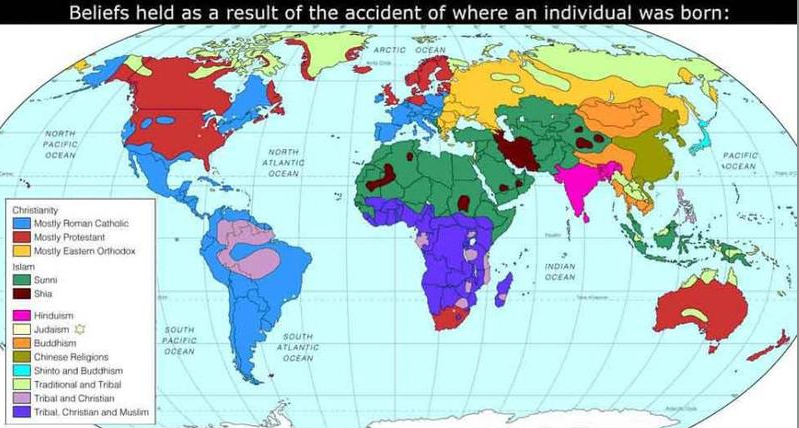
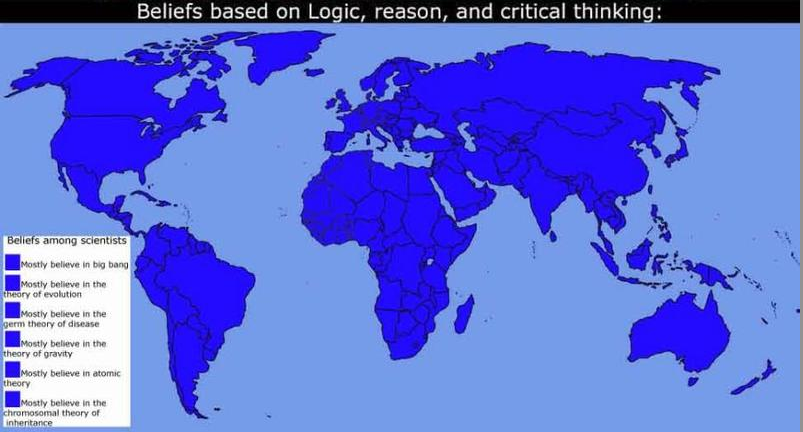
If having a belief depends on where you live, the suspicion is that the belief is shaped by non-rational forces instead of being a consequence of the way the world is. We shouldn't take these kinds of beliefs too seriously, if at all.
And yet, and yet. The likelihood of believing in human rights, or equality for women, or same-sex marriage, or democracy ... all these beliefs would go on Map #1. They vary from place to place. Nevertheless, you could make a case that liberal democratic views on these matters are rooted in the way the world is. I'm not going to become a skeptic about women's equality, just because the folks in Afghanistan and Saudi Arabia don't believe in women's equality. So why should anyone take sheer geographical variation as evidence that the tenets of some religion are false? Bad precedent!
If having a belief depends on where you live, the suspicion is that the belief is shaped by non-rational forces instead of being a consequence of the way the world is. We shouldn't take these kinds of beliefs too seriously, if at all.
And yet, and yet. The likelihood of believing in human rights, or equality for women, or same-sex marriage, or democracy ... all these beliefs would go on Map #1. They vary from place to place. Nevertheless, you could make a case that liberal democratic views on these matters are rooted in the way the world is. I'm not going to become a skeptic about women's equality, just because the folks in Afghanistan and Saudi Arabia don't believe in women's equality. So why should anyone take sheer geographical variation as evidence that the tenets of some religion are false? Bad precedent!
4/28/12
Who to Trust?

I do not see this as a competition between us as to who is the better scholar, but as simply a matter of who to trust: someone who presents carefully researched, carefully worded, carefully reasoned work on this subject, with a minimum of mistakes (because as I’ve said, I make them, too), or someone who doesn’t.The part after "who to trust" is tendentious, of course. Bart Ehrman's books are fantastic, and they show he's a good scholar and perfectly prepared to be a skeptic (he abandoned the Christian faith of his youth). In rounds one and two of the web-debate, I think Ehrman slaughters Carrier. But here's what really destroyed Carrier's reputation in my eyes. It so happens that the first thing Carrier wrote after he joined Free Thought Blogs was an astonishingly cocky yet unbelievably stupid diatribe called "Meat not Bad". The thing was shot through with errors, yet the tone invited the reader to think Carrier was Mr. Smart slaughtering all the dummies. His conclusion: "I think being a vegetarian out of 'compassion' is irrational. I mean that in the classic sense: it’s a non sequitur, and thus illogical. It’s to treat animals like people, which they are not."
You could not read the literature on the treatment of animals, or watch videos put out by reliable groups like the Humane Society, and come away with this opinion. Could not. Yet he holds forth with certitude, and make the other side out to be illogical. This, I take it, is Carrier's modus operandi. It's exactly what you see in his current debate with Ehrman. So I have no time for Richard Carrier, but Ehrman's book sounds fun--perhaps just because it's intriguing how some atheists are so determined to move from "No God" to "No Jesus". I'd like to see this passion for no-Jesus dissected.
4/26/12
Martha Nussbaum on Religious Intolerance
She talks about her latest book The New Religious Intolerance here. I think she goes too far in the direction of "can't we all just get along?" What she says about martyrdom made me especially queasy. People who let themselves be killed during the Holocaust, in solidarity with Jews, have no connection with suicide bombers who blow up other people in the service of "jihad". And no, we don't have as much reason to worry about orthodox Jews as we have to worry about fundamentalist Muslims. Nonetheless, an interesting interview, and the book is probably good reading too.
4/14/12
Coyne v. Haidt
I thought it was not so nice of Jerry Coyne to dismiss Jonathan Haidt as "a bit of a woo-ish self-help guru". In fact, both unnice and not reality-based. Haidt's book The Happiness Hypothesis is extremely interesting and well-written, and no less valuable because it does have a self-help element (I use it in a course I teach). And that's saying nothing about his extensive and influential research on morality and disgust. Haidt is a mere "faitheist" (he is an atheist) in Coyne's eyes because he's not a religion-hater. Outrageous! But Haidt turns out to be above the fray. He responds to the substance of Coyne's post in this long and interesting comment. (My extra-curricular reading list is getting horribly long. Mooney and Haidt and E. O. Wilson's new book.)
1/13/12
The Value of Prayer
Julian Baggini acknowledges the value of prayer, despite being a non-believer:
 Like Baggini, I can see how it could be valuable to pray, but I'll go a step further--I can see how it could be valuable to think praying makes a difference (whether or not it really does). Suppose someone you know has a serious illness, and you want to express concern. I'm afraid "I'm thinking of you" doesn't convey quite the same thing as "I'm praying for you." If you're praying, and you believe praying makes a difference, then you're not just thinking of the person, you're trying to help them. It's better to try to help people than think of them, right? Sometimes we are in a position to pray, but can do nothing else. We are too far away, the disease is too serious, whatever. I have been in situations where I'd much rather be able to say "I'm praying for you."
I also think praying can be useful for the person suffering from an illness. You'd think it could backfire. The patient might pray instead of getting all the advanced treatments. Yes, there are people who believe in prayer instead of medicine. But what I've observed (here in the religious heart of Texas) is that people who pray will also go to the ends of the earth to find a medical cure. In fact, I believe there may be a connection, sometimes, between praying and aggressively trying to treat disease. Prayer may sometimes give someone just the boost in hopefulness she needs to believe that further treatment might be helpful. At least, that's how it seemed in the case of a woman I met about 15 years ago. A mother of three young children, she prayed mightily for a cure for her breast cancer, while also seeing out every conceivable cutting edge treatment. (Sadly, she did not survive.)
You'd think maybe if a person believed God answers prayers, then she'd have to think God also causes diseases to begin with. So she'd feel better in a way ("God may help me") but also worse ("God let me get this disease"). Could be--but not necessarily! God is good, you might think. The cancer is not God's doing--but the cure could be.
I couldn't possibly believe in the efficacy of prayer. Come on--what God can cure, he could have prevented in the first place. More overwhelmingly, it's impossible for me to believe in a God who let six million Jews die in the Holocaust, but is now on standby to help individuals with cancer. Please. Still, it would be good in very tangible ways not only to be able to pray, but to believe it was beneficial.
I do think that prayer, like many rituals, is something that the religious get some real benefits from that are just lost to us heathens. One reason is that many of these rituals are performed communally, as part of a regular meeting or worship. This means there is social reinforcement. But the main one is that the religious context transforms them from something optional and arbitrary into something necessary and grounded. Because the rituals are a duty to our absolute sovereign, there is strong reason to keep them up. You pray every day because you sense you really ought to, and it will be noticed if you don't. In contrast, the belief that daily meditation is beneficial motivates in much the same way as the thought that eating more vegetables or exercising is. Inclination comes and goes and needs to be constantly renewed.
I also think praying can be useful for the person suffering from an illness. You'd think it could backfire. The patient might pray instead of getting all the advanced treatments. Yes, there are people who believe in prayer instead of medicine. But what I've observed (here in the religious heart of Texas) is that people who pray will also go to the ends of the earth to find a medical cure. In fact, I believe there may be a connection, sometimes, between praying and aggressively trying to treat disease. Prayer may sometimes give someone just the boost in hopefulness she needs to believe that further treatment might be helpful. At least, that's how it seemed in the case of a woman I met about 15 years ago. A mother of three young children, she prayed mightily for a cure for her breast cancer, while also seeing out every conceivable cutting edge treatment. (Sadly, she did not survive.)
You'd think maybe if a person believed God answers prayers, then she'd have to think God also causes diseases to begin with. So she'd feel better in a way ("God may help me") but also worse ("God let me get this disease"). Could be--but not necessarily! God is good, you might think. The cancer is not God's doing--but the cure could be.
I couldn't possibly believe in the efficacy of prayer. Come on--what God can cure, he could have prevented in the first place. More overwhelmingly, it's impossible for me to believe in a God who let six million Jews die in the Holocaust, but is now on standby to help individuals with cancer. Please. Still, it would be good in very tangible ways not only to be able to pray, but to believe it was beneficial.
12/14/11
God Talk
 In honor of the Plantinga article in the NYT today, I'm republishing a post I wrote when he visited SMU last year (2/4/10). I think the talk covered some of the same ground as his new book.
***
No, God didn't talk at SMU yesterday, but Alvin Plantinga did. He gave a talk called "Science and Religion: Where the Conflict Really Lies."
10/29/11
Free Will and Divine Foreknowledge -- Mental Masturbation?

The latest atheist-derided project is UC Riverside graduate student Patrick Todd's research on divine foreknowledge and free will. According to the university announcement --
The fellowship enables young scholars to use contemporary analytic methods to pursue independent research in the fields of divine and human agency, such as moral responsibility and freedom of will; or philosophy of mind and its theological implications, such as the presence of the divine in a natural world and the emergence of consciousness ...
His postdoctoral research project, “Divine Foreknowledge, the Philosophy of Time, and the Metaphysics of Dependence: Some New Approaches to an Old Problem,” assesses a core Ockhamist thesis about foreknowledge. William of Ockham was a 13th century philosopher. “The central contention of the Ockhamist concerns a point about the order of explanation. According to the Ockhamist, it is because of what we do that God long ago believed that we would do these things. That is, God’s past beliefs depend in an important sense on what we do, and thus, says the Ockhamist, we can sometimes have a choice about God’s past beliefs,” he explained. “The overarching goal of this project is to develop and assess this core Ockhamist thesis along two underexplored dimensions: the philosophy of time, and the metaphysics of dependence – both of which have seen an explosion of recent interest.”Patrick Todd works with John Martin Fischer, one of the top free will experts in the world -- and a non-believer. Todd has already published about free will in the top peer-reviewed journal in philosophy. Given these indirect clues, the chances that this student is a mush-minded fool are roughly zero. But here's biologist Jerry Coyne's learned, or unlearned, assessment: "This is an area about which I’m completely ignorant, and happy to remain so, because it sounds like a godawful cesspool of theological lucubration."
Ophelia Benson at least shows appropriate modesty when she wonders if she's missing something. She has the gut feeling that it's "conceptually incoherent" to imagine there could be divine foreknowledge in a world with free will. God would have to be capable of the logically impossible. I take it that's her point when she writes,
But what’s being described here is not something that doesn’t actually exist but something that (given everything we know) couldn’t exist – something that makes no sense – an omniscient god that knows the future, which is not determined because free will says it can’t be. If god knows the future, it’s determined. If it’s not determined, then god doesn’t know it. Gotta pick one; can’t have both. Both in combination are just contradictory.Certainly God's omnipotence is not thought to include doing the logically impossible, like lifting a rock nobody can lift. But is foreknowledge, in a world with free will, really logically impossible?
Suppose God right now in October 2011 knows that Obama will win the election in 2012. There is free will, we are supposing, so millions of people will freely cast their votes in 2012, before Obama wins. Since we are ruling out determinism, God does not know about Obama winning by knowing facts about how the world is right now, and drawing on his knowledge of laws to make a prediction. Rather, God knows about Obama winning directly, despite the fact that his winning turns on all those free votes. Also suppose knowledge requires the right sort of dependence of the knower's belief on the fact that's believed. Many theories of knowledge say something of that sort.
Are we now at the point of supposing the logically impossible? Not necessarily. What we have to believe, to make all this coherent, is that the state of God's mind in 2011 can depend in a certain way on facts about the world in 2012. The past has to depend on the future in the right sort of way. That would be possible, even if there is free will, assuming there is backward causation, or time worked in some funny way. That may or may not be physically impossible, but it's not (obviously) logically impossible. And there may(may, may) also be ways to make sense of this sort of dependence, without making extravagant claims about time and causation. Perhaps that's part of what the student plans to think about, with the help of his Templeton grant.
Note, just for fun--the past does depend on the future in some trivial and unproblematic ways, even if there is free will. What happens in 2012 will make sentences written in 2011 true or false, will make desires in 2011 satisfied or unsatisfied, will make hopes in 2011 dashed or fulfilled. The past does depend on the future in some respects. The question, though, is whether it does, or could, conceivably, depend on the future in the right sort of way for anyone (like God) to know the future, assuming there is free will.
What value could this sort of research have, if there is no god? Jerry Coyne has this to say--
If there isn’t one ... then the project becomes an exercise in mental masturbation, musing about what something nonexistent would do if it existed. Why is that any more valid than wondering how an omnimalevolent God could allow good in the world, or why an omnibenevolent God allows evil? Or, for that matter, how fairies would keep their wings dry in the rain, or how Santa manages to deliver all those presents to billions of kids in only one evening. And what if you assume that God isn’t omniscient? Then the whole project is moot.He seems to think that all counterfactual assumptions are equally valuable or valueless, but this is obviously not so. We get nowhere by supposing there are fairies in the garden, but learn a lot from other fanciful assumptions. For example, there is a mountain of research in philosophy of mind and philosophy of language that proceeds from the counterfactual assumption that there is a place called Twin Earth--just like earth in every single way, but a distinct place. Can you really dismiss it all as mental masturbation, on grounds that there is no twin earth? The answer is no.
Likewise, you get some valuable insights in ethics from supposing (contrary to fact) that the fetus is a person (see Judith Jarvis Thomson's famous article on abortion), or from supposing (contrary to fact) that once upon a time people got together and contracted with one another to form a society (see Rawls and the whole social contract tradition), or from supposing there's this thing called an experience machine, that people can enter to maximize their future happiness (see Nozick).
What do we gain, philosophically, by supposing (or even believing!) that there is an omnipotent God, and trying to figure out if his/her/its knowledge of the future is compatible with free will? The discussion above ought to have made that clear. To make headway on these things, you must carefully think about time, knowledge, causation, free will, etc. There is plenty of philosophical pay-off, whether you enter the discussion as a believer, or you regard God as a counterfactual assumption, like twin earth, fetal personhood, the social contract, or Nozick's experience machine.
10/9/11
What about the Cherubim?

**
While sitting in services yesterday I read the first couple of chapters of Genesis and gave a little more thought to the Shea-Coyne-Sullivan-Rosenhouse debate about Adam and Eve. There's a lot in there that reinforces what I said a few days ago about sheer story telling, with neither literal/historical import nor metaphorical/meaningful import.
Like: what about the cherubim? God banishes Adam and Eve from the Garden of Eden and then "he stationed east of the garden of Eden the cherubim and the fiery ever-turning sword, to guard the way to the tree of life." Come on--why should I think the author of this passage was serious about cherubim (winged creatures of some sort) and fiery ever-turning swords, instead of just a colorful story-teller? And if the author was a colorful story-teller, why should I think he/she put the cherubim in the story to convey some deep, ever-lasting meaning?
So it's "none of the above"--we shouldn't necessarily think the author(s) believed in cherubim, nor should we think they're metaphors. Sometimes story elements are just story elements. The beanstalk in Jack in the Beanstalk is--a beanstalk! The fact that we find story elements evocative and amazing doesn't mean that the story teller was in the metaphors 'n' meanings business, like Melville writing Moby Dick.
**
But what about the core of the Adam and Eve story, and how they got expelled from the garden? That's obviously supposed to be instructive ... or so it seems. So either it was intended as an instructive history, or as an instructive story. It's not an option to think it was just a story. Ross Douthat reasons it must have been intended as an instructive story, based on all the inconsistencies. Nobody could have meant such an inconsistent story to be read as The Historical Truth.
Sitting there in services, I spent some time examining the inconsistencies, using the very fine Torah with commentary provided in front of each seat for scholarly (or bored) congregants. In Genesis 1, God created humans, male and female he created them. So it's definitely not first Adam, then Eve. In Genesis 2, it's first Adam, then Eve, and all signs are nobody else exists. If Adam could have wandered out of the garden and found himself some friends, he wouldn't have had to create Eve from his rib to avoid being "alone" and to have a "helper." In Genesis 3 we have the expulsion, and then in Genesis 4 Adam and Eve have a couple of nice (or not so nice) boys, Cain and Abel. After Cain kills Abel, Cain "knows his wife." Um, where'd the wife come from?
So in the space of a few pages, there are three pictures of the beginning: (1) First there are two humans, a male and a female; (2) first there's one human (Adam), and then there's a second (Eve); (3) the first humans include a lot of people beyond the garden.
What does it tell us that compilers and bible readers were satisfied with such a mess? I don't think it tells us (a la Douthat) that this is all in the realm of metaphor&meaning. Even in a metaphorical/meaningful story, consistency is important. You can't have Ahab chasing one whale on page 1, and two whales on page 2, even if the whale is just symbolic, and the whole thing is presented as make-believe.
One thing you have to say is that ancient compilers and readers didn't care if the story/history went like (1), (2), or (3). These were not matters of orthodoxy--there was no catechism. You could think it was one way or it was another, and nobody would freak out. That's why it's strange how fundamentalists today put so much energy into defending the veracity of one of these accounts. They're doctrinaire about human origins, when the ancient Israelites evidently were not.
10/6/11
Truth, Metaphor, or Something Else?

I've always wondered about the state of mind of the authors of the bible. What were they thinking when they told the story of Adam and Eve, stories about 900 year old people and whatshername who got transformed into the pillar of salt and ... all that. Jerry Coyne's been having a debate with Mark Shea, Ross Douthat, and Andrew Sullivan that's (partly) about that question.
10/1/11
The Essential Skeptic

7/18/11
When a picture is worth much less than a thousand words

As it happens, I read all this just as I came upon this passage in The Diary of Anne Frank (I'm very excited that I'll be visiting Anne Frank's house in Amsterdam later in the summer)--
I think that what's happening to me is so wonderful, and I don't just mean the changes taking place on the outside of my body, but also those on the inside. I never discuss myself or any of these things with others, which is why I have to talk about them to myself. Whenever I get my period (and that's only been three times), I have the feeling that in spite of all the pain, discomfort and mess, I'm carrying around a sweet secret. So even though it's a nuisance, in a certain way I'm always looking forward to the time when I'll feel that secret inside me once again.Isn't that lovely? Those poor Muslim girls--they're not allowed to enjoy menstruation in the same healthy way! That's how everyone reads the picture. For example, here's Heather Malick, whose editorial in the Toronto Star is the source of the picture--
Stigmatized, bleeding mysteriously and bewildered by maternal instructions, these girls are not allowed to pray (I am told other religions require this as well). You can see them in the Star’s photograph, the boys at the front, the girls hidden behind, flattened in prayer, and the girls with periods sitting cross-legged or kneeling.
These girls are in grades 7 and 8. OMG I am like totally remembering myself at that age and I would like have died of embarrassment except that I noticed even then that no one ever actually does. That’s unfortunate.
Now it’s different, of course. Menstruation should be a happy sexy thing, proof of femininity and non-pregnancy, and a harbinger of pleasure.
But here's the thing. You can't read a picture. You can only project--and here it's particularly difficult. We can't even see the girls' faces!
Now, don't get me wrong. If these girls consider prayer a privilege, then it's not fair that they are denied that privilege without cause. If Islam considers menstruation unclean, this is one place where religion has to let itself be revised in light of evidence. And yes, it may very well be embarrassing for these girls to tell everyone they are menstruating.
But the picture does not tell us. We know what Anne Frank felt because she told us in her own words. Malick (and all the atheist bloggers) are merely projecting when they suppose that the girls are dying of embarrassment. There is not a single word in Malick's editorial based on what these girls have written or said about the matter themselves.
"Oh, but it's obvious! They've been told they can't pray because they're unclean--so they've got to feel unclean!" No, that just will not do as a basis for presuming what these girls feel.
Think again about Anne Frank. She had been living in the cramped annex with seven other people for over a year by the time she started her period, with no privacy and few modern conveniences. And this was a Jewish girl, too, a girl who often spoke about God in her diary, and must have know that in Judaism menstruation is considered unclean. We would have no idea what she felt about menstruating if it weren't for the words she put on paper. She did not feel what you might imagine she'd feel.
"But the girls have to sit there, advertising the fact that they are menstruating! How awful, how embarrassing!" But that's just how Malick would feel, within her own cultural setting. In a cultural setting where girls regularly reveal that they are menstruating, it could be different. It's not impossible, is it, that girls secretly enjoy broadcasting their sexual maturity to the group--they might even (if truth be told) like giving the boys something interesting to think about!
As a parent, I have discovered over and over again that what you think young people must feel is not always what they do feel--especially on issues having to do with their bodies. For example, sex education in Texas involves an absolutely batty curriculum, where each kid has to buy a 10 pound bag of flour, decorate it like a baby, and carry it everywhere for a week. This is supposed to teach them not to have premarital sex. I assumed kids would dread and resent this, and find the whole thing a burden.
The truth is that kids take this required class as soon as they can, because the flour baby week is so much fun. They decorate the bags of flour in hilarious ways, and have great fun throwing them around for a week.
So--take the picture with a grain of salt. It does tell you about an injustice. The girls are behind the boys, and the menstruating girls don't have the privilege of praying. It does not tell you what it's like to suffer that injustice. An injustice is an injustice, however it feels, but we do respond differently, depending on the victims' experience.
For example, it's an injustice that girls don't get to put away the cafeteria tables at the elementary school my kids attended. The idea is that they're too weak. Not fair, not true, not a good message, and I think cafeteria duty is considered a privilege. But how strong a response is warranted? You can't know the answer, unless you let the girls speak for themselves. You cannot just look at photographs and pretend you understand.
6/26/11
Miss USA Discusses Evolution
You may find this amusing....or not.
Why do so many of these women say both evolution and the biblical creation story should be taught in schools? What's causing them to give the wrong answer? Probably just a desire to please, in many cases, but those who genuinely take this position need to be diagnosed. What's their problem?
#1 They don't understand the first amendment to the US constitution. Religion clearly can't be taught in public schools.
You might also add...
#2 They don't understand that the creation story is false, so it shouldn't be taught as a rival of evolution, which is true.
Then again, instead of adding #2, you might say--
#3 They think of evolution and the biblical creation story as being in competition, like the pro-choice and pro-life positions on abortion, which misleads them into thinking it's only fair for schools to teach both. The creation story is false, but it's not even in the truth business--it's not that kind of thing.
I think #3 is what ultra-liberal religious people believe. They think the creation story--the first chapter of Genesis--is a poetic vision of the world. The really, really important part of the vision is the repeated phrase "and God saw that it was good." The message is about the value of this world, not at all about how the universe and the various species came to be.
If you see the creation story that way, it's no more in competition with evolution than poetry about the civil war is in competition with a history book about the civil war. There's no debate between creation and evolution, no reason to cover both in a biology class.
But should biblical creation be kept out of school altogether? An ultra-liberal religious Miss USA contestant ought to smile wildly, gesticulate gracefully, and say something like this--
Why do so many of these women say both evolution and the biblical creation story should be taught in schools? What's causing them to give the wrong answer? Probably just a desire to please, in many cases, but those who genuinely take this position need to be diagnosed. What's their problem?
#1 They don't understand the first amendment to the US constitution. Religion clearly can't be taught in public schools.
You might also add...
#2 They don't understand that the creation story is false, so it shouldn't be taught as a rival of evolution, which is true.
Then again, instead of adding #2, you might say--
#3 They think of evolution and the biblical creation story as being in competition, like the pro-choice and pro-life positions on abortion, which misleads them into thinking it's only fair for schools to teach both. The creation story is false, but it's not even in the truth business--it's not that kind of thing.
I think #3 is what ultra-liberal religious people believe. They think the creation story--the first chapter of Genesis--is a poetic vision of the world. The really, really important part of the vision is the repeated phrase "and God saw that it was good." The message is about the value of this world, not at all about how the universe and the various species came to be.
If you see the creation story that way, it's no more in competition with evolution than poetry about the civil war is in competition with a history book about the civil war. There's no debate between creation and evolution, no reason to cover both in a biology class.
But should biblical creation be kept out of school altogether? An ultra-liberal religious Miss USA contestant ought to smile wildly, gesticulate gracefully, and say something like this--
It's fine if it's in a book of poetry or mythology, but because of the first amendment, it can't be taught in the way it's taught in a religious setting. In that setting the creation story is taught as religion, which means, not necessarily as scientific or historical truth, but as something students are expected to cleave to as part of 'who they are' (as Jews, or Episcopalians, or whatever). So--evolution should be taught in science class, and the creation story possibly in some other class, but not as religion.Next up: the swimsuit competition.
Subscribe to:
Posts (Atom)